Best International Feature-length Documentary (2024)


2—9 November 2024
This year, Festival Film Dokumenter presents 67 works from 32 countries across 9 programs. Festival Film Dokumenter 2024 is open and free for anyone, only in Taman Budaya Yogyakarta and IFI-LIP Yogyakarta.
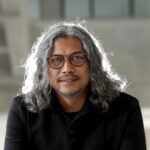
Ade Darmawan
Ade Darmawan
Ade Darmawan is an artist, curator and member of ruangrupa. He studied at Institut Seni Indonesia and Rijksakademie Van Beeldende Kunsten, Amsterdam. His exhibitions include “Magic Centre” (solo show in Portikus, and Van AbbeMuseum), Gwangju and Singapore Biennale (2016) and “Doing Business with the Dutch” (Lumen Travo, Amsterdam, 2018). As a curator, he contributed to many international projects. Together with ruangrupa, he has curated TRANSaction: Sonsbeek 2016 and served as artistic director for Documenta 15 in 2022.

Swann Dubus
Swann Dubus
Swann Dubus is a French, Vietnam based, documentary director-producer with over 20 years experience across Europe, Africa, and Asia. After a Master of Literature, Swann completed a PhD about intimacy in cinema at Paris Sorbonne-Nouvelle University in 2006. A year later, he moved to Hanoi to join the Varan Vietnam team, a production company founded with the sole purpose of developing and spearheading creative documentary projects in Vietnam.

Thong Kay Wee
Thong Kay Wee
Thong Kay Wee is the Programme Director at SGIFF and a cultural worker and moving image curator based in Singapore. He was previously the Programmes and Outreach Officer at the Asian Film Archive (AFA) from 2014 to 2021. During his tenure at the AFA, he was responsible for establishing the AFA’s regular programmes and presiding over specialized showcases, including commissions by the National Arts Council of Singapore and the Singapore International Festival of the Arts.
The progression of documentary films, just like humans who always shift along with complexity, is constantly evolving. Staying true to human reality in documentary encourages…
Notes on International Feature-length Competition
The progression of documentary films, just like humans who always shift along with complexity, is constantly evolving. Staying true to human reality in documentary encourages experimentation and expansion of understanding of it. The advent of digital social media has changed the way we understand reality. It is continuously reproduced and influenced by its medium, which then impacts the way people see and construct their everyday reality.
As reality becomes mediated and reproduced, the meaning of it becomes inadequate to encompass people’s real experiences. Today, what counts as “real” is becoming more mobile and further blurring the lines between fiction and nonfiction. In the end, reality is always being reproduced, or at least like humans, it is in tension as technology and digital media become a co-producing force.
The films in this year’s International Feature-Length Competition are not simply looking for fresh submissions from documentary filmmakers. This means that the selection process relies on an understanding of the creation of the films. However, the selection process also requires a fresh reading that calls for an expanded understanding of documentary to be able to grasp the complexity and relevance of documentary film production in today’s society.
This program is an attempt to initiate a dialogue that defends the tension between what is “seen” and what is not “seen”–and so forth–in reordering the order. Ultimately, it may be that documentary films no longer simply revolve around news and facts, but what becomes memory, reality, and the ongoing battle of producing realities.
– Gerry Junus
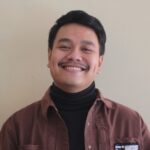
Gerry Junus
Gerry Junus
Gerry Junus is a curator and film programmer who currently serves as Program Director of KDM CINEMA, an alternative cinema initiative in Yogyakarta, Indonesia. In addition, he is also the program coordinator for Festival Film Dokumenter while organizing screenings with Klub Sinema Sisifus Salatiga. Gerry also conducts research on film festival practices and Southeast Asian cinema.


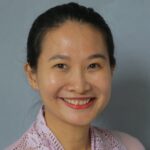
Amelia Hapsari
Amelia Hapsari
Amelia Hapsari is a documentary filmmaker who also shapes the documentary film ecosystem. During her 8,5 years as In-Docs Program Director, she connected Southeast Asia’s best documentary films with the international industry, mentors from around the world, and various stakeholders; government, non-government, and private. She initiated Dare to Dream Asia with STEPS; Good Pitch Southeast Asia and Good Pitch Indonesia with Doc Society and Jia Foundation; and Docs by the Sea with Bekraf and Kemenparekraf. Amelia is currently the Communications Director of Ashoka, which is establishing the Everyone a Changemaker movement with the education and families ecosystem in Indonesia. Amelia lives and works in Indonesia and Australia.
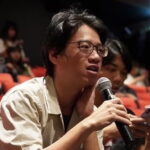
Chayanin Tiangpitayagorn
Chayanin Tiangpitayagorn
Chayanin Tiangpitayagorn (b. 1987) is a Bangkok-based cinephile and an independent film and theatre critic. He started working for film magazines such as Starpics and Bioscope, and then expanded to other journals, online media publications and festivals. He’s serving as a jury for Starpics Thai Film Awards, Bangkok Critics Assembly Award; where he also leads the selection committee for its short film branch, and IATC-Thailand Dance and Theatre Awards. Since 2013, he co-curates Wildtype and Wildtype Middleclass, annual film screening programmes focusing on overlooked Thai independent films, and recently joined the selection committee of Thai Short Film and Video Festival in 2022.

Novasari Widyaningsih
Novasari Widyaningsih
Novasari Widyaningsih is a lecturer, researcher, and media producer with a Master of Arts in Film Studies from the University of Leeds. She actively engages with the Association of Indonesian Film Scholars and The British Association of Film, Television and Screen Studies. Her work focuses on the documentary film ecosystem. She believes film is not just entertainment but also a powerful form of creative expression that educates, sparks discussions, and inspires social change.
Indonesia Feature-Length Competition is a window offering perspectives on the complex existence and agency of present-day Indonesia. The four films in this year's program selection…
Notes on Indonesia Feature-length Competition
Indonesia Feature-Length Competition is a window offering perspectives on the complex existence and agency of present-day Indonesia. The four films in this year’s program selection underline the significance of documentary film as the means to explore layered human memories and experiences. From an observational look at the life of a highly controversy-filled transgender boarding school in Yogyakarta, a quiet meditation on the lives of lower-middle-class citizens after more than 25 years of democratic reform, an expository biographical portrait of an artist with no formal education grounded in a sense of inner being, to the life of a Dutch priest who came to Papua as a young missionary and decided to be an Indonesian citizen.
Bringing out documentaries with a technical and aesthetic appeal that could support the way of storytelling and perspectives of the filmmakers is a significant factor. The very few documentaries that have been produced have affected the variety and diversity of the genre. This program is not only a look at how far Indonesian feature-length documentaries have come, but also a reference to where they are heading.
– Gerry Junus
Gerry Junus
Gerry Junus
Gerry Junus is a curator and film programmer who currently serves as Program Director of KDM CINEMA, an alternative cinema initiative in Yogyakarta, Indonesia. In addition, he is also the program coordinator for Festival Film Dokumenter while organizing screenings with Klub Sinema Sisifus Salatiga. Gerry also conducts research on film festival practices and Southeast Asian cinema.


Kong Rithdee
Kong Rithdee
Kong Rithdee began his career in 1996 as a feature writer on culture (covering film, literature, and visual arts) for the English-language newspaper, The Bangkok Post. He contributed to various international film magazines from the late 1990s until now. Since 2019, he has served as deputy director of Thai Film Archive, a nonprofit archive, preservation, and education organization; while continuing to write for several English and Thai publications. Kong has been a jury member at several film festivals over the past two decades, including Rotterdam, Singapore, Hong Kong, Jeonju, Busan, Vancouver, Dubai, and many more.

Mira Asriningtyas
Mira Asriningtyas
Mira Asriningtyas is a curator, writer, and co-founder of LIR–art space turned nomadic curatorial collective. Her practice focuses on site-specific, socially engaged, and decolonial practices that explore histories, ecology, and address current socio-political contexts. She has curated exhibitions and public programs internationally, and her writing appears in books and journals such as PARSE and Stedelijk Studies. In 2017, she initiated 900mdpl, a site-specific project in Kaliurang, Yogyakarta. In 2024, with Dito Yuwono, they became the directors of Cemeti – Institute for Art and Society in Yogyakarta.

Sébastien Simon
Sébastien Simon
Based in Busan, South Korea, Sébastien Simon is a French filmmaker, a guest professor at Dongseo University International College, and a programmer for Busan International Short Film Festival. He graduated from the ESEC film school and from Université Paris 1 Panthéon Sorbonne. He is an alumnus of Berlinale Talents (2024) and BiFan’s Fantastic Film School (2020). His directed works include One-Minded (2014), Tetsu Kono’s Crazy Routine (2016), The Troubled Troubadour (2016), and The Old, The New, and The Other (2022).
This year, a sense of variety was present in the Short Competition as its films attempted to bring creative and experimental approaches to their presentation…
Notes on Short Competition
This year, a sense of variety was present in the Short Competition as its films attempted to bring creative and experimental approaches to their presentation as documentaries. This way of storytelling signifies a variety of ways in telling a story in a perceived “reality”. These films not only reflect the filmmakers’ vision, but also show a familiarity or deep understanding of the protagonists and the topics they investigate.
The five films competing in this year’s Short Competition address contemporary issues, spanning multi-directional bridges to the past and future. They range from collective, to personal and domestic issues. Archives, folklore, memories, letters, and identity are featured in these films. Their presentation style provides additional insights or invites further questions that are not only limited to a cognitive level, but also usher in a lasting impression, reflective, and emotional impact.
– Gerry Junus
Gerry Junus
Gerry Junus
Gerry Junus is a curator and film programmer who currently serves as Program Director of KDM CINEMA, an alternative cinema initiative in Yogyakarta, Indonesia. In addition, he is also the program coordinator for Festival Film Dokumenter while organizing screenings with Klub Sinema Sisifus Salatiga. Gerry also conducts research on film festival practices and Southeast Asian cinema.



Diah Kusumaningrum
Diah Kusumaningrum
Diah teaches peace studies, gender and politics, as well as nonviolent resistance at the Department of International Relations, Universitas Gadjah Mada. She loves puppies, cookies, and coffee.

Permata Adinda
Permata Adinda
Permata Adinda is a Jakarta-based journalist at Project Multatuli. Her piece about the abortion stigma in Indonesia that was published on Project Multatuli received a special mention at the SOPA 2024 Awards for Excellence in Reporting on Women’s Issues (Regional/Local). As a film enthusiast, she also won the Tanete Pong Masak (Best Film Criticism) award at the 2023 Festival Film Indonesia for her Like & Share (2022) film review that was published on Cinema Poetica.
Valencia Winata
Valencia Winata
Valencia Winata is a film researcher who has made several short videos. Since 2024, she has been part of the selection committee for ARKIPEL – Jakarta International Documentary and Experimental Film Festival. She was also part of the database team at Forum Film Dokumenter, Yogyakarta, that manages Indonesia’s documentary film collection. She is currently continuing her education in Cultural Studies at Universitas Sanata Dharma. Her research focuses on film history, aesthetics, and culture.
This year’s Student Competition program is an attempt to expose topics closely related to the younger generation. Documentary films are used as a medium of…
Notes on Student Competition
This year’s Student Competition program is an attempt to expose topics closely related to the younger generation. Documentary films are used as a medium of exploration to uncover the world around them, as if they are acting as “detectives” who try to answer their internal questions. This program not only presents films that capture cultural legacy, as tradition is still a dominant theme, but also reflects their desire to understand social issues, intergenerational relations, and globalization challenges.
This year’s selection of student films showcases the filmmakers’ exploratory abilities in terms of fresh storytelling or perspective in observing an event/phenomenon. Furthermore, each exploration offered can still show the authenticity of the filmmakers who are students. This authenticity not only shows honesty in telling the story, but also shows how students as filmmakers reflect and take a stand on the issues they address. Student films ultimately do not stop at being a mere documentation instrument, but rather a means of exercising sensitivity, provoking curiosity, and enhancing critical thinking skills.
– Gerry Junus
Gerry Junus
Gerry Junus
Gerry Junus is a curator and film programmer who currently serves as Program Director of KDM CINEMA, an alternative cinema initiative in Yogyakarta, Indonesia. In addition, he is also the program coordinator for Festival Film Dokumenter while organizing screenings with Klub Sinema Sisifus Salatiga. Gerry also conducts research on film festival practices and Southeast Asian cinema.


In the 1960s, several Latin American filmmakers launched a movement referred to as third cinema. They declared the third cinema as a counter to Hollywood's…
Third Cinema
In the 1960s, several Latin American filmmakers launched a movement referred to as third cinema. They declared the third cinema as a counter to Hollywood’s first cinema and Europe’s second cinema. Third cinema for these filmmakers was a revolutionary-oriented cinema, a cinema with an aesthetic and political approach that was sensitive to the situation of the third world. The term third world came from Latin American intellectuals who identified in the term third world not only a condition of dependency and poverty, but also a possibility–an ideology, a dream, a route of progress. According to two exponents of this movement-Octavio Getino and Fernando Solanas, third cinema is “a cinema that recognizes that within the struggle of the peoples of the third world against imperialism lies the noblest cultural, scientific, and artistic manifestation of the present, a possibility of forming a liberated personality, with each person being the starting point of change-in other words, the decolonization of culture” (1969). Through the film The Hour of the Furnaces (La hora de los hornos) (1968), they illustrated this anti-imperialist struggle through a comprehensive analysis of oppression in Argentina.
The films in the Perspektif program do not date back to the third cinema revival of the 1960s. However, the films made in the last five years carry the same spirit and approach to contemporary aesthetic and political issues, which concern the intertwining of oppression, violence, and injustice. The first film, The Trial (2023), was created from the court archives of military generals involved in violence and terror during Argentina’s military junta (1974-1983). The film not only exposes the atrocities of the military regime, especially against student activists, trade unionists and critical artists, but also the power of cinema to bear witness to the drama of a nation seeking to set its own history straight.
Inadelso Cossa’s The Nights Still Smell of Gunpowder (2024) takes us on a long meditation on violence, challenging the strict temporality between past and present, colonial and postcolonial, memory and history, ghost and reality in Mozambique. Amidst the sounds of the night, the chirping insects, third world problems continue to be present in a land that has experienced colonization and a history of slavery for hundreds of years. Independence is a passage, but also a condemnation.
The third and final film in the program, Fifth Cinema (2018) by filmmaker Nguyễn Trinh Thi offers a critical take on the stagnation of third cinema. Indigenous filmmakers have taken their place in the fourth cinema, declaring how the third cinema, although populist and revolutionary in orientation, has forgotten the relationships built by genocide, gender injustice, and racism. Set in the context of Vietnam, one of the nations that managed to defeat almost all of the world’s imperialists (China, France, and the United States), Fifth cinema brings us to reflect on the duties of artists and cinema: presenting possibilities and offering new realms.
–Veronika Kusumaryati
Programmer

Veronika Kusumaryati
Veronika Kusumaryati
Veronika Kusumaryati is a political and media anthropologist working in West Papua. She is currently an assistant professor of anthropology and international studies at the University of Wisconsin-Madison. With Ernst Karel, she composed a feature-length documentary Expedition Content (2020). The film has been screened at international film festivals and listed as one of the New York Times’ best films of 2022.
A woman sits at a table in a seaside restaurant, writing a letter while being photographed by a photographer. The wind, the clear sky, and…
Bonds of Solidarity in Movie Tape
A woman sits at a table in a seaside restaurant, writing a letter while being photographed by a photographer. The wind, the clear sky, and the voice of famous singer Umi Kalsum give the impression of a relaxed atmosphere, contrasting with the voice of the woman who tells us that the atmosphere is critical in the midst of war. The position of the woman, none other than Jocelyne Saab herself, offers a completely different place from that of a war reporter. Jocelyn invites the audience to come to her hometown where she herself begins to feel unfamiliar and catches the restlessness of the locals. It is from her perspective that we walk through Beirut, get to know her friends and understand what is happening. Let’s imagine Beirut today is in a similar state as it was in the film Letter From Beirut made 46 years ago.
Why are things no better today than they were nearly five decades ago? The reality in Jocelyne Saab’s films suggests that the violence, war, displacement, and anxiety that were already recorded in the 1970s persist today. The struggle for freedom and justice in Lebanon’s neighboring territories such as Palestine, Jordan, or Syria is still steep and devastating. Up close, Jocelyne recorded images of the struggle for survival and the refusal to submit to society. Her footage may resemble what people in the same region are experiencing today.
We present three works of Jocelyne Saab in this edition of the festival as one of the many opportunities and channels to empathize and learn from the practices and expressions of solidarity of filmmakers who are geographically close to the Palestinian struggle for independence. The existence of communities in neighboring Lebanon or Jordan is deeply affected by the continuity of the struggle there, both in terms of experiencing violence and destruction, as well as growing and nurturing together the spirit of resistance.
When armed conflict breaks out, we as civilians are often jolted and pushed into the position of being spectators or consumers who either receive or ingest the news. Documentary allows us to look at issues and experiences of conflict in a more complex and, in the case of Saab’s works, more personal way. Through the act of watching, talking, discussing, writing, or sharing news, festival-goers have the option to actively engage in a discourse exchange. As such, a forum like Festival Film Dokumenter provides itself as a connecting and mutually reinforcing platform between the experiences and works of Lebanon and the communities in Yogyakarta.
Finally, when films or documents of the past come to our present, we should remember that this possibility did not just happen. There are those who preserve and bring them to meet audiences and enrich the space where knowledge circulates. If we pay close attention, documents of the past made by subjects from the Asian-African community are still relatively difficult to find, even though there are more accessible digital channels available. This scarcity of access and availability can be explained by the unequal quality of infrastructure, capital and preservation knowledge in the Asia-Africa region. By providing and watching mini-retrospective programs like this, we all take a step forward together to move towards rectifying this inequality.
I would like to thank Festival Film Dokumenter for welcoming the idea of this mini-retrospective as well as the Association Jocelyne Saab (Jinane and Mathilde Rouxelles) team for preserving her films. Moreover, my special thanks go to researcher Nathalie Rosa Bucher who ensured that this program could be made possible and kept the lines of contact open.
–Lisabona Rahman
Programmer

Lisabona Rahman
Lisabona Rahman
Lisabona Rahman is a program manager and film preservation practitioner who works in Berlin and Jakarta. She earned a Master or Arts from the Moving Image Preservation and Presentation Department at the University of Amsterdam, the Netherlands, then worked as a film restoration specialist at the L’mmagine ritrovata laboratory, Bologna, Italy. She provides consultancy in film archive maintenance and restoration for institutions such as the Arsenal Institute (Berlin) and Cimatheque (Cairo). She also co-founded the Lab Labalaba laboratory (Jakarta), and organizes film screening and exhibition programs. She is currently a member of the Southeast Asia-Pacific Audiovisual Archive Association (SEAPAVAA).
Reminiscence? What is reminiscence? What is the difference between them and memories? What can constitute a reminiscence and memory? How does reminiscence work? Whose reminiscence?…
Cinema as Memorial
Reminiscence? What is reminiscence? What is the difference between them and memories? What can constitute a reminiscence and memory? How does reminiscence work? Whose reminiscence? What reminiscence? What memory? Whose memory? When should we reminisce and when should we remember? How do we remember and how do we reminisce?
The films in this year’s Spektrum explore these questions through a variety of approaches, both experimental and traditional in documentary film production.


Instead of contestation, this year’s Spektrum tries to present a range of diverse scores on memory and how we remember. From the very personal to/or at the same time the collective, as well as from the hegemonic to the alternative. Memories and ways of remembering coexist; they can be equally important for us to know or learn. It’s not about finding answers in an instant, but rather as a reminder that we can retain as a critical aid to navigate life now and then.
–Wimo Ambala Bayang
Programmer
Wimo Ambala Bayang
Wimo Ambala Bayang
Wimo Ambala Bayang is an artist and co-founder of Ruang MES 56, based in Yogyakarta, Indonesia. Working across photography, film, video, objects, and painting, he explores how images shape our understanding of memory and reality.
The Utopia/Dystopia program presents a selection of films exploring personal, cultural, and societal transformations. Each film offers a distinct perspective, examining the tensions between tradition…
Narratives of Change and Resistance
The Utopia/Dystopia program presents a selection of films exploring personal, cultural, and societal transformations. Each film offers a distinct perspective, examining the tensions between tradition and progress, repression and resilience, while presenting human stories of struggle, connection, and hope. These films showcase narratives of individuals and communities striving to adapt and thrive in challenging circumstances.
K-Family Affairs (2023) takes an intimate look at the director’s journey as the daughter of the 386 generation, a group pivotal to South Korea’s democratization. Her father, a public servant, and her mother, a feminist activist, embody ideals of progress and the fight for a better future. However, when 18-year-old Arum witnesses the Sewol ferry disaster, a tragedy that exposes systemic failures, her father’s role in managing the aftermath leads her to question the democracy her parents fought for. Potraying resilience amidst farmer suicides in India, we follow Sanjeevani, a young widow who finds strength among women sharing her loss. Marching in the Dark (2024), through peer sessions with a psychologist, she confronts her grief, challenges societal taboos, and works toward financial independence. Despite obstacles, she remains determined, finding hope in supporting other women farmers. The film highlights the power of community and the courage needed to navigate a patriarchal society.
Mullinkosson captures the intersection of personal identity and socio-economic shifts, shedding light on how gentrification impacts marginalized communities. The Last Year of Darkness (2023), other than portrays the resilience of those seeking to maintain their identity in a rapidly changing landscape, this film offers a glimpse into the lives of young queer individuals in Chengdu, China, centering on Funky Town, an underground nightclub that serves as a refuge amid rapid urban redevelopment. Moved from urban stories, set in Medellín, ANHELL69 (2022) presents a blend of documentary, remembrance, and celebration. The film tells the stories of marginalized individuals navigating the liminal spaces between life and death, visibility and invisibility. It explores themes of youth, community, and survival in an ever-shifting world, celebrating the spirit of those on the edges of society.
And, Towards Happy Alley (2023) is a tribute to Iranian cinema and poetry, offering an intimate glimpse into the nation’s cultural essence. Through lyrical storytelling, it captures the spirit of a fearless generation demanding civil liberties, portraying the challenges and triumphs of individuals striving for freedom and dignity. Meanwhile, Breaking the Cycle (2024) takes the audience on a journey through Thailand’s political landscape, chronicling the rise and fall of Thanatorn, a charismatic young politician. Set against the backdrop of the 2019 election, the film highlights a new generation of leaders challenging an authoritarian constitution and reveals the power of grassroots movements.
Together, these films reflect how individuals and communities confront, challenge, and adapt to the uncertainties of the world. Each piece stands as a testament to resilience, healing, and transformation, weaving a tapestry of experiences that resonate on both personal and global levels. By capturing these deeply human stories, Utopia/Dystopia offers a window into the shared struggles and triumphs that define the human experience, emphasizing community, resistance, and the capacity for change.
–Gugi Gumilang
Programmer

Gugi Gumilang
Gugi Gumilang
Gugi is currently based in Jakarta and Berlin, where he is currently appointed as an Program Director for an award-winning organisation: In-Docs, the non-profit behind Docs by the Sea and Good Pitch Asia and VitaminDocs. Moreover, the Documentary of Association of Europe (DAE) has elected him to its Executive Board since 2022 and recently he joined Hot Docs as International Film Programmer. As part of his diverse experience, he has been involved as a selection committee and jury member for several reputable international film festivals and film funds. The following are among them: IDA, Purin Pictures, DOK Leipzig, Cannes Docs, IDFA Forum, RIDM, CPH:DOX, Points North Institute, Dokufest, Ji.hlava IDFF etc.
Since humans understand their fateful steps in the Anthropocene epoch, their position as dominant creatures starts to get loose. A human’s role is not limited…
Terraform
Since humans understand their fateful steps in the Anthropocene epoch, their position as dominant creatures starts to get loose. A human’s role is not limited to rights and self-determination but also as a form of shared responsibility. In the condition of an anxious geopolitical and life among the ruins of nature, awareness of shared responsibility builds an alternative path for connecting to others and ourselves.
If we imagine everything corresponding to each other, we cannot separate the relationship between humans and nature and the care within the landscape. Without care, the land only ends as ruins, forcing all inhabitants to navigate on their own aims. This premise is explored by Tour on Mud (2017) in the unfinished Sidoarjo mudflow tragedy, showing the irony of job and tourism as a dynamic dialogue in an abandoned land. In other places, the results from flawed planning of the transmigration program in the New Order period, 1880 MASL (2016) shows coffee farmers attempt to produce both their guardianship and survivability chance. Clenched by land infertility, they assess the possibility of state-protected forest areas, showing how the imagination of the near future could affect the present economic motive and decision.
Sense and meaning of space could further be a locus of care even when the definition is crucial to the struggle and activism. Mentawai Tattoo Revival (2010) delves into tattoo interpretation as a remembrance and memoir of their relation with nonhumans in the Mentawai communities. The records of practice and meaning from communities’ perspectives serve as guides when many parties contest the chamber of culture, each with its interest. The same premise is critically and poetically used by Salmiyah (2017) through a portrait of natural resources grabbing in a tobacco factory in the Dutch colonial period in Indonesia. Attempts to examine spatial space might be a meaningful reminder when the braid of care between humans, nature, and nonhumans slowly disappears or might be forgotten.
In this program, four films from Forum Film Dokumenter’s film collection strive to start an initial dialogue of interweaving relations of humans, nature, and nonhumans, and a passage to reflect a segment of human struggle.
–Michael Don Lopulalan & Nurrul Nelwan
Programmer
Michael Don Lopulalan
Michael Don Lopulalan
Michael Don Lopulalan, a Cultural Anthropology graduate from Universitas Gadjah Mada, is a researcher with publications and interests spanning landscapes, myths, and media. He has worked on various research projects across Java, Kalimantan, and East Nusa Tenggara, collaborating with government institution, NGOs, and university research lab/institutes. Currently, he is active at Forum Film Dokumenter, where he serves as Database Program staff—managing the film collection for educational use.

Nurrul Nelwan
Nurrul Nelwan
Nurrul Nelwan, a graduate of the Indonesian Institute of the Arts (ISI) Yogyakarta, is an experienced filmmaker—working as both a screenwriter and director—with a particular interest in issues of gender and sexuality. She has written several short films, including “Rahim Puan”, which was nominated for a Piala Maya award (2019), and “Human VS Elephant”, which won an award at the Denpasar Documentary Film Festival and the Gaia Award in Bozcaada (2020). She is currently developing her latest documentary film and works with FFD as part of the team managing filmdokumenter.id.


History is not immune from the canonization of periods as a signifier of the peak success of an event or subject that took place in…
Scope of Cinema
History is not immune from the canonization of periods as a signifier of the peak success of an event or subject that took place in its time. In the age of digital cinema itself, some observers’ readings also do not escape the canonization of cinema history in the analog era where the factors of reading are still not separated from the narrative tradition and do not expand or change the understanding of cinema in the digital media era. Historical essentialism seems to generalize the history of cinema from different medium periods, especially how the history of cinema in the digital era actually has a different perspective in presupposing the notion of cinema, including what cinema history is-especially Indonesian cinema-whose historical understanding itself is also expanded or changed to reach cinema practices in this digital era that are increasingly diverse and widely used. Diversity is an important signifier in the growth of digital Indonesian cinema. The fluidity of using this digital medium then forms a variety of images, which of course, produces its own narrative patterns.
This program is an attempt to outline a multifaceted reading of cinema practices in this digital era. It involves simultaneous receptions of cinema practice modes from various practitioners and their ways of producing images. Competition programs are consciously and politically heavily burdened by the conventional regime of Indonesian cinema; noncompetition programs in film festivals become a stake for various cinema ideas as a desire to get out of the canonical regime of linear historical schools of thought. In the noncompetition program, it takes more sensitivity to discern variances as part of resisting the canonical regime of the historical school of Indonesian cinema. Of course, this is not an easy challenge, and how to build a noncompetition environment can contribute to a more open and fluid cinematic history.
History is basically an open book as the reading of history is also in a state where it can be chronicled as history itself. Everyday images are not free from the use of digital mediums, including how images are personal, which form their own unique narratives–and not vice versa. The four films in this program are themselves confined spaces that try to reach the ongoing variety in Indonesian cinema. Utilizing various sensory things marks how digital mediums are fluid in using sounds to form images, including the utilization of personal archives, as well as other mediums outside of cinema as body choreography which is possible on digital cinema.
Hopefully, noncompetition spaces will become essential marks in reading cinema development history, as well as the need to reverse and break the epistemological paradigm, where history is no longer at the peak of events, such as festival-winning films, but as something that grows, expands, and is continuously being produced.
–Akbar Yumni
Programmer
Akbar Yumni
Akbar Yumni
Akbar Yumni attended Sekolah Tinggi Filsafat Driyarkara (Driyarkara College of Philosophy) in Jakarta. He was the curator of ARKIPEL – Jakarta International Documentary and Experimental Film Festival (2013–2018) and is active as a researcher and performance artist. Some of his performances are based on Indonesian film archives that were lost during the authoritarian regime, including Menonton “Turang” (1957), Menonton “Daerah Hilang” (1956), and Menonton “Sedap Malam” (1951). Currently, Akbar is a member of the theater committee of Dewan Kesenian Jakarta (Jakarta Arts Council) for 2023–2026.
In montage cinema, images are built solely for the sake of the audience, which was originally constructed for the sake of building dialectical consciousness through…
Ghost Culture
In montage cinema, images are built solely for the sake of the audience, which was originally constructed for the sake of building dialectical consciousness through image reality by Russian directors in the 20th century. In its expansion, this approach has grown to build montage or decoupage for the sake of drama on the screen. An observation of image juxtaposition possibilities with all the associations of “experience” formed through this moving image, orienting to the audience rather than to the drama in the image, does not escape the influence of classical conditioning especially for the audience, who are ready to accept the Pavlov effect through the montage cinema approach. It is this orientation towards the audience rather than the image that makes horror films cater to the longing for the “shocking” and irrational aspects of modern society’s routines that shape ghost culture.
Since the colonial period, ghost culture has been embedded in the culture of entertainment for Indonesians to this day. The ghost figure itself actually has political value, how ghosts can disrupt the boundaries of the past and present, including the future. Time becomes inhomogeneous and linear, having the potential to provoke historical consciousness. In Indonesian cinema, the presence of ghosts is often a kind of figure of the past, of testimonies or incomplete incidents that took place in the past. In the Indonesian context, the potential of ghost films is also filled with stereotypes on one particular gender as a derivative of the surrounding culture of Indonesian society.
–Akbar Yumni
Programmer
Akbar Yumni
Akbar Yumni
Akbar Yumni attended Sekolah Tinggi Filsafat Driyarkara (Driyarkara College of Philosophy) in Jakarta. He was the curator of ARKIPEL – Jakarta International Documentary and Experimental Film Festival (2013–2018) and is active as a researcher and performance artist. Some of his performances are based on Indonesian film archives that were lost during the authoritarian regime, including Menonton “Turang” (1957), Menonton “Daerah Hilang” (1956), and Menonton “Sedap Malam” (1951). Currently, Akbar is a member of the theater committee of Dewan Kesenian Jakarta (Jakarta Arts Council) for 2023–2026.
Four emerging documentary filmmakers try to share stories from across Indonesia, a country of tens of thousands of islands and hundreds of ethnic groups and…
Constellation of Relations
Four emerging documentary filmmakers try to share stories from across Indonesia, a country of tens of thousands of islands and hundreds of ethnic groups and languages. Portraits of the complexity of human relationships with nature based on the Mandar river culture, along with personal stories of human and earth relationships in a form of lifelong caretaking works, the dilemma of young people and traditional legacy, to the relationship between mothers and children as a transgenerational wound will be presented through this program.
It is not an easy thing to capture Indonesia with its plurality and variety of problems. The filmmakers in this program try to present it in a very close intention by underlining personal, communal, and natural relations. Without the pretension of making this an omnibus, each film is felt to be able to present the director’s vision that manifests in various forms, including intangibility, sound, detailed dialogues, and the subject of the films themselves. At one point, we realize that Indonesian documentaries are not just about simply following subjects or capturing events then stitching them on the editing table.
The four films in this program are the awarded films from Indonesia Documentary Lab 2023, a documentary project incubation program to develop storytelling and production skills for aspiring documentary filmmakers in Indonesia initiated by Forum Film Dokumenter with the full support of the Ministry of Education and Culture of the Republic of Indonesia.
–Kurnia Yudha F.
Programmer
Kurnia Yudha F.
Kurnia Yudha F.
Kurnia Yudha F. is a documentary filmmaker who has been involved with Forum Film Dokumenter since 2006. As the organization grows, he has played a key role in developing various initiatives aimed at strengthening documentary practices, networks, and learning spaces in Indonesia. Through his work with the organization and the community, Yudha actively works to establish relationships with various practitioners, collectives, and institutions that contribute to the development of the documentary ecosystem. Currently, he serves as the Director of Forum Film Dokumenter while continuing to work as a director and camera person on independent documentary projects.
Explores our interdependencies in all their beauty and harshness, fragility, persistence and vulnerability, familial and other ties are formed, and at the same time, formative.…
Familial and Other Ties
Explores our interdependencies in all their beauty and harshness, fragility, persistence and vulnerability, familial and other ties are formed, and at the same time, formative. Their possibility is punctuated but not defined by socio-political histories, the deep-rooted inequalities of global capitalism and the bureaucratic structures of the modern world. What if we think of family not as a given unit of biology but as a liminal moment of being in relation with those around us, as our being part of global supply chains, as a relational reverberation with uncomfortable histories? Familial and other ties are world-making, constitutive not mere context, they are beyond the dichotomies of good or bad, they have always been and always will be. It is about time we grapple with them, all of them.
We experience raw escapist beauty, clouds, flowers, bubbles, smiles. A young family in Japan creates cinematic memories during the liminal space of slowness brought on by the COVID pandemic, capturing moments that would otherwise slip by unnoticed in Radiance (2024), this condensing observation of the shortest moments mesmerizes. And yet, we can sense a peculiar tension. The harmonious togetherness of families is far out of reach for the iron factory workers in Yangon, Myanmar in In the Heat of the Fire (2023). As domestic labor migrants they are separated from their families for most of the year. Their memories of love and hopes for a better future for their children compete with an unbearable present.
A Thai filmmaker reflects on their own family history, echoing the experiences of many who have had (and continue) to migrate to Bangkok for work, tuning to histories in order to make sense of the present, Here We Are (2023) points to the violent reverberations of Thailand’s development into a modern nation on the shoulders of people from its newly defined peripheries that reflects on their own family history. And without interest in further consolidation in dualisms, The Trap (2024) dwells in the peripheries of modernization and offers a different gravitational pull, inviting us to experience and meditate on our eternal connection with nature through close encounters with animal companions along the waterways of a Colombian jungle. Water continues its elemental flow in The Good Omen (2024), a filmic journey that centers the beauty of the margins, the urgency of countering bureaucracies inability to cater to the precious livelihoods of the shepherd is noted but not given space. A strong refusal to hold cinematic space for destructive forces when there is so much to convey about the beauty of familial ties between people, elemental materials and landscape.
Docs Docs: Short! Series Familial and Other Ties is an invitation to the notion of family to dare itself and a rehearsal to gain ground elsewhere with care for those ties we might have neglected.
–Rosalia Namsai Engchuan
Programmer

Rosalia Namsai Engchuan
Rosalia Namsai Engchuan
Rosalia Namsai Engchuan is an artist and researcher whose practice draws on collaborative encounters as well as decolonial, multispecies, and queer theory to examine questions of social justice. She has written widely for art and academic publications on Asian femininities and epistemic violence and lectured internationally at Cornell University, Harvard University, HKB Fine Arts, NYU Tisch School of the Arts, and Sandberg Institute. Her ongoing research is on the global evolution of wellness cultures and botanical-elemental-spiritual rituals of care.
Docs Docs: Short! Series Spatial Space is an invitation to think about space through its multiplicity of relations, recognizing that humans and other actants play…
Spatial Space
Docs Docs: Short! Series Spatial Space is an invitation to think about space through its multiplicity of relations, recognizing that humans and other actants play a role in creating space and the ways by which we inhabit them. Space is empty potentiality actualized through relations. Thus, the urban and the rural, the past and the present, the present and absent, are not antidotes but mutually constitutive relations. They exist because of and with each other. It is within these spatial spaces that we return to our bodies and respond to the spaces we inhabit. There is no outside. There is only relation and interdependency.
Between archival images, soundscapes and personal memories a lot is left unspoken but everything is conveyed in City of Poets (2024) is the history of a neighborhood in Iran; works against the representational hardness and sensationalism of detached war journalism and pulls us right into the rhythm of a space and its inhabitants that has gone through war.
What becomes of a space when alien forces organize and enable a series of material manifestations? Object 817 (2024) visits an isolated village in the Urals to talk about a nuclear accident and the discovery of an alien creature. Inconvenient occurrences and whispers that challenge the official narrative on the absence of atomic disaster. Here other spaces emerge: a public prayer, a ritual enchantment, future-making through spiritual and animistic practice. Such inhabitations of space open up the question of the non-rational space, which in so called modern societies has been captured by institutionalized religion.
No Exorcism Film (2024) evokes a sense of Thailand as structured by the desires of many to change the ways by which people can inhabit a nation, where the real story can never be spoken because the wants of some have been captured under an umbrella that assumes the generalism of agency. Liberating Shipwreck (2024) thinks with the descendants of African slaves who have survived a shipwreck and built communities on the shores of Ecuador. Their cooperation with natives and settlers led to the formation of hybrid spaces, where institutionalized religion and embodied rituals of dance, create new spaces of emancipation where sense-making enters the terrain of theory. Theories are stories about our lives and the pride of telling your own story is infectious!
Jumping scales via cinematic spaces we become witness to the liminality of spaces; taking back to our present moment a new hope, perhaps more urgent, for things to be different. What remains are the echoes of questions. How can we build out differences from within the spaces we are living in? Can the dances of freedom in Ecuador be a space of hope for Thailand? When will the rhythm flip in Iran for there to be archives of women smiling again? When will the microscopic forces of radioactivity dissipate and when, if ever, will landscape be conducive to life again?
–Rosalia Namsai Engchuan & Alia Damaihati
Programmer
Rosalia Namsai Engchuan
Rosalia Namsai Engchuan
Rosalia Namsai Engchuan is an artist and researcher whose practice draws on collaborative encounters as well as decolonial, multispecies, and queer theory to examine questions of social justice. She has written widely for art and academic publications on Asian femininities and epistemic violence and lectured internationally at Cornell University, Harvard University, HKB Fine Arts, NYU Tisch School of the Arts, and Sandberg Institute. Her ongoing research is on the global evolution of wellness cultures and botanical-elemental-spiritual rituals of care.

Alia Damaihati
Alia Damaihati
For two decades, Alia Damaihati has been involved in developing various programs for Forum Film Dokumenter. Her work focuses on managing film programs and exhibitions, and her experience has led her to participate in various forums, festivals, and documentary networks in Indonesia and internationally. Alia plays a key role in program development and in mapping documentary trends, which serve as the foundation for the organization’s various initiatives. She currently serves as Program Director of Festival Film Dokumenter.

Kurniadi Widodo
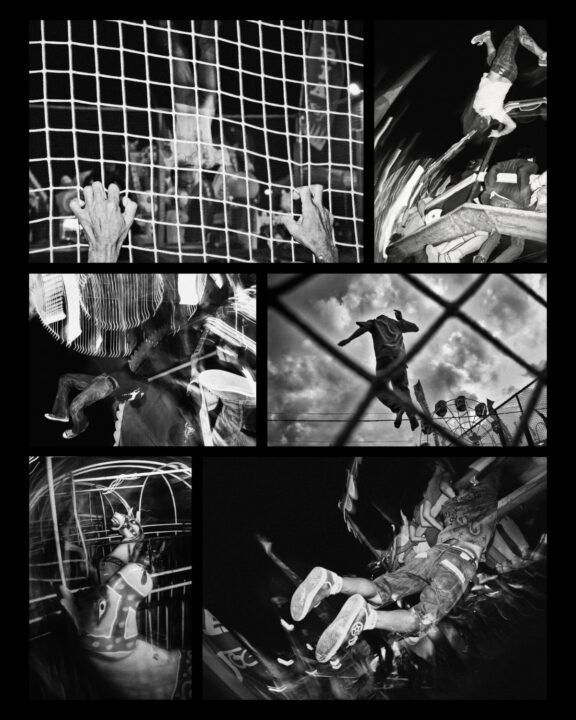
A Leap in Time, Stillness Whispers
The stillness time in a photograph sometimes triggers a thaw of long-frozen memories of the past. Silently, it stirs up memories of space and time that have fallen silent.
This visual record was made almost 15 years ago, at an annual celebration in a small plot of public space whose presence was always anticipated by so many people. It still lingers in my memory that being there was an all-sensory attack; the lights and colors vying for the eye’s attention, the cacophony of deafening rides, and the aromas that aroused and tantalized the taste buds. Bodies fused and bonded in a buzz of excitement. Emotions erupted in the commotion.
Looking back at it now, this fleeting capture has turned out to be a sign of the times. The living space captured is now locked in solitude. The cheering is over. The silence of the photo that fails to depict the excitement that was once present there, ironically becomes a more apt representation of its condition today.
Most visual recollections don’t often get the chance to leap far from the purpose for which they were made. However, the memories triggered by a photograph can go beyond what is visible within its four-sided frame; gazing at a slice of the past with our contemporary eyes might just make it leap through the boundaries imposed upon it.

Kurniadi Widodo
Kurniadi Widodo (1985) is an educator and freelance photographer based in Yogyakarta. Since 2010, he has been actively engaged in a number of photography education communities and initiatives, including Kelas Pagi Yogyakarta, Pannafoto Future Talents, and the collective Arkademy Project.
Wok The Rock
Adult Contemporary
Today’s world is alive with a multi-layered whirlwind of distinctive behaviors. Hybrid figures formed by human mobilization and culture through economic transactions, machtpolitik, climate change, technological developments, and many other means. Then, does the ethnicity and customs in one particular location created in the past still exist as a single entity? How do we envision our hometowns? Do we still need to dispute our authenticity in the face of artificial intelligence?
Wok The Rock
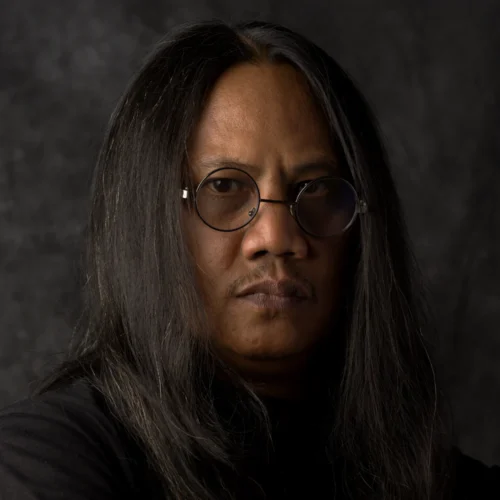
Wok The Rock is an artist whose practice spans across the fields of visual arts, sound, and social relations. He explores collaborative, experimental, and interdisciplinary work in various open and ongoing artistic activities. Wok is a member of MES 56 art collective and manages the music label Yes No Wave Music. His short documentary film, Wisisi Nit Meke (2023), won a Citra Award at Festival Film Indonesia 2023 for Best Short Documentary. He is a co-curator of the music platform GAUNG and currently curates the Yes No Klub stage at Pestapora.


