Bazin argued that cinema in its truest sense serves as something indexical. Unlike painters or writers that choose to operate in a “realistic” style vis-à-vis the objective world—cinema never simply had “realism” as a stylistic choice. Its realism is simply there, a given. Realism is the starting point of each film, unlike in most other mediums, where it is the end-goal. Furthering Bazin’s idea that cinema preserves the real, Deleuze argued that cinema thinks through reality—arguing that the image itself can create thoughts, even without the causality of action and story as time itself is directly presented in it. This, in turn, forces the viewer to feel the passing weight of time as they observe cinema. This, in his terms, is the time-image.

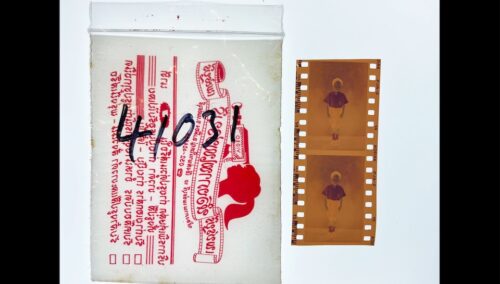
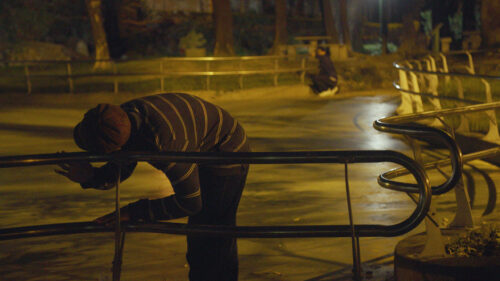
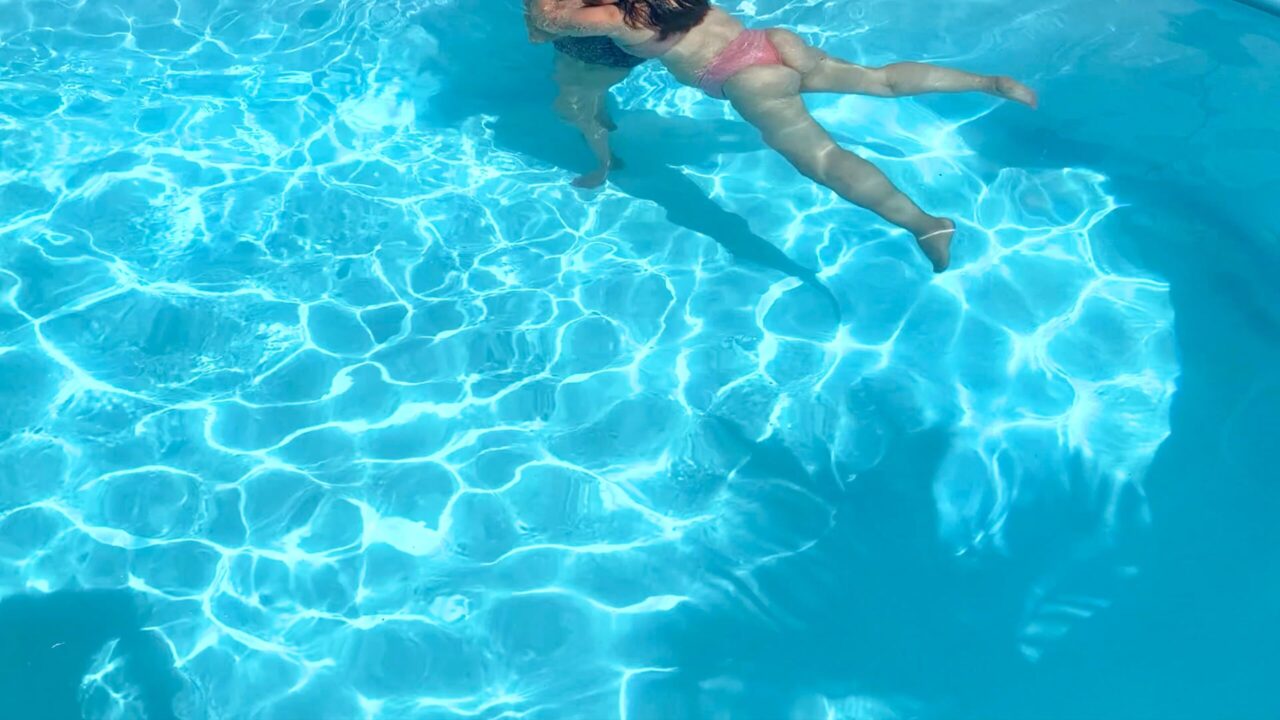
Dissipate (Victor Laet, 2025) is a case study on these concepts, shown in two completely different sections. The first being a Brakhagian collage of movement and textures, seemingly salvaged from a recording of a swimming pool superimposed with various moving lights. The audio that accompanies it also appears briefly and repetitively: “[…] in a jiffy, in a jiffy…” The latter part of the film shows a single static long shot of two drunken sisters swimming and talking to each other—going in and out of frame as they move around; their mother who talk to them whilst remembering about her past memories; and Victor, the director which is placed outside of the frame, who simply watches from the camera.
The first part of the film focuses on light, color, movement, and texture which fuses independently without story or even character. The latter part then inserts space and interacting subjects within the film. The swimming pool captured in the film then serves to be the film’s space, and the sisters and their mothers as subjects. Apart from the real space where and when it happened at one point in time, the recording of said pool is another constructed space—which is the cinematic space. Through the static framing, lack of editing, and fixed focal length, the film offers an experience of real duration, of la durée: felt, continuous, and qualitative. The first part of the film implies that, in the purest form of the time-image, even without the presence of subjects and the conventions of spatial logic that appears on the latter half: cinema is time itself made visible and felt.

This short film, in its deceptively simple form, synthesizes a moving-image with and without spatial logic and subject as an experiment towards how it makes the observers feel. Does cinema make more sense with an explicit sense of space within it? Can it function perfectly without it? How does it make us feel—to watch a recorded moment unfold in its full duration without cuts, without camera movements? Which method best preserves a moment, a memory? Amidst these questions, one thing is made clear—even when stripped bare, Dissipate (2025) proves that its images and time cannot be separated. Like you and me, held together by the time that passes through us. (Timmie) (Ed. Vanis)
Film Details
Dissipate (De Hoje a Oito)
Victor Laet | 10 min | 2025 | Brazil
Official Selection for Docs Docs: Short!
Festival Film Dokumenter 2025