The distribution circuit is not a confined space that discourages activism before it begins to grow. Instead, it is a space that continues to evolve and can be established. However, not all short documentary films get a chance to get into festivals for various reasons: rigorous curation, specific themes that rapidly transform, safety reasons, and the high price for each submission and distribution. Even so, the distribution of impact must be fought for in this distribution circuit. As a result, distribution mapping is a job that cannot be overlooked today, both for distributors, producers, and filmmakers themselves.
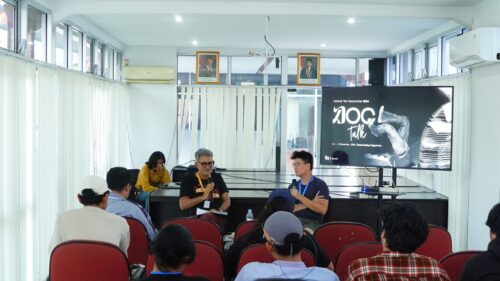
Festival Film Dokumenter (FFD) 2024 presents a forum to discuss documentary film distribution through DOC Talk entitled Patah Tumbuh Hilang Berganti (6/11/2024). The forum was attended by Wulan Putri, director of A Tale for My Daughter (Tutaha Subang), Anggun Pradhesa, director of To Face My Father in Jambi (Balek ke Jambi), and moderated by Gerry Junus as the coordinator of FFD 2024 Competition Program. This forum specifically discussed the distribution channel of films, especially short documentaries, and their impact on the audience and the wider public.
Wulan Putri is the producer and director of A Tale for My Daughter (Tutaha Subang) (2024). This film is actually not a stand-alone documentary, but rather a third film from the Awyu trilogy. This trilogy is an advocacy project for the Awyu tribe whose customary land is in the assessment stage to be deforested into oil palm plantations by PT Indo Asiana Lestari (IAL). The agrarian conflict on the customary land is advocated to the public through two documentaries that have been aired on Project Multatuli’s Youtube channel with the first film entitled Mama Lihat Awan Jatuh (2023) and the second film entitled Asu Pemige Sawa Pemige (2024). Unlike the previous two films, the third film of this trilogy, A Tale for My Daughter (2024) is the only film distributed through festivals. This strategy was chosen to expand the audience and aesthetically differentiate the documentary from its two predecessors.

In each of her documentary films, especially To Face My Father in Jambi (Balek ke Jambi) (2024), Anggun Pradesha tries to echo the gender justice campaign. This is her fifth documentary after debuting in 2015 with Emak dari Jambi (2015). To Face My Father in Jambi (2024) is a documentary that she started producing in 2016. However, due to funding constraints, the film could only be completed in 2024.
Every film—in this context, short documentaries—always has a specific viewing space and activism goals. Wulan Putri explained that each producer has its own target audience, which results in a diverse distribution trajectory. A Tale for My Daughter (2024), which was made to advocate for the Awyu tribe, was distributed through specific channels and mediums based on the discourse and artistic vision that had been formulated. Unlike Wulan Putri who used her film as an advocacy tool through her liminal story, Anggun chose to use a short documentary film for the purpose of opening an inclusive space for her community. Therefore, festivals are not the only channel of distribution. Rather, it is part of the choices offered by various mediums, platforms, site specifics, vehicles, and programs.
Anggun recounted her experience when she had to screen her movie on a small screen, in a small room of a village hall in a small town. However, according to her, small space is not a problem as long as it gives meaningful impact and benefits. In that small space, inclusive discussions between subjects can be held fluidly and warmly. This is quite reasonable because through her documentaries, she hopes to provide a space of understanding for transgender families to accept and be aware of each other.
Talking about the reception of the subjects in the documentary A Tale for My Daughter (2024), Wulan Putri explained that they accepted and appreciated it. Although she has not been able to come to watch it directly among them. That is the role taken by the producer and distributor in the distribution of this film. They shared tasks in the distribution process through their respective masses and relationships. It is quite difficult to advocate for the Awyu tribe in particular, and the Papuan people in general, who are experiencing oppression by certain parties. To bridge the discourse, Wulan Putri circulates it through subtle family stories. That is what makes the subject and the audience connect.

Festivals may be a platform that can meet the needs of wide and massive film distribution. Inclusive discourse spaces, adequate facilities, meetings between filmmakers, and wide exposure are attractive offers from the hustle and bustle of festivals. However, not all festivals provide the necessities that filmmakers need in distributing their work. Sometimes, there are festivals that charge a high price for the distribution of films.
Anggun complained that after the production of films—that were not cheap—the process of distributing films through festivals is a privilege because it has to go through various strict selections and a hefty budget. Not to mention that films with specific themes that challenge oppression and discrimination require a safe space to be screened. Despite these, festivals—like FFD—provide an open space to help expand activism and broaden awareness of the issues. Putri added that festivals can be a platform for knowledge circulation. The presence of experts and cross-discussions can make films and their makers gain exposure, making them being appreciated more. This opportunity allows for the establishment of relationships that lead to a new collaboration, both in film production and distribution.
One of the exciting offers of a film festival is a public premiere. The opportunity to premiere does provide more exposure and allows the film to have more appeal and be the center of attention. However, Anggun and Putri mentioned that they do not always pursue premieres in certain festivals. In fact, Anggun once premiered one of her films through a distribution network between communities based in villages. Although festivals are an exciting platform, not all films get the same opportunity. Therefore, mapping the distribution of a film becomes important to determine the direction of its distribution route. Many filmmakers then choose the pro bono distribution channel to disseminate their work.

Himas, one of the participants in this DOC Talk, appreciated the distribution of films—especially short documentaries—that was done through Youtube. According to her, through Youtube, documentary films can be accessed and discussed more widely and fluidly, in contrast to other mediums that tend to be more exclusive. Then, she asked Putri and Anggun about the distribution of films in campus festivals and their tactics in the process, which according to her is an echo chamber of discourse.
Responding to Himas’ question, Putri then told her that the Awyu tribe trilogy was screened at Sewon Screening, an annual film festival organized by FSMR ISI Yogyakarta. Academic spaces open up opportunities for more inclusive circulation of knowledge. Anggun also shared her experience of distributing her films on several campuses such as UI and UGM, and even UIN. According to Anggun, the opportunity to screen on campus can open up a wider landscape of different perspectives to respond to her documentary work. The critical attitude also sparked a healthy discussion and cross-opinion that created a cross-discourse. However, there are still tactics and strategies in this distribution route. “We need to map which campuses are safe to enter,” she explains. In addition, a safety net is also needed to protect each chosen distribution route. Audience selection through registration, cooperation with Legal Aid, and the preparation of experts such as psychologists and doctors are safety nets that should be realized.
The next comment came from Ozi who asked about the fun way of distribution. In response, Putri explained the importance of networking in film distribution and that there is no specific strategy for her to do so. “The strength of documentary filmmakers is their willingness to help each other,” she said. Anggun added that film distribution should be done without pressure and collaboratively. In addition, documentary works should pay attention to the stories and issues they raise and be representative of their subjects. “Don’t let the technicalities be excellent, but the story is weak,” she said.
Veronika Kusumaryati, the program manager of Perspektif FFD 2024 who was also present in this discussion asked the question, “Will you (Putri and Anggun) continue to survive in documentary films with the reality of expensive production, and is there pressure to continue to exist?” Putri then explained that she is currently in the process of working on a short documentary film. She also agreed that pressure does exist, but she still tries to survive by building networks and continuing to coordinate with the laboratory for the production of the next film. Anggun also shared that she is currently trying to realize her desire to make a documentary film about transgender ID cards, which is currently her activism movement.
When asked further about the possibility of short documentary films getting economic reciprocity and the possibility of living from short films, Putri said that there is a possibility there. Perhaps short film production is not profitable, but she admits to earning fees in her documentary works. Like Putri, Anggun agrees to the possibility. However, she prefers to seek income from other channels to support her work. Not the other way around. Anggun and Putri also answered questions about the screening of films in the location of their subjects—Anggun in Jambi and Putri in Papua. According to one of the audience members, screening a documentary film in the subject’s location would have a different impact due to the different level of sensitivity they have. Putri said that she herself had never screened A Tale for My Daughter (2024) in Papua. However, the film was screened there through Greenpeace who aggressively conducted screenings with residents. Meanwhile, Anggun has also not screened her documentary To Face My Father in Jambi (2024) in Jambi, but she intensively screened it to her community. She has also never screened the film in front of religious groups, which she finds resistant. However, she admitted that she had screened her other documentary works in front of dozens of Christian school principals throughout Asia-Pacific who wanted to know about the lives of queers.

The distribution of short documentaries is then not limited to exclusive festival and OTT programs, as YouTube is also a platform that is often used in the distribution route. We can see this in the distribution of National Geographic documentaries, Watchdoc Documentary, and Project Multatuli. Through YouTube, Project Multatuli also distributed the first two documentaries of the Awyu tribe trilogy. However, according to Anggun, making Youtube as a distribution medium also requires more consideration, because open space creates a wide circulation of discourse. Anggun also recounted the experience of a friend who had distributed a documentary through Youtube and ended up getting pressure from various parties.
In the end, the interest to seize narrative space becomes important in the distribution trajectory of our short documentary films today. The discourse of activism that is echoed must be circulated to ensure that future generations will be better and free from oppression, pressure, annexation, and alienation. Filmmakers also need to have a passion for the original purpose-distribution of impact. It is also expected to give voice to marginalized voices that are often unheard and reduce the stigmatization in the social space.
Covered by Ahmad Radhitya Alam on 6 November 2024. (Ed. Vanis/Trans. Naufal Shabri)