Documentary film storytelling often can serve as an opportunity to create intergenerational dialogue. Not only can it bridge the past with the present, it can also be an in depth look into the different contexts behind them; may that be global and local, national and transnational, and how they all interact. DOC Talk: A Form of Intergenerational Dialogues, held at Ruang Rapat TBY on Tuesday the 5th of November, explores these different layers a documentary film can express and the process behind producing pictures that enforce transgenerational discussion.
At the DOC Talk, award-winning director Kek-Huat Lau discussed the process behind his latest picture, From Island to Island (2024). Director Lau talked about the aesthetic development and creative choices he took from setting the scenes and tone to building the tension and narrative, in what is a personal project for the Malaysian-born, Taiwan-based director. Sandeep Ray, a writer, filmmaker, historian and Head of Humanities at University of Nottingham, Malaysia, provided ample insight as moderator, a perfect fit for what was a multidimensional discussion not only on documentary filmmaking but also how film can address history, memory and how we as human beings often collectively grapple with our different identities and our shared past.

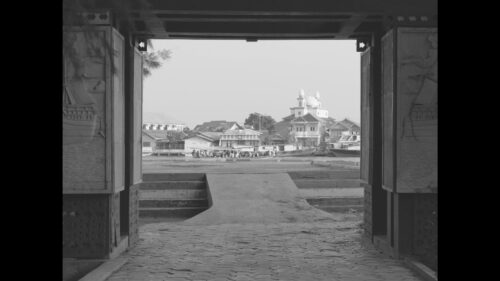
Kek-Huat Lau’s feature-length film is an example of such multilayered presentation needed to effectively encourage intergenerational dialogue, sometimes even by directly showing how it plays out on screen. From Island to Island (2024) combines interviews and archival material from footage to family letters and everything in between, to thoughtfully explore the different experiences of Taiwanese soldiers, doctors and diaspora in Southeast Asia during World War II. The film addresses the complexities of Taiwan’s historical memory to impose the construction of collective memory of Taiwan when it was still a part of the Japanese Empire
Director Lau expressed how he felt anger throughout the almost five years of filmmaking, a feeling shared by many who watch the film, is directed towards different generations and societal scales and is reflected in how the resulting From Island to Island (2024) is a multilayered reckoning of them. “Along the way as I discovered more, I became angry… How come the Taiwanese society kept quiet for more than 70 years? I’m not a trained historian, I go and do my research and straight away the evidence is there, why didn’t they face them?” Director Lau said, on the lack of attempts to address atrocities in Southeast Asia incited by the Taiwanese in the Japanese army and supported by Taiwanese society in these countries at the time.
However, he did not shy away from denouncing these deep rooted difficulties in addressing intergenerational issues, and how they’ve openly shared how they’ve shaped his creative processes and decision making before, during and even after the creation of From Island to Island (2024). He shared stories about the difficult dilemma of interviewing the families of, or the former perpetrators of the horrors of war themselves. He saw first-hand the many outlets of avoidance, providing an intimate look into the intricacies of memory, may it be individual or collective, and more importantly, through the interviews, he let them play out on screen.
“I don’t see my documentary more as a history documentary, I’d say it’s a memory documentary. It shows how the memory works. If you easily judge people on whether they’re wrong or right straight away, they’ll refuse to talk to you. But if you empathize with them, then they’ll start to talk,” said director Lau in his efforts to invite intergenerational dialogue with the perceived perpetrators, victims, and their families during the research and interviews shown.
Director Lau talked about how he would try his best to put himself in the shoes of anyone that he talks to, and how that approach is important in intergenerational dialogue. When talking to former Taiwanese soldiers, he would try to be fair and understand the personal and contextual conditions and what has been taught to them and shaped them and their point of view at the time. Understanding that they see him as an outsider, and potentially hostile due to his background, Director Lau would go to the lengths of sometime staying silent behind the camera, for example allowing Japanese army ex-soldiers to instead open up to his interpreter, who is a Japanese student, or even sometimes with members of their families instead.

Director Lau added that behind fairness and trust, what’s most important in intergenerational dialogue is talking about the actual facts. As seen on screen and as director Lau shared from behind it, that was his approach when dealing with the descendants of those Taiwanese who played a role in the Japanese army. Director Lau spoke about how this played out with Simon Yeoh, who is featured in From Island to Island (2024), after being presented with historical documents proving his grandfather’s collaboration with Japanese colonizers in Malaysia. “He still wanted to remember his grandfather’s good side. But when I showed contradicting evidence and documents, he started to change his stance. I’m trying to show that process. He knew my purpose… He found this to be a chance for him to reveal his memories, to reveal himself.”
Other occasions did not play out that way. When confronted with the fact of his fathers’ involvement with the Japanese army’s chemical weapons, a Taiwanese doctor stated that he refused to tell the tale to his children or grandchildren, expressing that he does not want them to bear this burden. Reflecting on this, Director Lau added, “Taiwan society needs time to start to look back on this history. I hope there is the chance of a removal of these rejections one day. I hope (From Island to Island) can create thoughts for young Taiwanese. How we can think about it can free us from the past… This is my expectation for the young Taiwanese people nowadays; That they can deal with this past history,” Director Lau added, of how presenting the processes of intergenerational dialogue, with all the difficulties, can hopefully inspire.
Diliput oleh Aradi Ghalizha pada 5 November 2024. (Ed. Vanis)