Turang and Cinema of New Emerging Forces

Description
Khrisna Sen is an important figure in the history of Indonesian cinema. Her book, Indonesian Cinema: Framing the New Order (1994), or in its Indonesian translation by a publisher, Kuasa Dalam Sinema Indonesia: Negara, Masyarakat & Sinema Orde Baru (Power in Indonesian Cinema: State, Society & New Order Cinema), was the main and only reference at the time for readers of Indonesian film studies who wanted to learn about the period that was omitted by the New Order from Indonesian film history: the history of leftist cinema. In one chapter of the book, Krishna Sen examines two Indonesian directors, Usmar Ismail and Bachtiar Siagian, in the tension between “individuality” and “mass” (citizens), or between the dramatic conflict in the hero’s mind and its solution and the emotional experience of “material” individuals with the masses in a revolutionary situation leading to public action. Krishna Sen is also the only film scholar who met and interviewed Bachtiar Siagian and other leftist filmmakers directly. The audio archives of these interviews are now an important source of knowledge in the context of film archives that were destroyed by the New Order regime.
In interpreting Bachtiar Siagian’s works, Krishna Sen does not immediately associate them with the third cinema movement, which is considered unable to fully capture the radical momentum in Indonesian cinema. For him, the radicalism of Indonesian cinema needs to be defined in the context of the domestic political constellation and cannot be interpreted in general terms in relation to Hollywood, global culture, or capitalism. In an interview with Krishna Sen, Bachtiar Siagian stated that socialist realist cinema cannot be learned from secondhand sources in books, but rather through the development of social practices. This adds a unique perspective to the discourse on the history of Indonesian cinema, which had its own elements in responding to the global cinema phenomenon of its time.
Bunga Siagian developed Krishna Sen’s proposal through her project, Sinefo (Sinema of Emerging Forces), as a way of reading the trends in cinema that developed after the Asian-African Conference, as well as the precedent for third cinema. A cinema that was born alongside the birth of a new independent nation, mass-oriented, and rooted in the dynamics of transnational anti-colonial networks. In this lecture, Turang, that has just returned to its social context, will be the gateway to creating and understanding what cinema of new emerging forces is.
Photo ©︎ Turang (Bachtiar Siagian, 1957)
Schedule
26 November 2025, 19:00 WIB
Langgeng Art Foundation
Credits

Akbar Yumni
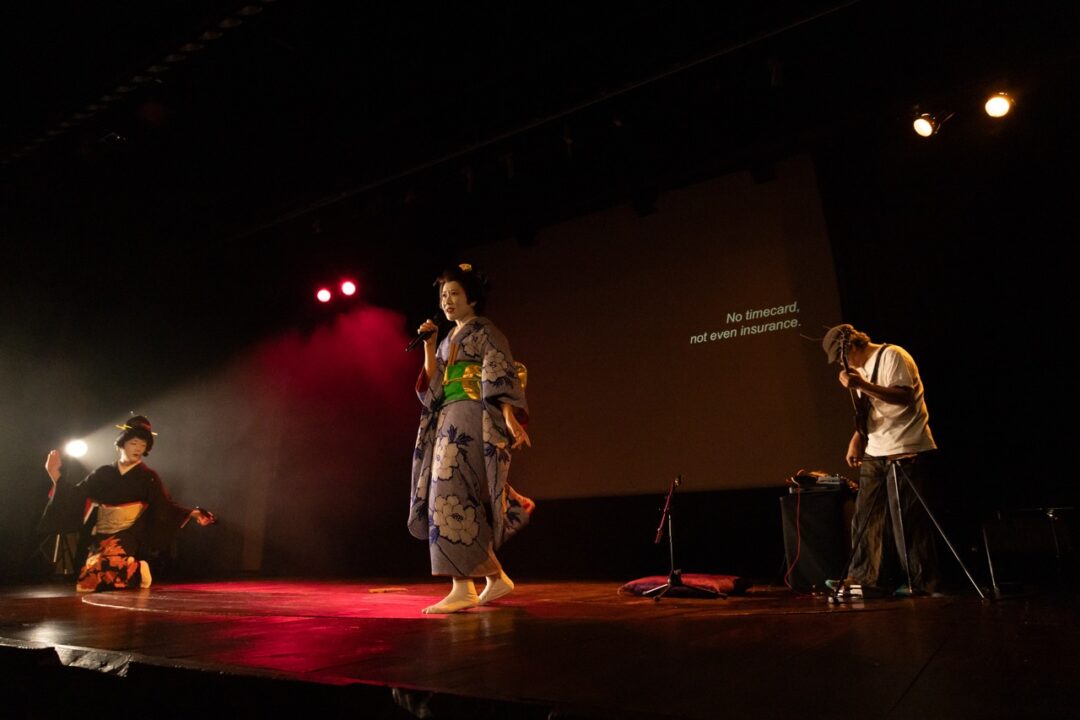
Akbar Yumni attended Sekolah Tinggi Filsafat Driyarkara (Driyarkara College of Philosophy) in Jakarta. He was the curator of ARKIPEL – Jakarta International Documentary and Experimental Film Festival (2013–2018) and is active as a researcher and performance artist. Some of his performances are based on Indonesian film archives that were lost during the authoritarian regime, including Menonton “Turang” (1957), Menonton “Daerah Hilang” (1956), and Menonton “Sedap Malam” (1951). Currently, Akbar is a member of the theater committee of Dewan Kesenian Jakarta (Jakarta Arts Council) for 2023–2026.

Krishna Sen
Krishna Sen FAHA is an Australian professor and internationally recognized scholar in contemporary Indonesian and media studies. Her first book was a comprehensive account of Indonesian film history. She is Chair of the Perth Centre of PEN International, Emerita at the University of Western Australia, and a member of the Murdoch University Senate. Indian by birth and Australian by circumstance, she has dedicated much of her academic career to researching and writing about the connections between media and politics in Indonesia. Her long-standing interest in media censorship, developed through her work on Indonesia under Soeharto, now informs her role with PEN International, particularly in supporting imprisoned writers worldwide.

Bunga Siagian
Bunga Siagian is an artist, curator, and cultural producer. She completed her master’s degree in Cultural Studies. Bunga is interested in the history of Asian-African networks, Third World internationalism, and the political-cinematic commitment of leftist groups during the era of decolonization. Her practice often takes the form of public institutions, such as Mother Bank and BKP (Badan Kajian Pertanahan, Land Study Agency), artistic research projects that focus on women’s and land issues by placing her practice at the intersection of art and collective work.