For more than 200 years, olive trees and an old cacti around Damascus were devoured by excavators under the orders of foreman Bashar Al-Assad. The Orchards (Antoine Chapon, 2025) emerges as a kaleidoscope of the reflections and resistance of the people of Damascus. Although Bashar Al-Asaad’s dictatorial regime has fallen, there remains a need to fill the void that the revolution created with meaning, as a momentum to restore those who have lost everything: their homes, their families, and their lives.
The film offers an exposition of capturing activism through a digital model blueprint of the Marota city development, a state-of-the-art urban development project built on the former expulsion zone of Al-Basateen in Damascus. Director Chapon and the Al-Basateen community, who have been victims of eviction, tell their story in opposing Marota’s three-dimensional design with graffiti patches and “replanting” of olive, cactus, pear, pomegranate, and mulberry trees. A storm of anger and sorrow erupts as we encounter the songs and banners of the Syrian Revolution, carried with faceless fists. The shot then moves to a documentation of settlements and fertile plantations and vegetation, depicting a contrast to the previous footage of excavators grinding and uprooting them.
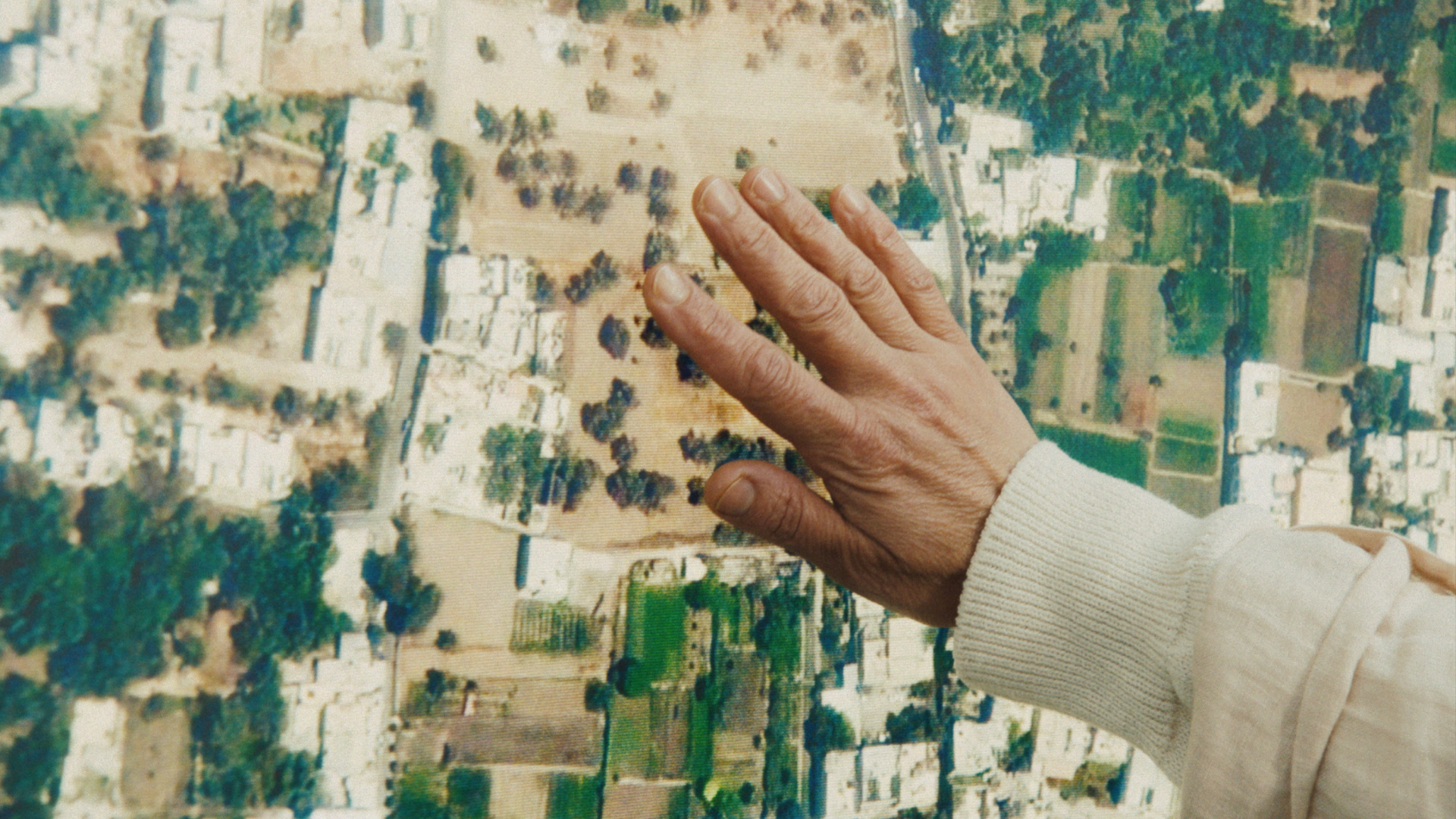
Strips of heavy tape were fixed to the floor in the shape of a house, stirring a woman’s sense of longing for what was lost.
“We will finish our story, and we will come back,” “The empty cities don’t breathe, we will come back.”
One by one, it will eventually come back. The cactus, in fact, will grow together. Amid the concrete walls, asphalt roads, barren infrastructure, and drifting beneath the blue sky of Damascus. (Gantar Sinaga) (Ed. Vanis/Trans. Shafira Rahmasari)
Film Details
The Orchards (Al Basateen)
Antoine Chapon | 25 min | 2025 | France
Official Selection for Perspektif
Festival Film Dokumenter 2025