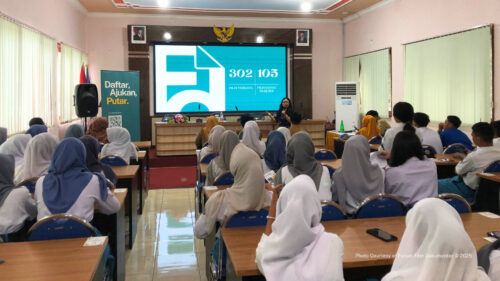
On November 23, 2025, at 7:00 p.m., the auditorium of Pascasarjana ISI Yogyakarta was filled with an audience who came not only to watch a film, but also to revisit the fragmented and perhaps enigmatic history of Indonesian cinema. Bachtiar (Hafiz Rancajale, 2025), which is competing in Indonesia Feature-Length category of FFD 2025, was screened as part of a series of efforts to re-read Indonesian film archives—especially those that have been marginalized, scattered, and erased.
Director Hafiz Rancajale, an artist and filmmaker who has been working at the junction of cinema, fine arts, and archival research for more than two decades, attended a discussion session after the screening. His documentary is an attempt to trace the footsteps of a figure whose position in Indonesian film history has never been fully recognized: Bachtiar Siagian, director of Turang (1957), a work long believed to be lost and later rediscovered in Russia.

An audience member began the discussion by contrasting this film with Hafiz’s previous work. For him, the title Bachtiar felt more straightforward, less metaphorical than previous titles. Hafiz responded that the title was an important part of his discourse strategy. If DOLO (Hafiz Rancajale, 2020) moved in a metaphorical space, then Bachtiar affirmed the name—an attempt to bring to light a figure who had been obscured for decades by various pressures. Hafiz admitted that he deliberately did not include (his last name) “Siagian” in the title so that the film would not be immediately interpreted through the lens of left-wing political stereotypes.
The questions continued on the choice of visuals and camera performance. Throughout the film, the audience captures the camera movement that feels like a cinema or even a baptism process; from left to right and then backward. Hafiz explained that he often works with new cameramen to bring out and highlight the honesty of gestures in recording. For him, the images in this film are not sterile; they are events. The camera movement becomes a kind of open language. The audience is at liberty to interpret whether it is moving to the “right” or to the “left”. What is clear is that the camera itself is neither neutral. It is a body and a witness.
The discussion then moved to the topic of characters in the history of Indonesian cinema: between Bachtiar and Usmar Ismail, why were the two confronted in the film? Hafiz emphasized that this needed to be presented for discussion, even debate if necessary. In his research, Bachtiar’s position is parallel to Usmar’s. However, the history of national cinema is certainly full of fragmentation and politicization, so that some parts are missing and some are deliberately hidden. The question is no longer who deserves to be “The Father of Indonesian Cinema”, but rather what happened to the narrative that was sterilized from the public.

The audience’s next question touched on Hafiz’s motivation for making Bachtiar the subject of the film. In Hafiz’s account, it is revealed that this film was not a single plan. He had once imagined making fifteen films about Indonesian intellectual figures together with Forum Lenteng, but limited funds and energy meant that the idea remained a fragment rather than a series. However, Bachtiar came to life through the research process for the film Turang. Initially, Hafiz and his team thought the film was lost forever. But networks, archives, and long work brought them together with it abroad. Part of the film’s process was halted due to a lack of funds, but the momentum of the discovery of Turang allowed Bachtiar to rediscover its form. The second part of the film developed into a story about the effort to bring Turang back to Indonesia; not only as an archival object, but as a fragment of history that regained its space and home.
Another question arose about how a film like this could raise awareness among today’s generation about forgotten history and how we should move forward as a nation. Hafiz responded honestly: in Indonesia, the production of knowledge, especially that which touches on layers of history that have been eroded by politics, is always in its own field of battle. He believes that the best strategy is collaboration and the courage to reclaim what is the public’s right: including archives, support, and funding.

The discussion closed with a question about how “dangerous” Turang was that it had to be hidden and was later rediscovered in Russia. Hafiz replied: there is nothing dangerous in its content. There is no explicit propaganda. What makes it considered dangerous is the ideological fear surrounding the narrative of Indonesian history after 1965. He emphasized that opening the archives is a form of resistance. “If we want to move forward, we must dare to open the wounds of our history.”
The evening ended without a single conclusion. However, that is precisely what made this session important. Bachtiar is not a finished film; it opens up a space that has been empty for so long. A space for names that have been almost forgotten. A space for films that were once lost but finally found their way back home. A space for history that has yet to regain its entirety. (Hesty N. Tyas, 23/11/2025 [Ed/Trans. Vanis])