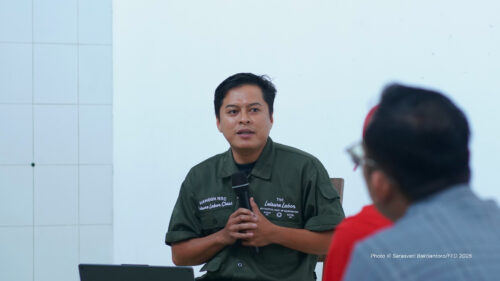
“History, especially Indonesian history, has many versions! A new history is being made as we speak,” said Arfan Sabran, director of The Last Accord: War, Apocalypse, and Peace (2025), featured in Festival Film Dokumenter 2025’s Lanskap series, Mo(nu)ment. The audience had the opportunity to participate in a Q&A session with director Arfan Sabran after the film’s premiere at Kedai Kebun Forum (11/23). The session discussed the research process, creative decisions, and perspectives taken in the making of the documentary.
Director Arfan Sabran began his research for The Last Accord: War, Apocalypse, and Peace by exploring the history of the Aceh conflict, with the help of local communities and former GAM members. This process included lengthy conversations with ex-GAM forest rangers whom he met while producing a documentary for Channel News Asia—an experience that later became one of the foundations for his research for this film. Interviews with important figures such as Jusuf Kalla and Susilo Bambang Yudhoyono required efficient time management.

The narrative and perspective were decided in collaboration with the Foreign Policy Community of Indonesia (FPCI), which encouraged Arfan to highlight the diplomatic aspects of the Helsinki Agreement. Ultimately, the focus of this documentary is to show all the negotiations and disputes between Aceh and Indonesia leading up to the ceasefire. He centers the narrative on the dynamics of diplomacy, the failure of negotiations in Switzerland and Tokyo, and the success in Helsinki.
In designing creative decisions, Arfan emphasizes the importance of finding a dynamic structure so that the film does not feel monotonous. As a solution, he spread key points of conflict evenly throughout the narrative. The complexity of history and limited access to meeting materials—which were confidential at the time—posed a major challenge in formulating the storytelling. The lack of archives from the Helsinki meetings led to the use of animation, which not only served to fill in the gaps in the archives but also provided an engaging visual experience. The team of animators in Yogyakarta was instructed to carefully visualize the situation inside the meeting room—GAM on the left, Indonesia on the right, Ahtisaari in the middle—while music was used to build tension and keep the audience engaged in the non-chronological plot. During the editing process, a lot of data and interviews had to be cut so that the narrative remained focused on the core message.

The discussion ended with Arfan recounting how his friend from Aceh was motivated to research the original documents and the original Helsinki Agreement after watching the film. Like him, Arfan hopes that the film will spark further discussion that will fill in the gaps in history, which are being further manipulated with each passing day. (Timmie, 23/11/2025 [Ed/Trans. Vanis])