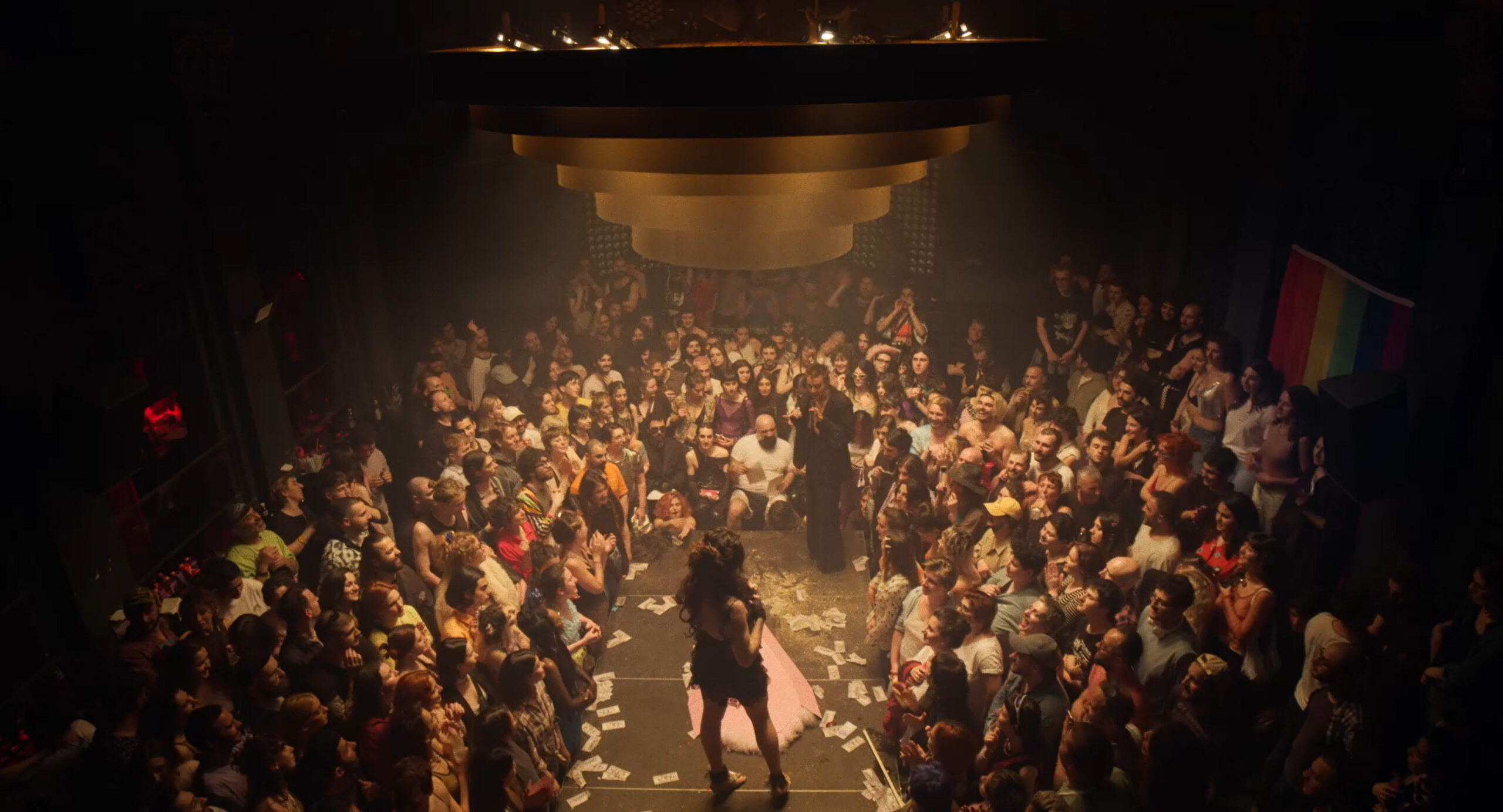
The FFD 2025 Student Competition program, screened at Kedai Kebun Forum on Saturday (22/11) at 15:45 WIB, highlighted an important aspect: documentaries are not just a genre, but also a medium for exploration. After the screening, six filmmakers from the six films that had been screened were invited to join a question-and-answer session. They were DJUM (Ahmad Brilliant Maulana Vitjayanto, 2025), Constructed (Jonathan Gradiyan, 2025), Our Father Hour (Aziz Hammad Kusteja, 2025), Forced to Be Wild (Muhammad Al Hafiz, 2025), When the Blues Goes Marching In (Beny Kristia, 2025), and Honey & Moon (Navin Dharma, Christopher Erick; 2025). The six films offered not only a range of themes but also the courage to question the form, the boundaries, and the vast possibilities of the documentary medium.
Teuku Muhammad Hafidz Ramadhan, the producer of Forced to Be Wild, opened the discussion by highlighting the social context behind the film, specifically the street racing community in Aceh. Hafidz did not see the protagonist as some kind of anomaly because, in reality, the street racing community, particularly in Aceh, accommodates their hobbies. “If they never train, how could they ever evolve? But if you practice (street racing), the citizens might be disturbed. They are aware of that,” he said. Behind the roar of motorcycle exhausts and the barricaded public streets, the film invites the audience to understand the layers behind it: resistance as well as negotiation over public space, access, and the need for expression.

Move on to another film, through Constructed, director Jonathan Gradiyan inquired a fundamental question about the documentaries themselves: what exactly is “reality”? For him, documentaries are constructions; a collection of political decisions taken through the eyes of the camera, duration, framing, and editing. “Sometimes, documentaries are considered less prestigious than fiction,” he says, “but the truth is both are the same: they are choices.”
Meanwhile, director Beny Kristia, through When the Blues Goes Marching In, approached the documentary as a space of archives, memories, feelings, and things in between. Demonstrations, dreams, generational trauma, and protest performativity come in theatrical, surreal, and layered forms. He acknowledged that the form of the film did not arise from an early choice, but from a long process of allowing the footage to sink in, reading post-election context, and discovering texts and literary works that spark a discussion. This film worked like a collective memory that never comes to an end.
Through Our Father Hour, Aziz Hammad Kusteja turned the idea of “personal film” into a space of dialogue between experiences. Taking inspiration from intimate moments as well as grief in his family, Aziz began to construct his animated documentary. He also adopted his friends’ story to broaden the narrative surrounding the father figure, a theme continually explored in his film. How is “fatherless” articulated through animation and spoken by the protagonist, who is the child himself? A father who left this world–literally and figuratively–depicted side by side and intertwined.

Ahmad Brilian Maulana Vitjayanto, through DJUM, chose the observational method. The figure of Pak Jum, a waste collector in Yogyakarta, appeared not as a victim, but as a person with a strong principle of life: To give is to believe that blessings will never run dry. Warmth and humour came subtly, becoming the glow behind the waste issue in Yogyakarta, which remains unsolved to this day.
The program concluded with Navin Dharma’s Honey & Moon, a story of two nursing home residents who had just tied the knot in the twilight of their years. Hope rather than sadness was the center of his narrative. “They still have hope for the future. So, I think that is the kind of spirit we, as the young generation, should embody,” said Navin, while explaining how the process of finding the subject of the film began with a visit to various nursing homes. The decision to choose this pair may suggest that documentaries can move in an affirmative direction without falling into sentimentality.

Across the entire session, one clear common thread emerged: these young filmmakers were not only experimenting with various kinds of themes, but also in operating the camera to see the world. Some brought the protagonist through longitudinal relationships and observations, some questioned the function of documentaries, and others used dreams and archives as methods. The difference in approach, from observational to experimental, suggested that documentary is no longer understood as a genre, but also as a negotiating space between experience, form, and ethical choice.
This year’s Student Competition program shows the courage to look for something that is not always to be the same or “as it should be”. If documentary is a way of understanding the world, then, from these filmmakers, we can learn that understanding means listening, questioning, and sometimes allowing things to remain suspended, filled with questions, yet without answers. (Hesty N. Tyas, 22/11/2025 [Ed. Vanis/Trans. Shafira Rahmasari])