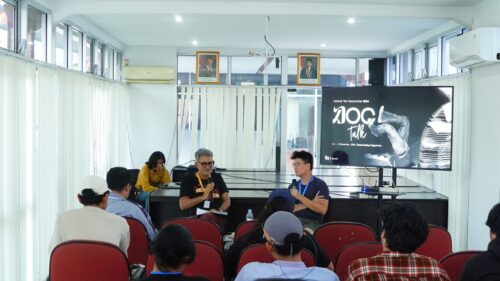
Film festivals are not only a celebration but also a way to change the perspective towards films and genres. To what extent can a film festival challenge itself by crossing between film and genre boundaries? Today’s DOC Talk explored how film festival programming acts as an artistic medium and its challenges. Answering these concerns/questions, Festival Film Dokumenter 2024 organized a public discussion under the program DOC Talk entitled What We Talk About? This discussion was held on November 8, 2024, in Ruang Rapat Taman Budaya Yogyakarta and was attended by participants from different backgrounds and demographics. Sandeep Ray was the moderator who led the discussion, presenting Sébastien Simon, a festival programmer at the Busan International Short Film Festival, and Thong Kay Wee, a festival programmer at the Singapore International Film Festival as the speakers.

Opening the DOC Talk session, Sandeep Ray threw a funny joke to the speakers and the audience, “What do you want to be when you grow up? I have never listened to a single kid who wants to be a film programmer.” The intriguing question followed by laughter from the audience that filled the air. Then, Sandeep invited Sébastien to start his presentation entitled Film Festival Programming: A Form of “Macro-Editing”. Sébastien presented his material, placing him as an editor. Growing up as an editor, Sébastien analogized that a programmer is just like an editor. For him, being an editor means being able to increase the strength to choose the shots. In the same ways as when he placed him as a film programmer, he had to choose a film that was able to represent visual articulation, tell a story, and be able to surprise the audience.
In choosing films to put into a program, a programmer must be able to compile various films, combining those films into one complete path and having enough power to invite the audience to feel the same emotions in each film. Sébastien also talked about the way he curated 90 films out of 4000 films listed. It requires a good ability to choose and select. He must also categorize the films that have been selected into a program that can articulate the same issues, visual representations, and emotions. Sébastien emphasized that, as a programmer, he does not only watch the film but also is expected to be an attentive viewer, where he needs to observe every aspect of the film. In his presentation, Simon asserted that film and festivals share some similarities––they are made for audiences.

Meanwhile, Kay Wee argued that the films selected in a film program appear as the best ones in terms of the visual aesthetics and the plot of the story, among others. In his experience, Kay Wee must be able to choose and organize various types of film genres, including fiction and documentary films. Kay Wee argued a programmer must also be aware of the issues raised in the film, such as cultural and political projections, even a film programmer must consider the films that might suit the audience’s preferences.
Sandeep asked, “Why do we have film festivals?” Sébastien and Kay Wee agreed that film festivals would keep cinema alive. In addition, they also argued that organizing a film festival has something to do with economic needs as well as cultural archiving. Through the views of Sébastien and Kay Wee, this discussion explored how film curation can connect complex themes considering social, political, and cultural issues. The festival film program not only served as the audience’s choice but also as an artistic medium that reflects the dynamics of contemporary cinema and the needs of the audience.
Covered by FadliAwan on November 8, 2024. (Ed. Vanis/Trans. Shafira Rahmasari)