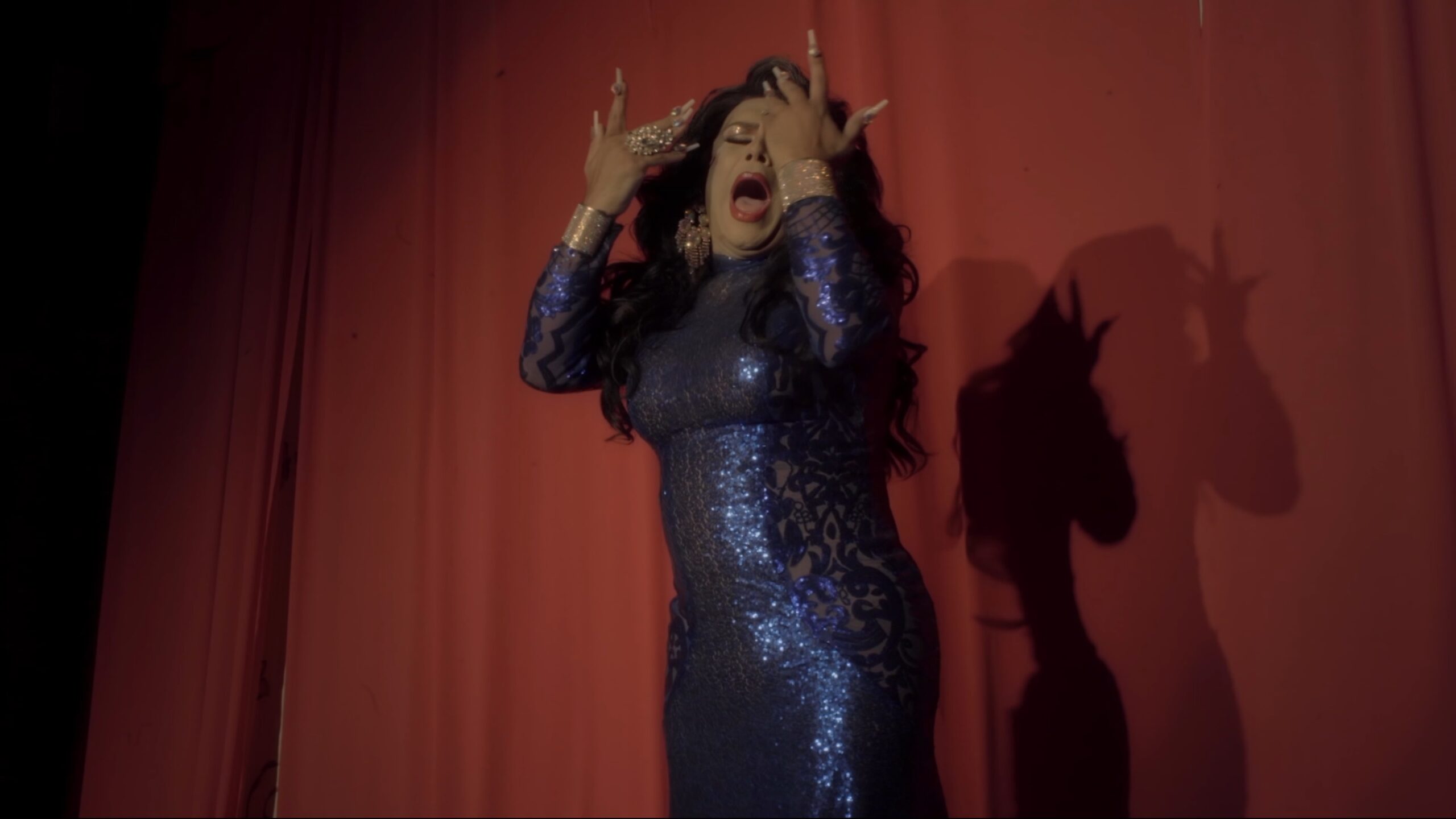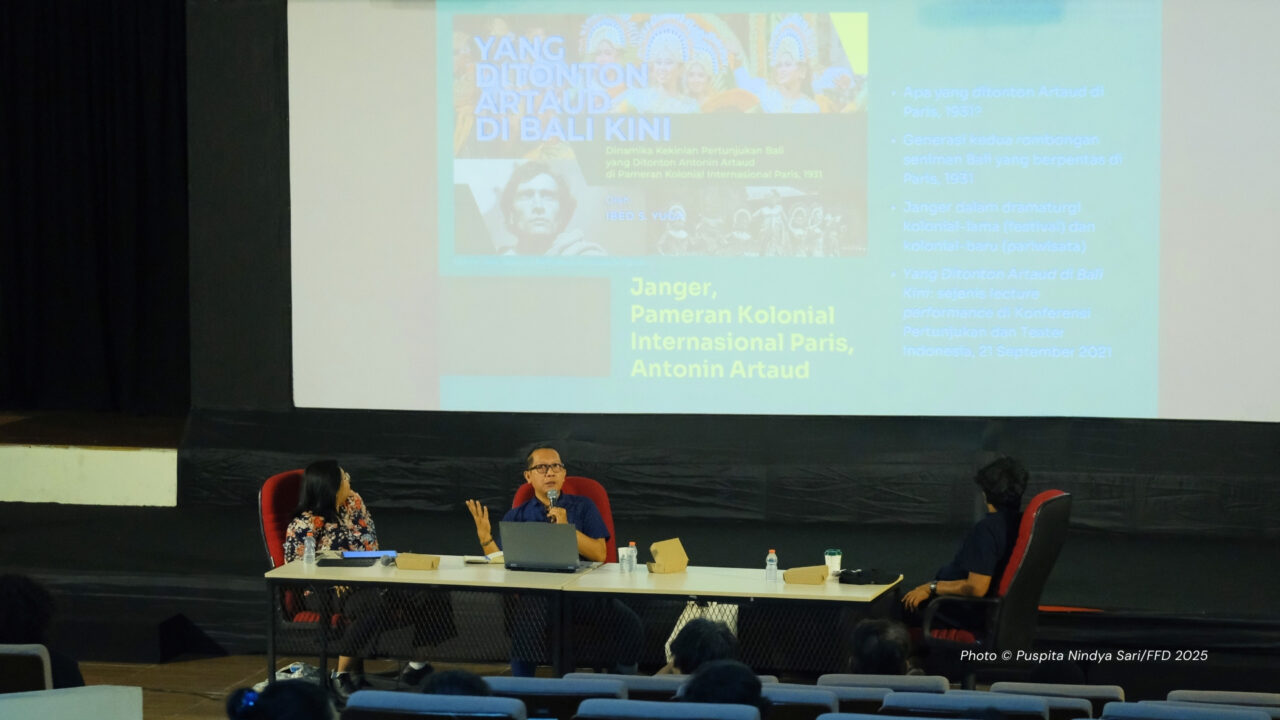
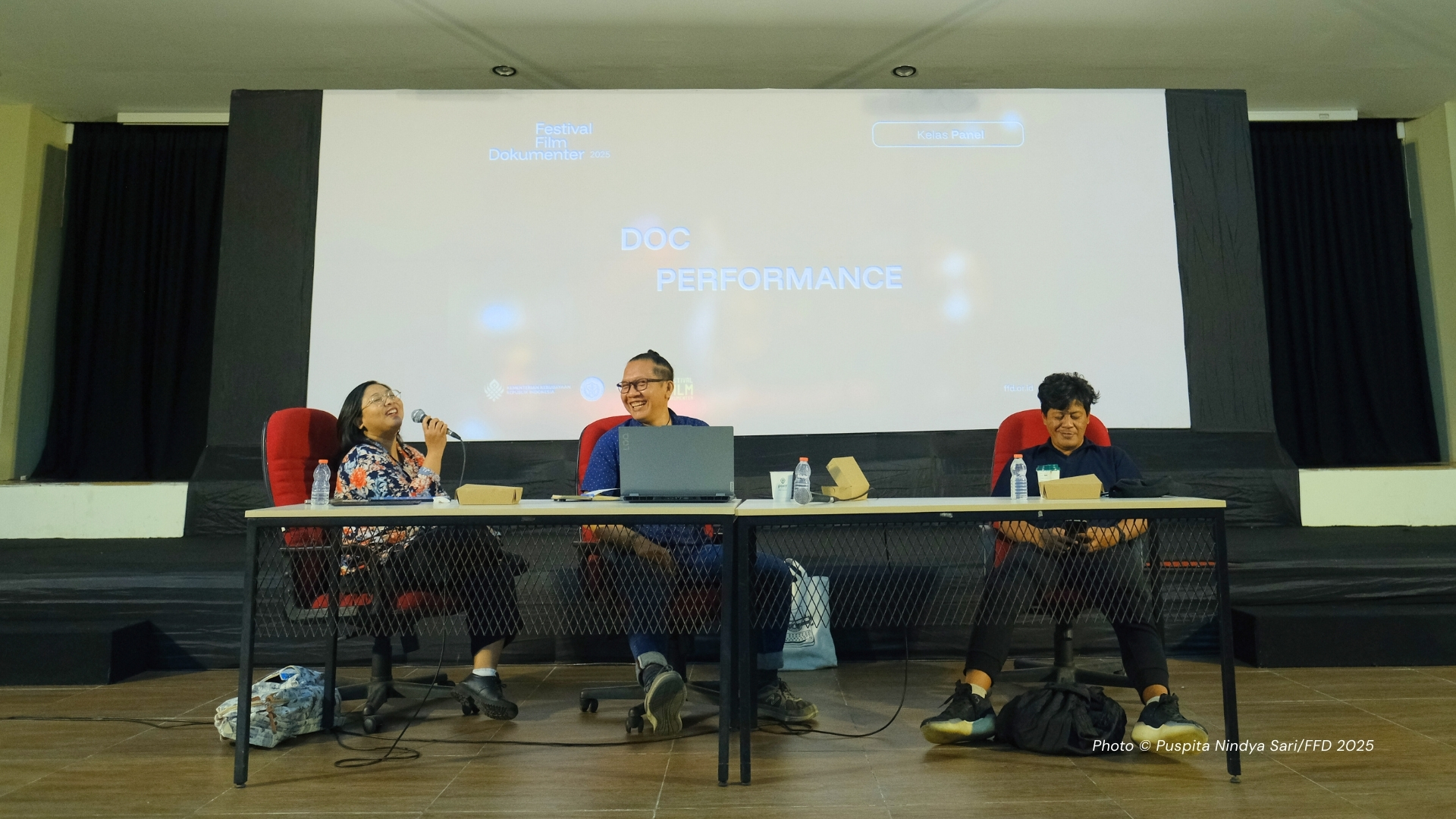
The second series of panel classes titled Doc Performance: Dokumenter Silang Media (Cross-Media Documentary) took place at Pascasarjana ISI Yogyakarta on November 25 as a continuation of the ongoing discussion on the intersection of documentary and performance. This class is a part of Festival Film Dokumenter’s effort to bridge the gap between the screen, the stage, and the audience. Featuring Ibed S. Yuga and Akbar Yumni, and moderated by Luna Kharisma, this panel became a meeting point between performance art, cinema, and ways of remembering.
Luna opened the class by explaining that the aim of this class was not to define a new genre, but to challenge the way documentaries work when they are understood as occurrences. For filmmakers, artists, researchers, and audiences, this class invites reflection on whether documentaries must always be on screen or can also occur in the space and body. Documentary performance is an experiment to reexamine how reality is represented when verbal narratives are unable to convey the experience.
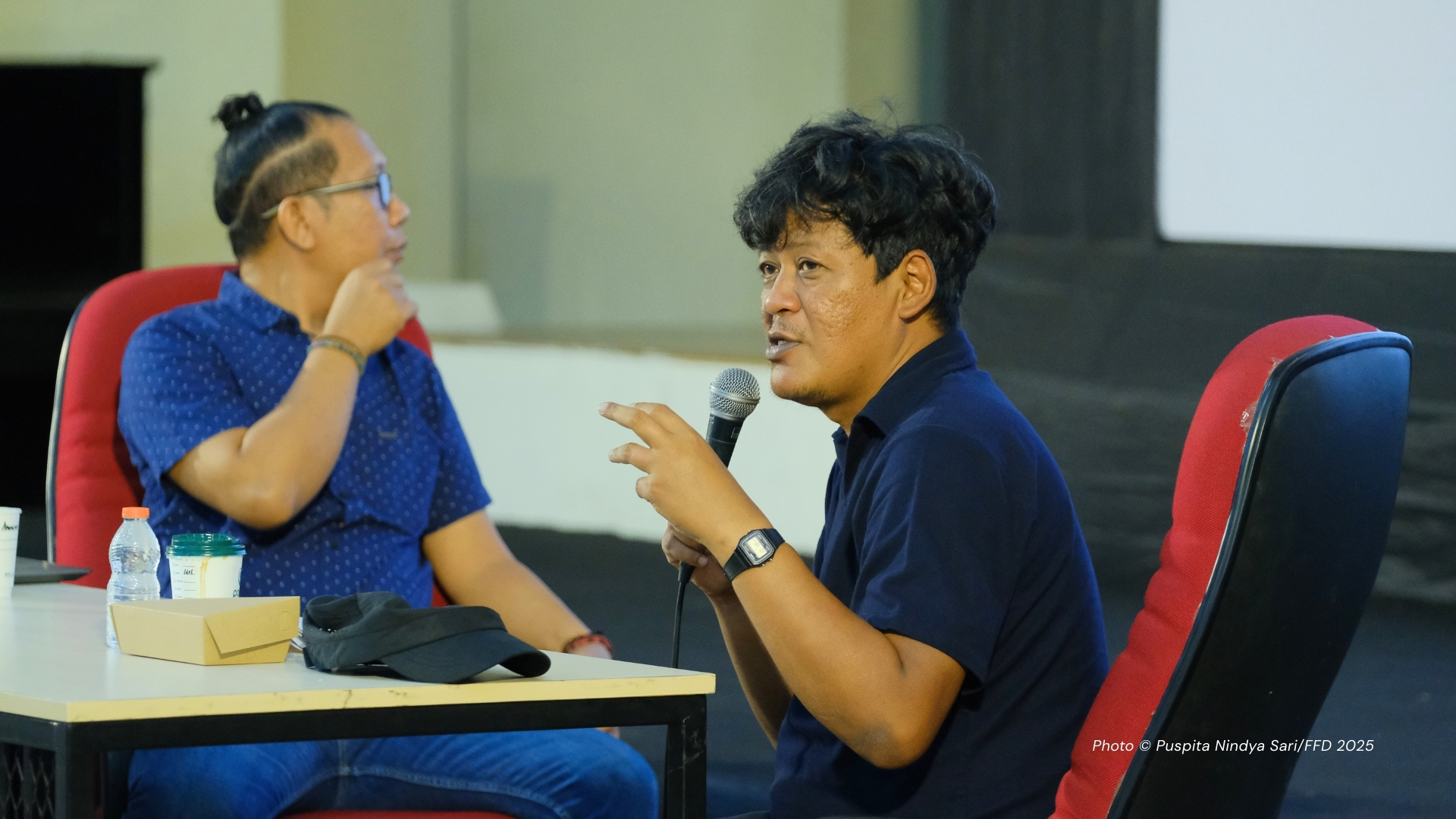
Akbar Yumni served as the first speaker, shifting the basis of the discussion to the field of cinema history. He addressed the expanded cinema movement, which emerged as an effort to transcend the screen. According to Akbar, Jean-Luc Godard, Alexander Kluge, and Béla Tarr paved the way for the merging of film with theater, poetry, and space. These figures actively challenged boundaries and broke down cinematic structures. In his explanation, he emphasized that today’s documentaries cannot be measured solely by the presence or absence of reality. We need to see how the filmmaker processes reality, brings it into space, and presents it for us to experience. Documentaries capture and produce knowledge, and the camera is an agent that selects, compiles, and arranges experiences. Expanded cinema helped open that threshold in its time. According to Akbar, performance documentaries have an urgency in positioning documentaries as events, rather than mere representations of reality.
Ibed S. Yuga responded through a different door. With a background in theater, he discussed post-dramatic theater as a tradition that does not consider the script as the bearer of meaning. He said that biographies, history, and memories do not always have to be told through words. The body can become an archive, and the stage can become a space for its documentation. Ibed recalled a time when theater tried to free itself from illusion, linear narratives, and the obligation to “entertain.” In the process, the body was confronted with itself as a source of history. Ibed then drew a line from stage experience to documentary film. He mentions an important shift in that in documentaries, verbal voices often become the sole truth, while the body becomes merely an illustration. In performance, the opposite occurs; the body becomes the center of meaning, while words are only occasionally present as markers. In his opinion, the intersection of stage and film can create a more honest way of reading history and memory.
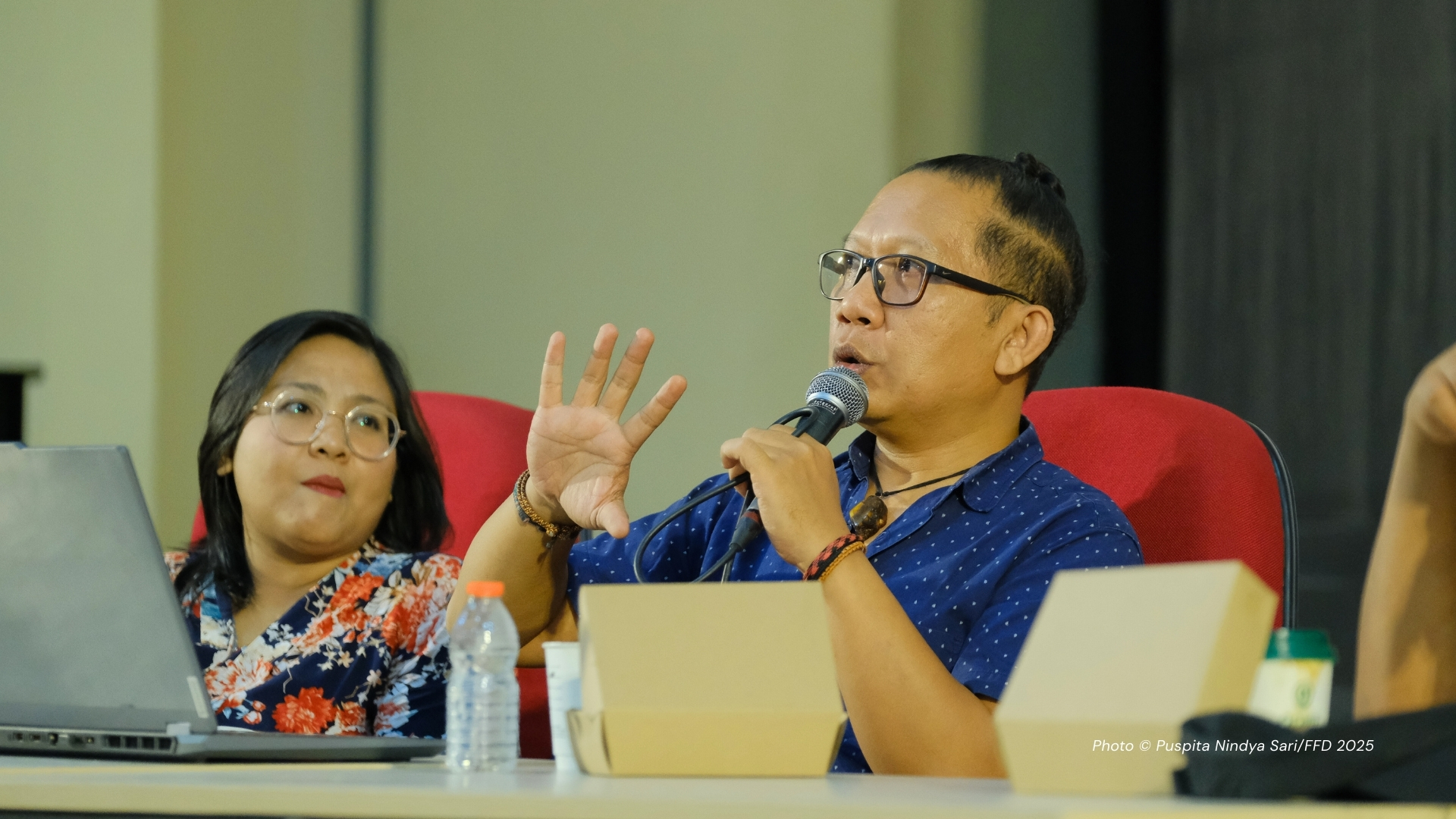
Akbar then explained how practical documentary performance works. He emphasized that documentaries no longer solely tell a story, but rather form a cinematic experience that brings the audience to a state of awareness. He used the term “becoming cinema,” a process that invites the audience to change while watching. Responding to this, Ibed discussed how the body often becomes the most honest actor on stage, especially when family history, social experiences, and personal trauma cannot be processed through words. In theater, the audience can see a body crying without knowing the cause. In documentaries, the body is rarely given such space.
The panel did not stop at the notion of aesthetics. The two then spoke candidly about the context of art in Indonesia. Akbar highlighted how art presentations are often required to adhere to a clear story structure, as if narrative is the only path to “clarity.” Ibed acknowledged that something similar happens in theater and film, where the honesty of the body is sometimes considered uncommunicative, even though verbal narratives often paralyze the experience. In a more reflective comment, Akbar said that documentary films are very likely to experience stagnation if they only comply with the same form over and over again, without questioning what the film is actually looking for in reality.
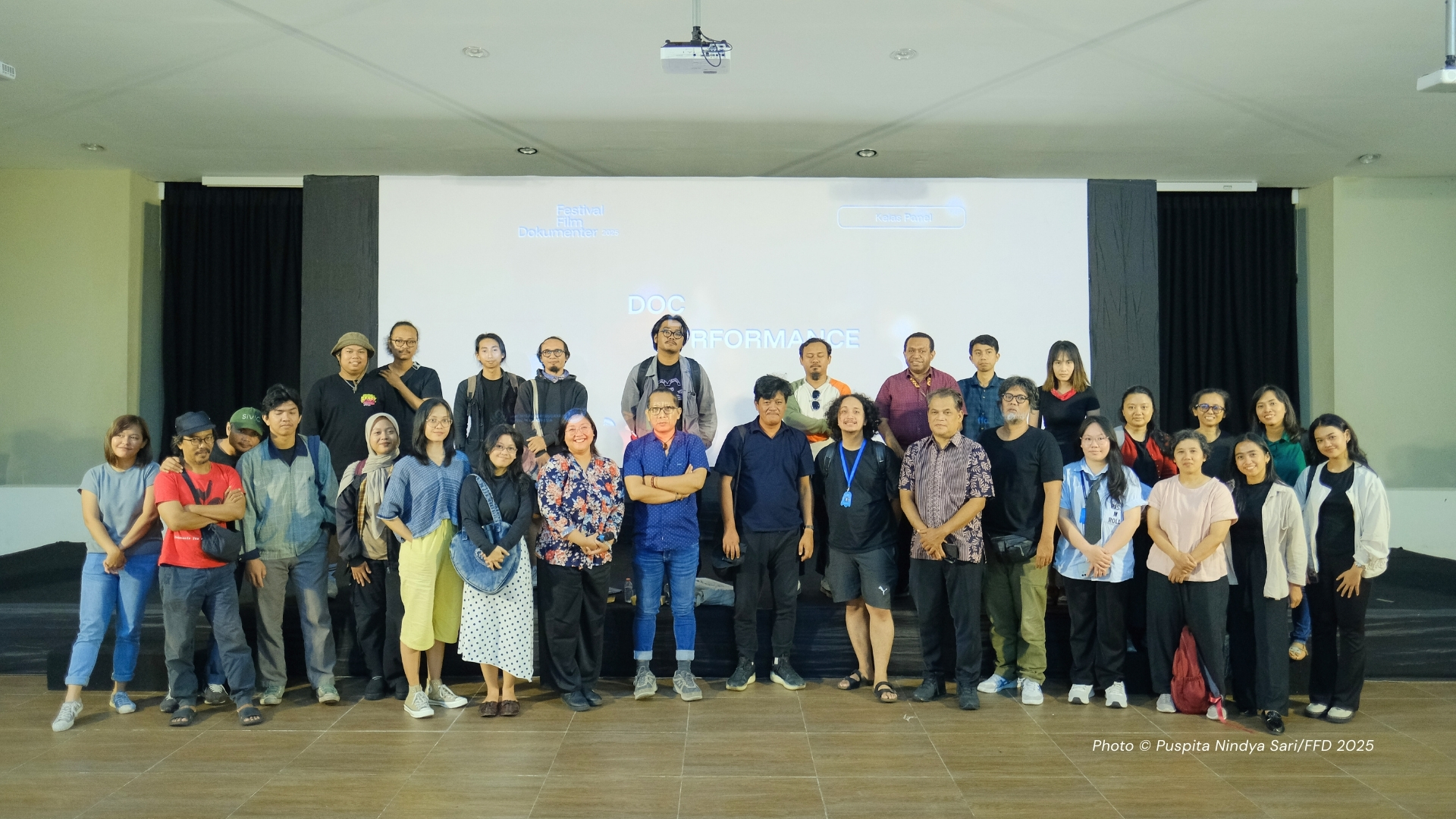
Luna then brought the discussion towards audience reception. She asked how audiences could be encouraged to understand documentary performance without feeling “lost,” given that the format is often not linearly driven. Akbar replied that feeling lost is not a sign of artistic failure, it can be part of the journey towards awareness. Ibed added that audiences do not have to understand everything right away, as the body sometimes captures something before the mind catches up. A question from one of the participants concluded the class session. “Will documentary performance produce hybrid artworks that will become its own category in the future?” The two speakers’ answers were quite firm, stating that documentary performance is not a genre. Based on what has been discussed previously, we need to consider documentaries not as a format, but as an action, meaning something that can happen on screen, on stage, in a gallery space, or in front of an audience as a live event. (Sarahdiva Rinaldy, 25/11/2025)