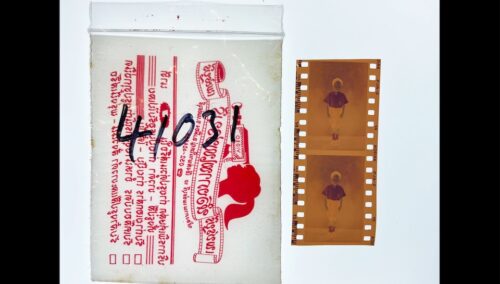
As the emergence of time travel as a literary theme at the fin de siècle is a phenomenon one may suspect to be linked to the simultaneous emergence of cinema (and by extension, photography), with its capacity to manipulate the illusion of time. Chris Marker’s La Jetée (1962), in its radical experimentation of form, mostly uses still photographs to tell the entirety of its story. That method doesn’t only function as a Kuleshovian proof-of-concept, though. By using photographs, the film utilizes the defining characteristics of it to its narrative’s advantage—which acts as a representation of memory, suspended between presence and absence, the now and the then—manifesting into a feeling of longing.
“The struggle of man against power is the struggle of memory against forgetting.”
— Milan Kundera, in his 1979 novel The Book of Laughter and Forgetting.

It is with this quote that I think La Jetée operates. Every political regime, especially of the authoritarian kind, uses “forgetting” as a tool for domination against the history that they don’t want anyone to remember. This manifests in the form of “future cops” that hunts for the protagonist, a prisoner of war of the fictional World War III, ultimately killing him as he travels back in time to fulfil his obsession to relive a particular pre-war childhood experience he was enamored by. By this logic, “remembering”, then, becomes a form of resistance against the dominating power’s tendencies to erase certain pasts. Like Kundera’s quote, the protagonist’s desperate moment to preserve a moment against the authoritative annihilation is a struggle of a memory against “forgetting”—and thus, against power itself.
Miren Felder (Malen Otaño, 2024) is a retelling of director Otaño’s journey to reach for her late grandmother through the means of mediumship. In her journey, however, she also saw glimpses of her family’s past—revealing their collaboration with Brazil’s dictatorship regime after the military coup in 1964. The short film uses still photography as its narrative method too—using her grandfather’s old photographs as its mode of narrative. Unlike it though, which utilizes the method in a science fiction context, Miren Felder uses it to tell Otaño’s real life (sensorial) experience in the form of a documentary. As our episteme grows less suspicious of non-Western or precolonial spiritual practices—including the art of mediumship, Miren Felder uses it as La Jetée-an time machine to confront the past and as a mnemonic device to long for said past’s intimacies.

As Miren Felder documents the director’s journey through mediumship, we too explore themes of national trauma, intergenerational guilt, memory, and death through a poetic essay in the film’s voiceover. The film, in its contradicting tension to cling unto past’s intimacies and to detach from military violence, serves as thought-provoking personal (and familial) discoveries. As it resists forgetting and succumbs to the dominating power’s tendencies to “erase” certain memories, it also serves as a mystical force of longing for lost loved ones. Miren Felder, then, is an evolution of concept in which La Jetée uses—beyond (science) fiction, documenting the real. (Timmie) (Ed. Vanis)
Film Details
MIREN FELDER
Malen Otaño | 20 min | 2024 | Argentina
In Competition for Short Documentary
Festival Film Dokumenter 2025