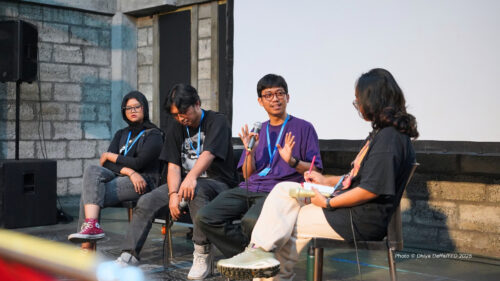
In a forum titled Doc Performance: Dokumenter Silang Media (Cross-Media Documentary) on November 24 held at Pascasarjana ISI Yogyakarta, Hafiz Rancajale and Agung Kurniawan attended as speakers to talk about the intersection between documentary, performativity, and the body. Moderated by Irfanuddin Ghozali, the session was part of a panel discussion series of Festival Film Dokumenter 2025, held with the support of the Indonesian Ministry of Culture. The panel discussion series is intended to encourage the exploration of new ways of understanding documentaries, which are no longer confined within cinema screens, but as living events. The session was designed as a space for filmmakers, artists, researchers, and the general public to reflect on the moving and intersecting boundaries between the two mediums.

Hafiz Rancajale began the session with a historical observation, tracing performance practices back to their avant-garde roots, when futurism, dada, installation, and experimental theater ripped apart the conventions of narrative and artistic aesthetics. He cited Hugo Ball as an early figure who recognized that the body can speak even without language, through his reading of the poem Karawane in anti-logical costumes. Hafiz presented the thesis that from the beginning, performance documentation—photos, sound, film—has been a compilation of memories rather than merely a recording device. This relates to the fact that what is recorded is something that transcends the event, which then gives rise to interpretation. In its place, technology seeks to not solely capture reality, but to both define and shape it.
To highlight this, Hafiz distinguishes between performance documentation and video performance. Performance documentation occurs when a performance is recorded, while video performance is a performance that is intentionally created for the camera. To back up this point, Hafiz then presented Bill Viola’s work, The Deluge (Going Forth By Day)—a conceptual visual experience created entirely for video media, not the stage. Hafiz shows how the camera can provide a new language that is not easily accessible on stage. Otty Widasari’s work, The Absence of Princess Van Kasiruta, then appears as another example of how the body can raise social history as a reading of identity that continues to move when framed by performativity.

From a different angle, Agung Kurniawan began with bodily experience. He saw performance as a space for self-criticism and confrontation of internal censorship, such as family stigma, religious morality, social pressure, and the shadows of unfinished history. Agung recalled a period when visual art was seen as a subversive medium, before performance became a way to discuss experiences that could not be expressed through ordinary narratives. For him, Kedai Kebun Forum is an important example—a closed space where the body can express things that are still impossible to say in public. In this space, performance acts as a mechanism for reading and bringing trauma to life.
The relation between performance and documentary was then linked by both speakers on one axis: the manner in which truth is conveyed. Hafiz stated that documentaries are often constrained by verbal narratives—the narrator’s voice, linear explanations, and visuals as a complement to the text. Agung added that documentaries often neglect their own visual language. When films are more preoccupied in “telling stories” rather than creating visual experiences, the presentation loses its bodily and spatial depth. With this premise, both speakers agreed that performance can reopen the visual language of documentaries, not as a theatrical alibi, but as another way of understanding reality.

The conversation became more personal when the two discussed the stagnation of contemporary art. Hafiz sees today’s performance practices as often trapped in stylistic repetition, losing the discipline of exploration and becoming too comfy with aesthetics. Agung sees a similar stagnation in documentaries, where films want to “be right” rather than “be able to speak”. For both of them, instead of a failure, stagnation is a turning point for finding a new language. Performance provides a way to speak without narrative, and documentary provides a way to test memory without stopping at bodily experience alone. Hafiz held onto the idea that performance documentation is a construction of representation, while Agung emphasized that performance is a confrontation of the body and memory. Both realized that what matters is not where the line is drawn, but when that line actually brings us to a halt in our thinking.
During the question and answer session, a question arose as to whether performance documentaries would change the way documentaries are made and presented. Hafiz reminded the audience that the purpose of this class was not to encourage documentaries to become performances or vice versa, but to remind them that documentaries do not have to be confined within a fixed frame and linear narrative format. Archives, interviews, or real experiences can be re-presented through the body as events. Agung added that art spaces provide an opportunity to discuss difficult, bitter, and traumatic experiences without the demands of public morality. In that space, the body becomes an archive, the camera becomes a witness, and experience becomes an event. Performance is not an aesthetic solution, but a method of reciting reality—something that happens when narrative is no longer able to fully contain experience.

Doc Performance: Dokumenter Silang Media panel generated a new awareness of how documentaries do not necessarily have to reiterate established forms, and performances do not have to be spectacles. The two can intersect when the body, archives, and camera work together to remember what is unspeakable. If documentary is a way of preserving the world and performance is a way of bringing it to life, then performance documentary lies precisely between the two, in the realm where memory becomes a body that can be autonomously experienced. (Vanis, 24/11/2025)