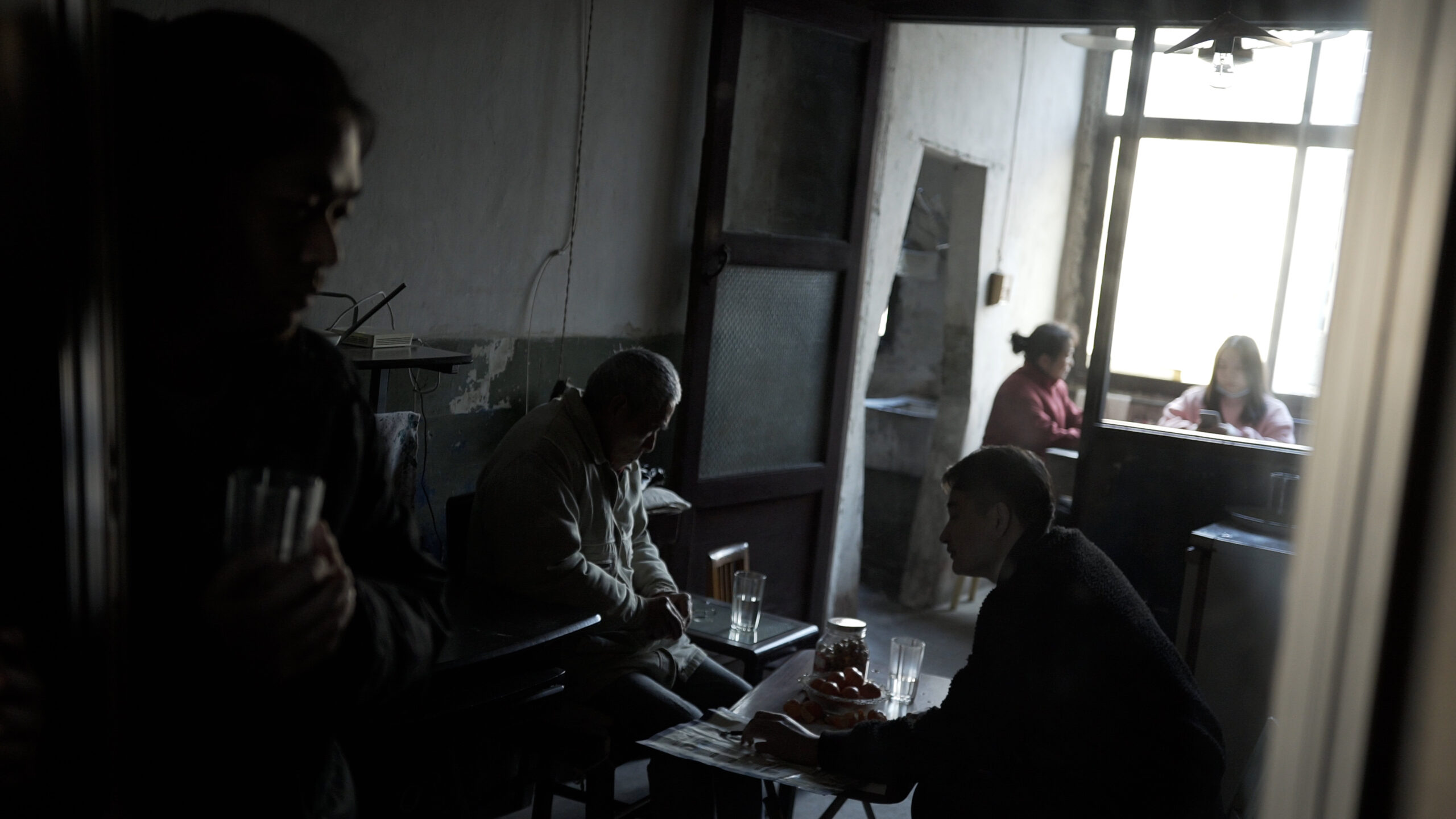
On Tuesday evening (25/11), at Kedai Kebun Forum, A Land With No Ceremony (Bichun Yang, 2024) was screened as part of International Full-Length Competition program at FFD 2025. This 94-minute documentary tells the story of a violinist who returned to Hong Kong in 2020 when pandemic restrictions began to ease. Then, an unexpected event occurred: the passing of his grandmother. This event became the narrative axis of the film, giving the story a sense of unity. Going beyond family documentation, this film becomes an exploratory medium for reinterpreting ceremonies, death, and everyday life within a complex modern social structure.
Bichun Yang (also known as Ricky) plays with the boundaries between fiction and nonfiction. On one hand, his film feels so personal and intimate that the distance between the camera and its subjects feels blurred, even dissolved. On the other hand, the film’s shots feel so neatly constructed and precisely staged that it raises questions among viewers. In response, Ricky shared the process that took place during production. Behind the camera, he was assisted by his wife, who served as cinematographer. They rehearsed many times to find and determine the right shooting angle. “We just put the camera there. Silent angle. Then, we do our work in front of the camera. We really did what we did in the film.” Regarding fiction and nonfiction, Ricky does not want to categorize his film into one particular genre. He believes that it is unnecessary.
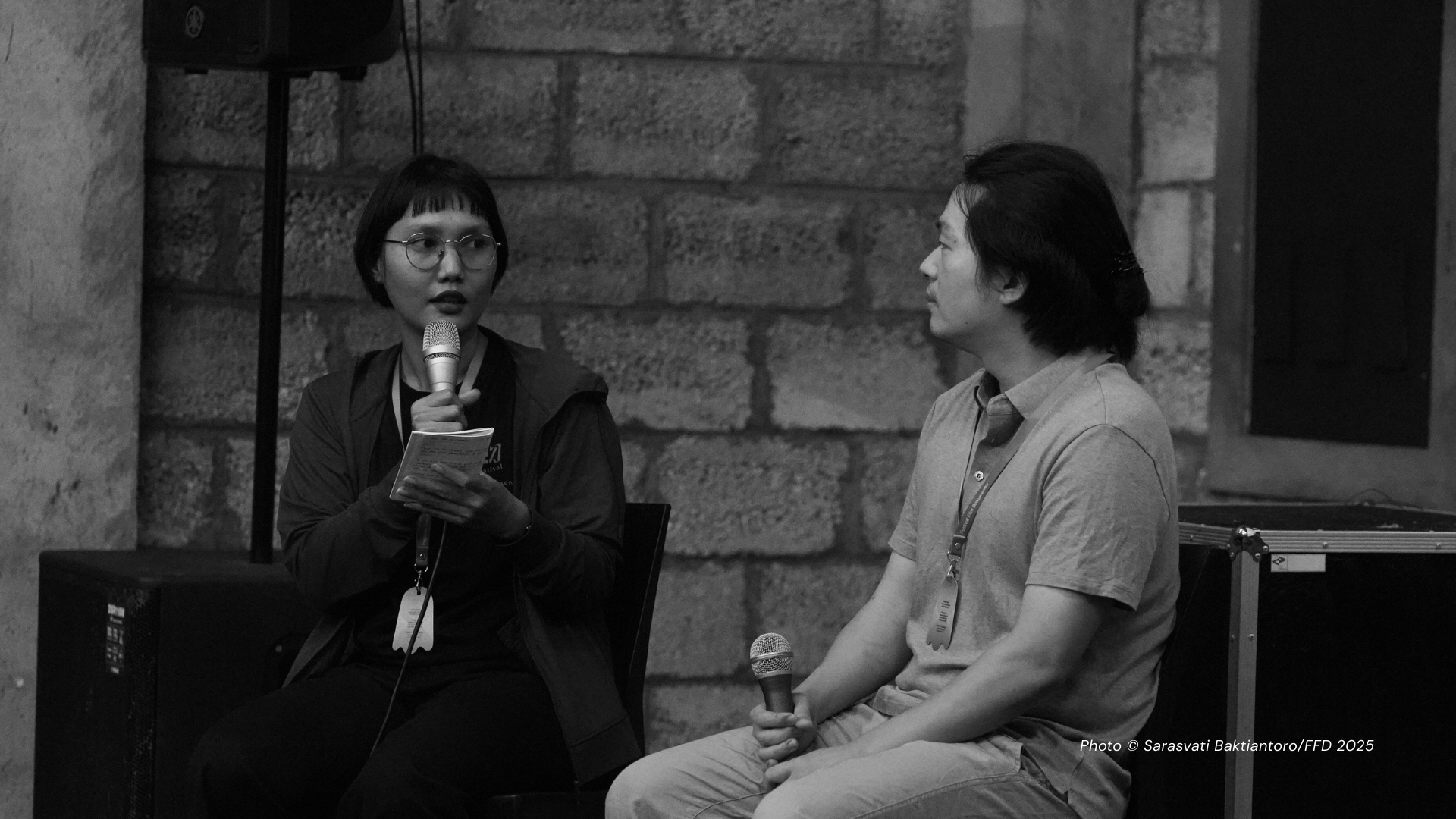
A Land With No Ceremony operates as a dialectical medium. Without simplifying family tragedy into mere sadness, this film also shows how social, cultural, and economic structures shape the way a person processes grief. “It’s actually by accident,” said Ricky. Initially, he only filmed his daily routine, including moments with his grandmother. When his grandmother passed away, the camera became a focal point: a medium for processing and making sense of loss. However, Ricky refuses to frame it as a film about grief. For him, this film is a realization that approaching and facing death is part of the process of life itself. “The film is to remind myself and people that remembering death is important.”
Other audience members questioned how Ricky convinced his family to participate as protagonists in the film. Ricky admitted that there were certain tensions during the production of the film. Moreover, his father initially refused to be recorded because he felt that recording was like acting. However, after witnessing how Ricky recorded their last moments with their grandmother, his family began to understand what Ricky was doing with his camera. At this point, the film changed its function from documentation to mediation; a bridge between Ricky and his family, who initially did not understand about cinema.
Another scene discussed in the discussion was the shot leading up to the ending; a scene that highlights elderly people sitting on benches in the city park, spending time with their families, letting the afternoon pass without any urgency. Ricky called the scene a representation of a typical Sunday; not symbolic in the conventional sense, but rich in context. He wanted to end the film with a calm but unsentimental atmosphere. Through this communal scene, Ricky also wanted to say that what his family had experienced might also be experienced by other families; something unique yet universal. Death after death is inevitable.
So, what does the word “ceremony” mean to Ricky? For him, a ceremony is a way to remember; events that are undeniably present in life. In this way, the film itself becomes a ceremony.
Ultimately, A Land With No Ceremony shows and offers the idea that ceremonies are not always present in the form of standard rituals. It exists in everyday actions. In a world increasingly obsessed with speed and performativity, this film offers closeness, attention, and meaningful togetherness. In its irregularity, life provides space for ceremonies born from the body and relationships. For many audience members who attended Ricky’s film that night, this documentary was not just a personal work by a filmmaker. It is a collective encounter and reflection on how humans remember, care for, and survive. The absence of ceremonies today does not mean there is no respect. On the contrary: ceremonies take place in our daily lives.

The resonance of this film does not stop at the credit title and in the screening room. After the discussion session, several audience members approached Ricky to express their gratitude in person—a simple gesture that shows how this film works as a safe dialectical space for those who have experienced loss. Although the film’s narrative is set in the context of a family in Hong Kong, the experience of grief it offers is not particular; it finds common ground with audiences from different countries, cultures, and languages.
This film shows how the impact of documentaries can extend beyond multidimensional boundaries: language, culture, geography. That the personal does not preclude the universal; that such a personal experience of loss and grief can become a rendezvous point for many other lives. (Hesty N. Tyas, 25/11/2025 [Ed/Trans. Vanis])