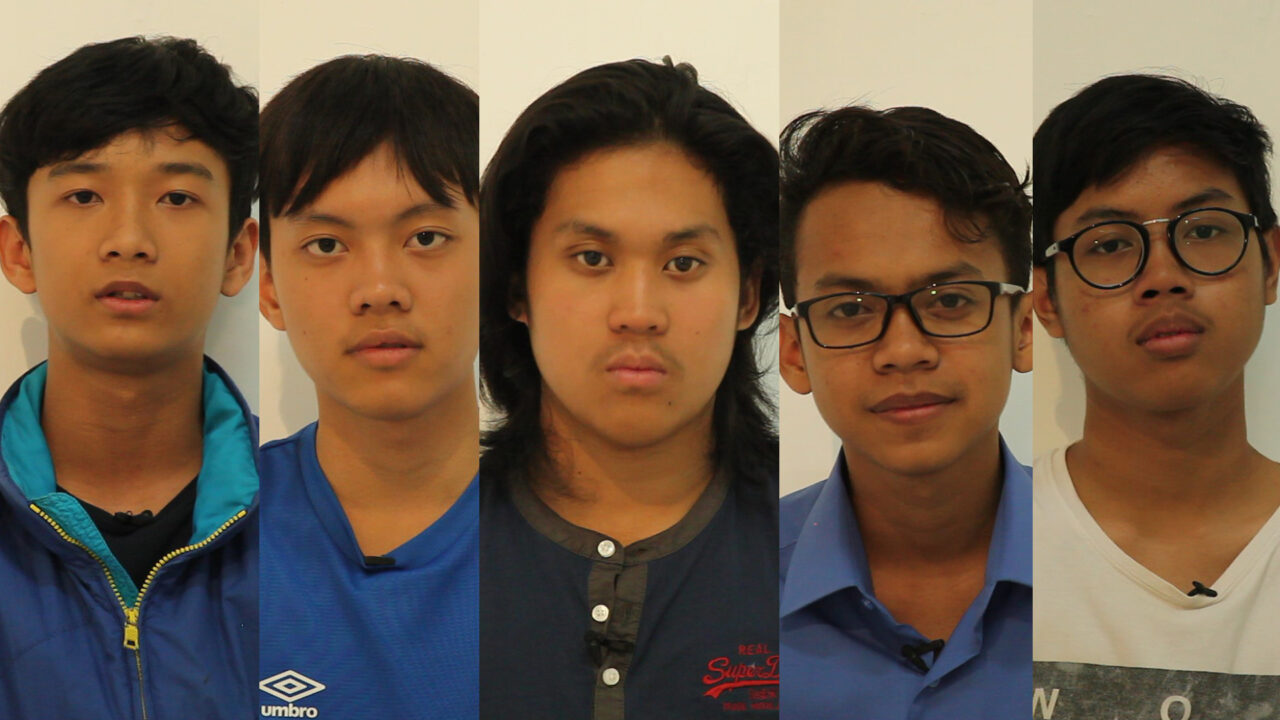
This year, Forum Film Dokumenter launched the SchoolDoc program, featuring documentary production workshops for high school students and their equivalents. This program is an effort to raise awareness about today’s media landscape.
Through this process, five works were produced by five participants. These works were exhibited during the 2019 Festival Film Dokumenter. The installations of these works were presented alongside footage of the production process and the stories behind their creation, forming a cohesive documentary narrative. We interviewed four SchoolDoc participants: Alhanz Sofyan David Alvarobin (SMKN 2 Sewon), Nickho Darmawan (SMA Kolese De Britto), Gyanrahma Indrajid Sofwan (SMA Kolese de Britto), and Thera Karunia (SMA Kolese de Britto). Here’s a summary:
In your opinion, what is film?
Alhanz Sofyan (AS): To me, film is a medium through which I can convey what I want to share with others in an audiovisual way. Because I prefer to express myself through other media rather than through my own voice.
Nickho Darmawan (ND): In my opinion, a film is a living or moving image. Or it can be described as a series of moving images.
Gyanrahma Indrajid (GI): A film is a medium of communication through audiovisual means. And from there, there are many different film styles.
Thera Karunia (TK): It’s like a photo, but it moves. It tells a story.
What made you decide to join SchoolDoc?
AS: At first, I didn’t really know what SchoolDoc was. It turns out SchoolDoc is a documentary program for students, and I found that really interesting because I didn’t know much about documentary films. Thanks to this, I’ve come to realize that the world of documentaries is vast.
GI: I wanted to develop my creative skills. So, I joined the film club. It just so happened that Mas Gogik (Her Raditya Mahendra Putra) from FFD—who’s also an alumnus of De Britto—suggested to my friends that we sign up for the SchoolDoc program. Well, I happened to be selected. There, I tried to develop my creative skills to work on films. Film isn’t just about creativity—it’s also about actually making it happen. Even if the final product isn’t guaranteed to turn out well, at least I gain valuable learning experiences along the way.
At school, some of you have already been part of a film club, which means you’ve participated in film production workshops before. Compared to those workshops, how is SchoolDoc different? What new experiences or knowledge did you gain from SchoolDoc?
AS: I used to look for ways to express what I wanted to convey, but not through myself. Then, after joining the cinematography club, I realized that film can actually be a medium for self-expression and for sharing that with others. What I found particularly interesting about SchoolDoc was the presence of mentors from abroad, Mr. Jean (Jean Paul Labro) and Miss Lyn (Lyn Nékorimaté). They were incredibly helpful in enabling me, as a complete beginner, to present the film I made. Even though my English isn’t very good, they were able to understand what I was trying to convey.
TK: I was able to learn about camera and sound setup. Because when I made films with friends, I wasn’t taught those things—my friends handled them. The thing is, when making films like that, it’s usually pretty hard to find people who are really committed. But in an extracurricular club, you can decide on the film and then make it together.
What do you guys think a documentary is like?
ND: I first learned about documentaries when I watched Animal Planet. There was this documentary about tarantulas—I’m still scared of them to this day. It was really interesting. It covered everything about them. The spider was just an image, and there was a narrator in the background. In my opinion, that’s a documentary. It tells a story based on the context of what we want to create. There has to be a narration, and the visuals have to be distinct. And what sets it apart is that it’s not just about documenting animals—it turns out humans are documented too.
GI: Actually, ever since I was little, I’ve had this tradition with my parents of watching movies every weekend. And honestly, you could say I’m a casual movie viewer—not someone who goes for alternative genres, like documentaries. I haven’t watched them very often, or even really dabbled in documentaries at all. My daily viewing consists of mainstream films. To be honest, when I joined SchoolDoc, I didn’t really have a clear picture of what documentaries were. I just thought they were basically just documentation. After participating in SchoolDoc, for me, a documentary is like taking an episode or a slice of real life and telling it to us, the audience. But it’s presented raw, without any “sugarcoating.”
During SchoolDoc, what challenges or difficulties did you face?
AS: In my opinion, the biggest challenge for me was the tight timeline. The timeframe for pre-production and production was extremely tight. That’s when I started thinking: how do I create a story that doesn’t require a large crew, yet still documents something very effectively? So it felt more complex. The timeframe was a week, if I’m not mistaken. At the time, I was still in school, but I was granted a five-day leave. One day for pre-production—including scriptwriting, storyboarding, and so on. Then I spent three hours working on my film.
GI: I don’t work alone, you know. Interactions with coworkers and friends need to be managed—especially when you’re tired. For example, when we had a packed shooting schedule, there was one friend who just kept joking around. So I instinctively said, “Hey, we’re working here—can you take this seriously, no?”
What are your hopes for SchoolDoc moving forward?
ND: I hope the participants produce even better work. So, I want next year’s participants to have boundless creativity. Create not just on the canvas, but use your minds to create. Even if it’s not on the canvas, make it appear on the canvas. Improvisation is a must, because it’s precisely improvisation that brings the film to life. And use elements such as the “element of surprise.” Hopefully the event will be bigger. I’d like it to be more lively. Not just the five of us, but as many people as possible. Because when I joined SchoolDoc, I really wanted to learn what it’s like to be on staff. Five people just isn’t enough. Maybe seven or eight.
GI: I only have one hope. To continue developing and raising the standards they’ve set, because those standards are already quite high. And through SchoolDoc, we can introduce ordinary people to documentaries. Because documentaries aren’t exactly mainstream. So maybe at SchoolDoc, there could be some basic introduction to documentaries. Because when I joined SchoolDoc, I didn’t really understand the boundaries and definitions of documentaries. So that could change the direction of their work.


