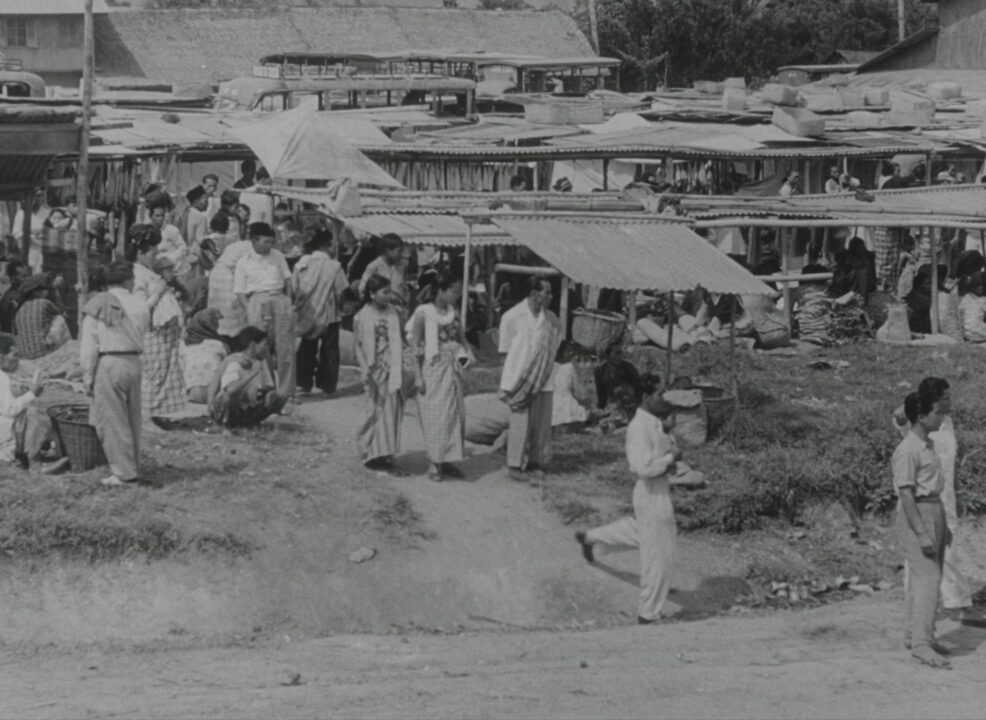
Turang (1957), a film by Bachtiar Siagian (1923–2002), was rediscovered around 2023. Following extensive searches and even reenactments inviting audiences to imagine the lost film archives of Indonesian filmmakers, the rediscovery of Turang (1957) is not only a revelation but also an encounter, particularly with director Bachtiar Siagian, as a part of Indonesian cinema’s historical heritage and diversity.
In the past, Bachtiar Siagian experienced discrimination and became a political prisoner, which resulted in many of the works of this left-wing director being lost and immediately erased from the history of Indonesian cinema. However, at the time, Turang held an important place in the history of Indonesian cinema. Its premiere was even held at Istana Negara (lit. State Palace) in Jakarta. The film also won an award at Pekan Apresiasi Film Nasional (lit. National Film Appreciation Week), which would later become the Festival Film Indonesia (FFI) in 1960.
Turang was found in the Taschen film archive in Uzbekistan when it was screened at the first Afro-Asian Film Festival (AAFF) held in the former Soviet Union in 1958 as a cultural agenda continuing the fervor of decolonization at the Asian-African Conference in Bandung, Indonesia, in 1955. When it was screened in Taschen, Turang became a popular film. “The audience at the Iskra Theater, which was packed to the brim, stared at the screen with bated breath,” said poet and translator Mikhail Kurgantsev, “…where a ray of sunlight slowly crossed the motionless faces of Rusli and Tipi. The sun rose over the blood-soaked land of Indonesia. A haunting and heart-wrenching song began, then faded into the distance,” (Elena Razlogova, 2021:117).
Turang’s discovery is not a repatriation of historical objects, but a kind of “homecoming” and reunion. The spirit of Turang, which embodies civic spirit, both as a player and as a character, is also Turang’s “homecoming” initiated by Indonesian cinema enthusiasts.
The film’s location, shot in Seberaya and Kabanjahe, Karo, North Sumatra, is a “real” backdrop depicting the struggle for independence that took place across Indonesia. The role of the villagers, both as actors and narrators, illustrates that it was not only the military but also people from all corners of the archipelago who fought for Indonesia’s independence.
The landscape markers in Turang, which takes place in the villages of Tanah Karo, show the diversity of local landscapes in Indonesian cinema at that time. This diversity is important considering that at that time, Java was still the central focus of Indonesian cinema, as seen in the film Anak Perawan di Sarang Penyamun (Usmar Ismail, 1962), which depicts a story set in the forests between Lahat and Pasemah, Palembang, but was actually filmed in forests in Java. The landscape in Turang is certainly not just a space, but also how it is brought to life by the actors, who are also the locals. Several long takes in Turang seem to celebrate Indonesianness, which is also consistent in other scenes, such as the scene where Rusli is shot, filled with traditional rituals from Tana Karo as part of how the landscape in cinema is brought to life by the residents who play in it.
“Pil Kina Bandung,” is how Bachtiar Siagian responds to the discourse on political ideologies and global cinema that is unique to Indonesia. Pil Kina is a metaphor for bitter medicine, while Bandung is a beautiful landscape and romantic narrative, representing Bachtiar Siagian’s decolonial practice in cinema. Turang is about the struggle of the Karo people to defend Indonesia’s independence, which was full of pain and sorrow, but it is packaged in beautiful natural landscapes and romanticism.
In its production context, Turang cannot be separated from the dominance of Hollywood melodramas at the time and the spirit of socialism against colonial domination. The discovery of Turang seems to uphold the right to life, especially the right to film archives, as part of Indonesian identity itself. In Walter Benjamin’s dialectical image, it does not mean that the past illuminates the present, or that the present illuminates the past; rather, the image is a place where what has happened meets the present in an instant to form a constellation. Through the image, the relationship between the two is a temporal one. Turang’s homecoming is not archaic, but forms a fresh constellation of how the role of “people” in its spatiality decolonizes the history of cinema and temporal Indonesianness.