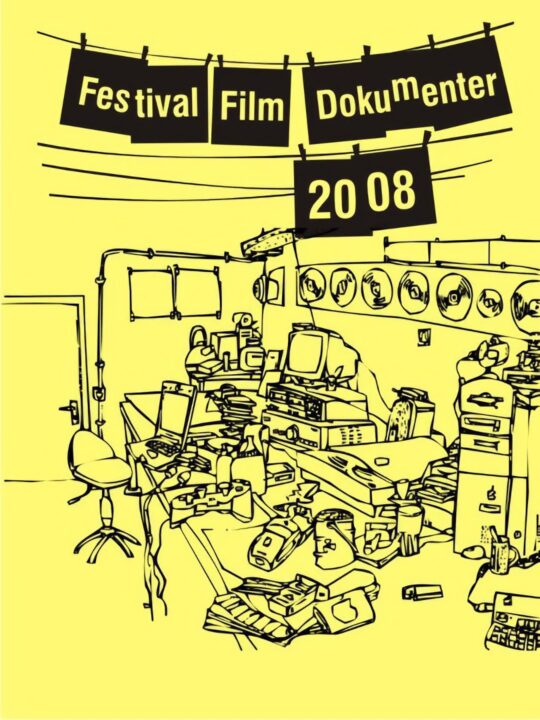
Ordinary people, those who live life unusually. The 7th Festival Film Dokumenter (FFD) 2008 looked at the world from this perspective. Like the big themes that are a common thread throughout this FFD, namely life, environment and culture, this year’s perspective also starts from efforts to explore, examine and explain the realities around us. Ordinary people, like anything else ordinary, often go unnoticed, are not taken into account, and are mostly forgotten. Who are they? Why are they ignored?
Ordinary people, common people, ordinary people. They are mostly mentioned for interests outside their own. Especially nowadays, before the general election. Elite groups who call themselves representatives of the people and leaders of the nation come and claim to be protectors, spread charm, compete to make promises. After that, everything is finished. And ordinary people return to being those who escape anyone’s attention. Also us.
These ordinary people are the real legitimate owners of life. They live real life as they are. And, really, there are many extraordinary things we can learn from their lives. There are many realities of ordinary people’s lives that are truly extraordinary, when we really pay attention to them. Those who live with incomes far below the minimum standard, babies who do not receive adequate nutritional intake, people who laugh at the floods that come every year, people who have been repeatedly evicted from one place to another. Who are those who are so brave through this unusual world?
Also, those who stubbornly organize the environment, those who live by traditional arts, those who continue to serve their lives without having to invite journalists, do not expect positions and badges of appreciation. They are independent soldiers who never receive donations, village children who have to walk kilometers to study in dilapidated schools, young people who work for others. How many ordinary people have extraordinary lives. From them we learn to live life as it is…
*automatically translated via Google Translate with minor edits.
What goes through the minds of American soldiers when they are deployed to Afghanistan and Iraq? They are ordinary people—teenagers, essentially—who happen to be soldiers in uniform, sent off to war. They are certainly not Supermen or the DC Comics-style superheroes currently filling our movie theaters. In his film Operation Homecoming: Writing the Wartime Experience, Richard Robbins reveals these remarkably ordinary individuals—people thrust into an extraordinary existence, where facing grenades, snipers, and gunfire is anything but “normal.” Serving as this year’s opening film, Operation Homecoming offers a look at war as it truly is. Robbins brings the visceral experience of the Iraq War to our doorstep through the eyes of soldiers who—unexpectedly—become something akin to Hemingway, penning poetic, deeply contemplative words, brought to life here by the voices of Robert Duvall and Josh Lucas.
Similarly, in Israel, young women not yet twenty years old undergo mandatory military service; they find themselves bearing arms and coming face-to-face with Palestinians in Gaza and the West Bank—the very epicenters of the ongoing conflict.
Why is religious life so often caught in the tension between terrorism, fundamentalism, and sectarianism? In an increasingly complex world—shaped by global culture and the accelerating pace of economic and social migration—the issue of cultural diversity demands our collective attention.
The 2008 FFD (Festival Film Dokumenter) perspective seeks to explore the vast spectrum of human experience, examining these issues to bring them into the public consciousness. This year’s theme focuses on: “Ordinary People, Extraordinary Life”.
The films in this program tell the stories of ordinary people living extraordinary lives. Stories about humanity and war, sanity and madness, the struggles of love, street life and punk culture, America and China, an Iraqi girl in a Canadian family, the global landscape, the Dalai Lama longing for his homeland, and young women guarding the Palestinian borders.
From Southeast Asia, The Convert follows a Thai woman’s transformation into a devout Muslim. We also follow Harman Hussein on his five-month overland journey from Singapore to the holy city of Mecca; witness Marlon’s persistent drive to stay in school; explore the legends of pirates haunting the waters between Indonesia and Malaysia; and learn about the long-standing efforts of the Center for Policy Reform in Media (CPRM) to survive under the immense pressure of media giants. From China, Lian Pek shares amusing tales—such as thousands of Chinese people gathering in a vast public square to learn English in preparation for the Olympics.
In the “Spectrum” section, the FFD once again presents a vibrant array of global documentaries. Kazuhiro Soda—whose feature-length documentary debut premiered at the Berlinale last year—returns with his latest film, MENTAL, which won the Best Documentary award at the Pusan International Film Festival (PIFF) last October. Maintaining his signature “direct cinema” style, Soda offers an intimate look at the lives of individuals with mental health conditions in Japan. Andrea Kreuzhage documents the experiences of those who participated in the “1000 Journals” project—a massive, collaborative endeavor that ran from 2003 to 2008, involving thousands of people and yielding unexpected results. From Scotland, children share their perspectives on the world in the animated documentary The World According to…, alongside short films that explore the meaning of “home” through simple, poignant narratives. Other works delve into the sexual lives of people in Russia, London, and Brussels following the collapse of the Soviet Union. Meanwhile, in the Congo, a community radio station upholds the principles of journalism while operating amidst constant danger. Still in Africa, Peace Mission explores Nigeria’s film industry—Nollywood—which ranks third globally, behind only the United States and India, yet remains largely under the world’s radar.
Indeed, being a Superman is no easy feat. The individuals captured in this film are ordinary people who—whether by choice or circumstance—embrace the lives they lead with their whole hearts. Lives that are, in themselves, extraordinary.
In the competition, young Indonesian directors summarized simple stories about humans. Humans who become wolves on plantations which become a conflict with local communities, the battle of ideologies and beliefs in reog art in Jogjakarta, the choice to give life or take life, stories of women who migrate to foreign countries, about crazy people, tsunamis, oil and education, and surviving life within limitations. There is also the story of Jaranan in Ponorogo, the travelogue of Djaduk Ferianto, the unlucky Bu Wagiyem and three conductors who have mass groups with very different songs. Apart from that, there are still students who summarize issues of sexuality, Islamic boarding school students, domestic violence and others in competition programs for students.
These are the stories, among the millions of world stories throughout this year that have been collected in the FFD program. Enjoy.
*automatically translated via Google Translate with minor edits