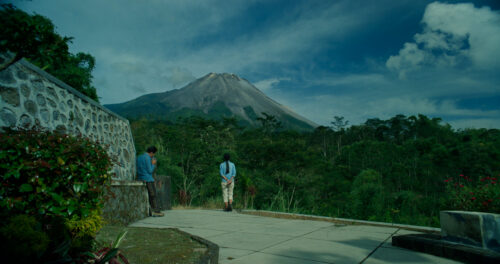
What happens when indigenous people have to live with extractive and massive industrial practices? How do these circumstances and narratives appear in the media and documentaries? What do we imagine when we talk about the aesthetics of resistance, especially the way it’s portrayed in documentaries? Are there specific ways to talk and frame resistance in documentaries? This series of questions are summarized in DOC Talk entitled “Deduction and Didactics”, and discussed through the short documentary film directed by Wulan Putri entitled Mama Lihat Awan Jatuh (2023).
This discussion takes place on Monday, December 4th 2023 at Cemeti-Institute for Art and Society. Wulan Putri (Director of Mama Lihat Awan Jatuh), Asep Komarudin (Senior Forest Campaigner Greenpeace), and Fahri Salam (Chief Editor Project Multatuli) were seen leading the discussion along with Suluh Pamuji (KDM Cinema) who were guiding the discussion.

Forests in Papua are home to heaps of flora and fauna in Indonesia. With the rapid deforestation of Papua’s forest, both Indonesia’s natural resources and Papuan indigenous community whose livelihoods depend on the forest are endangered. This fuels the fire in the Awyu people to resist corporate greed, even if it means going into trial.
Aside from being home to many flora and fauna species, Papua’s forests are also a source of income for the indigenous people who live there. If the forests are destroyed and gone, not only will it threaten the ecosystem, it’ll also threaten the livelihood of the Papuan indigenous community. The entire lives of the Awyu people have always been with and under the shades of the indigenous forest. However, they have been under threat ever since the palm oil companies were cleared by the Papua provincial government to take control of their indigenous forest. As the owners of the indigenous territories, the Awyu people were not informed of what the companies were doing. It got worse when the lawsuit they filed to legally defend their territories was rejected by the Jayapura State Administrative Court.
Asep Komarudin stated that Mama Lihat Awan Jatuh (2023) is a campaign on ownership issues of the indigenous forest that rightfully belonged to the Awyu people. Film is an effective media campaign to raise awareness to a wide range of communities. Film can be the voice for those who are silenced. Film can be the means to justice. Mama Lihat Awan Jatuh (2023) is a documentary in the format of a trilogy. There were things to consider surrounding the artistic choices of this documentary. Fahri Salam thought that the approach and execution needed for this documentary took some time. “We are constantly learning. We knew there were risks to take.”

“Everyone knows that Indonesia has great forests in Papua. But they have no clue on what is actually going on. The companies were given the rights to the forests and that is what we are trying to tell the public,” Asep revealed.
“I found a note that the Papuan people are concerned about the palm oil companies infiltrating. What is currently happening to the Awyu people isn’t exactly recent. This film serves as a collective memory of the Awyu women that were heard from different notes. Their collective memories when facing the company’s expansion and how they had to witness their forests slowly becoming palm oil plantations.” Wulan Putri said.
Documentary films remain as one of the most effective alternatives to watch and respond to various issues. They are also considered qualified to be an effective representative medium in campaigning and other subversive works. Other discussions in DOC Talk are still available. They will be held offline and free of charge. Find related information via Festival Film Dokumenter 2023 website.
Covered by Hesty N. Tyas on December 4, 2023.