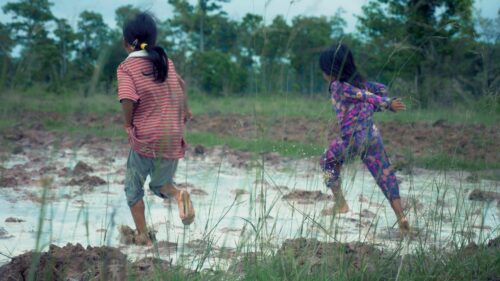
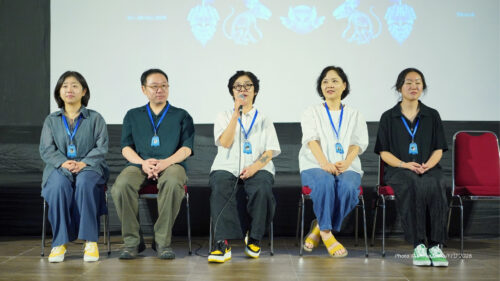
On 24 November 2025, the screening of Short Competition was held at Kedai Kebun Forum, Yogyakarta. This year, the Short Competition featured twelve films ranges from various countries and took on diverse themes. The twelve films featured are screened on different compilations. This evening, the screening of of the The Mother and the Bear (Yasmina El Kamaly, 2024), MIREN FELDER (Malen Otaño, 2024), Babylonia (Duda Gambogi, 2024), and Main Home (Cristian Hidalgo, 2024) took place followed by a Q&A session moderated by Valencia Winata. Director Cristian Hidalgo attended in person, receiving warm enthusiasm from the audience.
Main Home (original title La Casa Grande) tells the story of a house in a small Colombian village that became the epicentre of violent conflict in 2001. What was once the setting of a family’s everyday life turned into a place of abandonment and trauma. Through visual exercises of remembering and acknowledging oblivion, the film proposes rebuilding the house in order to live in it again.
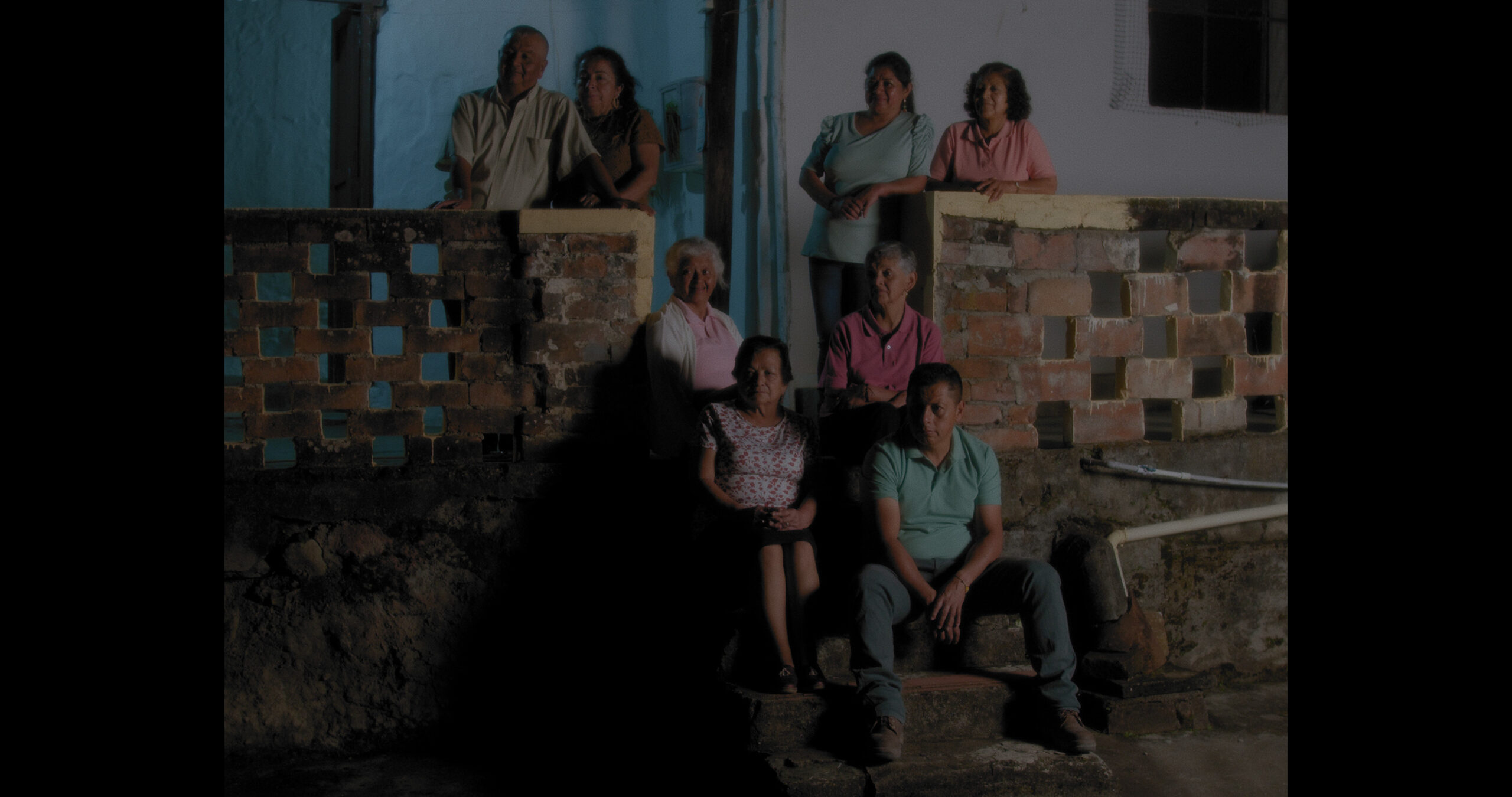
Valencia opened the discussion by asking about the synthesis of literary references within the film–-Álvaro Cepeda Samudio’s La Casa Grande (1962) and Gaston Bachelard’s Psychoanalysis of Fire (1938). Cristian explained that writing has long been central to his creative process and that literature shaped the foundations of the film’s development. He shared that his family referred to their house as la casa grande (lit. the big house). This led him to read Samudio’s novel and discover resonances between the book’s narrative and his own family history.
Cristian elaborated on how the film transforms literary rhythms and imagery into cinematic language, recalling his memories connected to fire and the machinery used to dry coffee in his childhood. He described the process as a connection between writing, memory, and visual construction, “The writing process is transversal to all the creative process,” tying the books’ conceptual frameworks to his personal experience.

Valencia then invited Cristian to discuss the film’s form and its dream-like qualities. Through an experimental documentary approach, he explained how the film plays with consciousness and subconsciousness by presenting space and objects as active agents. Cristian described the house itself as “a body… another character in the movie”, with objects acting as vivid presences rather than background elements. The film’s close-ups intentionally disrupt geographic orientation, allowing audiences to imagine space with a free attitude.
The audience had the opportunity to ask questions, including how Cristian’s family responded to seeing themselves in the film. He shared that the process became an intimate collaboration, revealing deeper relationships, “It was more a human experience as a family… we discovered new things from everyone”. He reflected on how his family transitioned into performing roles with comfort and confidence through an immersive two-month process. The session is concluded by a note of the transformation of non-professional family members into performers, which contributed a distinct texture to the film’s images. Cristian revealed that the film was created over five years, with the most challenging aspect being the discovery of its form, followed by three years of securing production support.

The Q&A concluded with gratitude from the filmmaker and appreciation from the audience. The film, alongside other Short Competition films, are still available to be enjoyed on Festival Film Dokumenter 2025 until 28 November 2025. (Vanis, 24/11/2025)