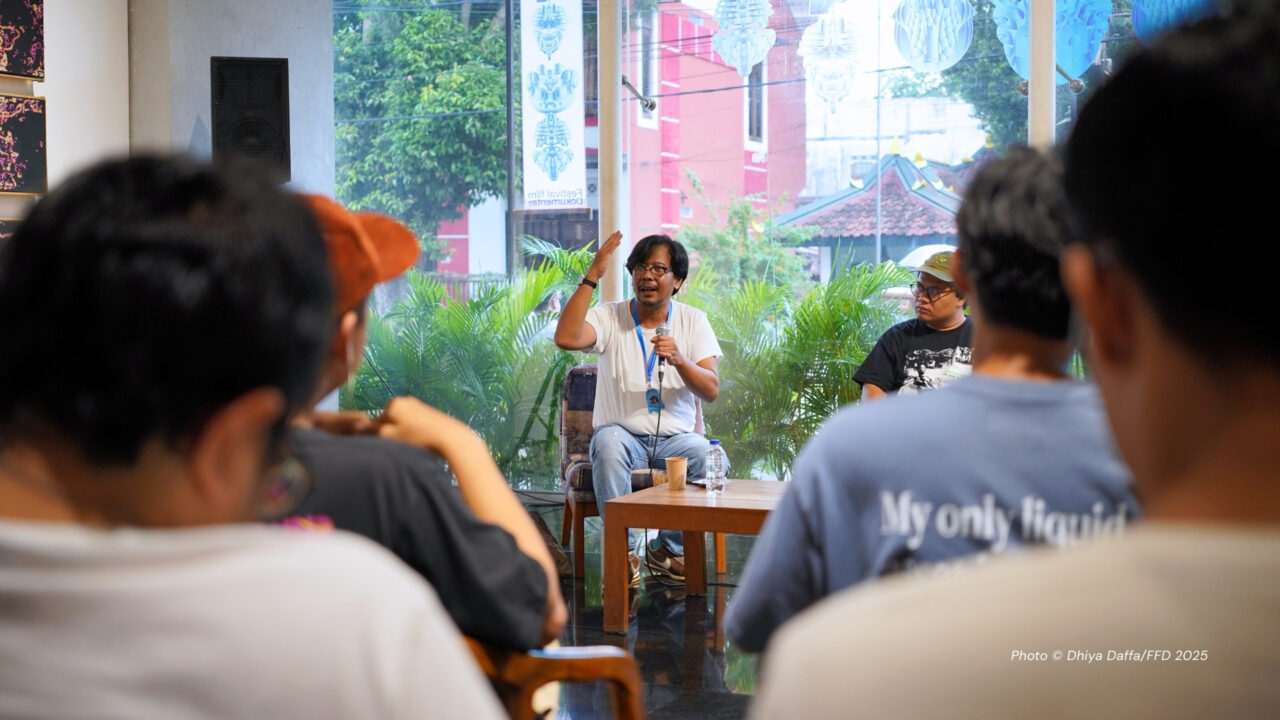
DOC Talk’s session, “Foto: Ruang-Waktu Sinema” (lit. Photo: Cinema Space-Time), held at Langgeng Art Foundation (23/11), opened a discussion on the shifting boundaries between photography and cinema. Rather than look at the two as separate mediums, this discussion invited the audience to see how photos can work as bridges, markers of pauses, and liminal spaces in the construction of cinema. The discussion was moderated by Wimo A. Bayang with two speakers, namely: Akiq AW and Riar Rizaldi—two artists whose practices not only intersect with photography and moving images, but also challenge the definitions of both.
Akiq began the conversation with the background of the establishment of the Jogja Fotografis Festival (JOFFIS) (lit. Jogja Photographic Festival [JOFFIS]). The drive behind this initiative was an awareness of the gap between the progression of cinema and photography in Yogyakarta. While he considered film to already have a platform—a regular program to mature its ecosystem—Akiq assessed photography as stagnant, lacking a sustainable space for appreciation and regeneration.
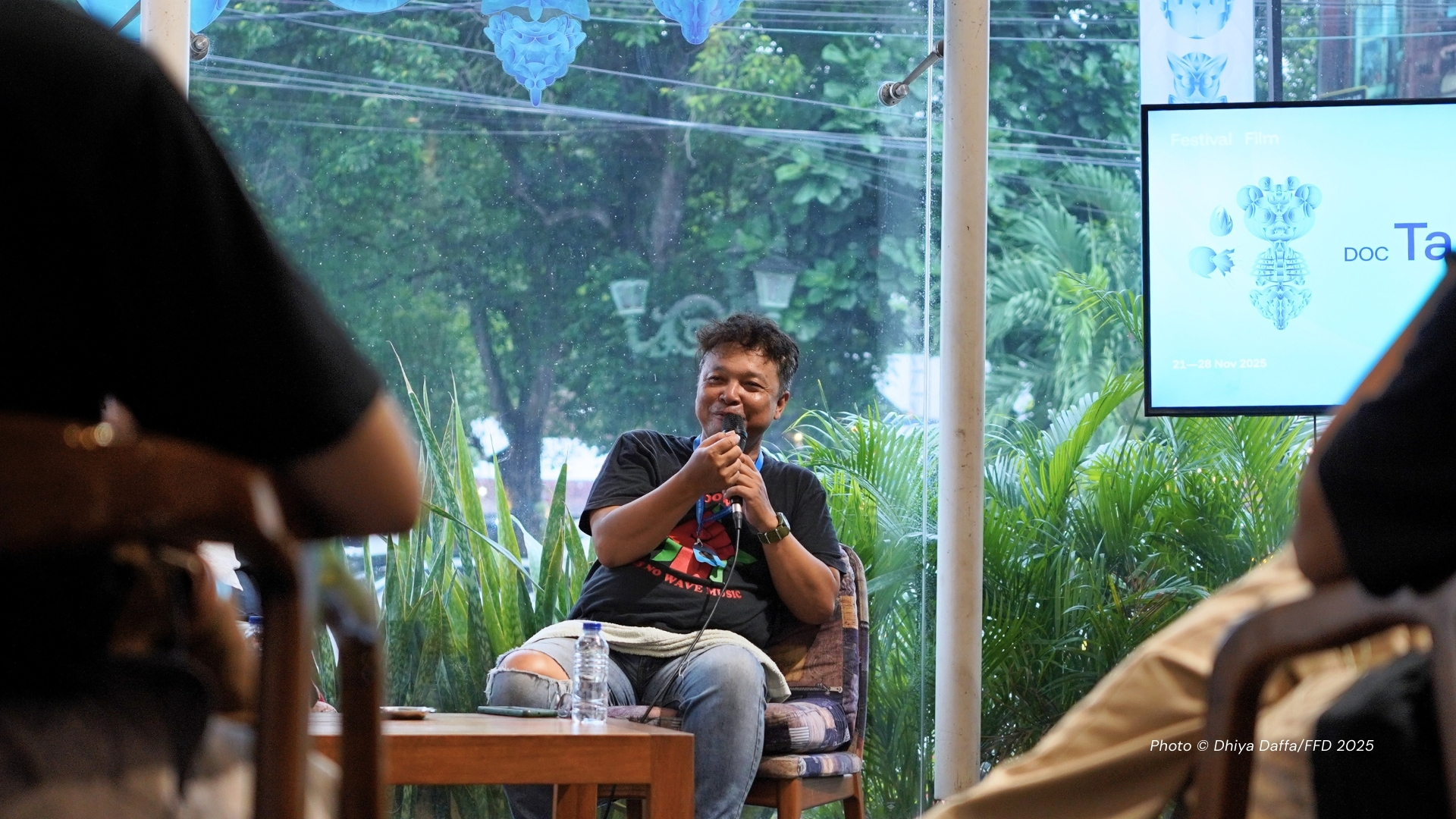
The term “photographic” rather than photography in the festival’s name was chosen because Akiq considered it more flexible and able to accommodate a spectrum of photographic practices that are not limited to shooting and printing images. Photography, in the understanding of Akiq and his colleagues, is also a way of seeing, offering a diversity of perspectives, and re-presenting liminal realities through visual artistic mediums. Therefore, JOFFIS also attempts to present the broad domain of photography through cross-medium formats, such as installations, films, photography itself, and various other hybrid experiments. For Akiq, an object or visual work becomes interesting precisely when it can be reinterpreted. Thus, a photo is not just an object, but also a space for interpretation.
Furthermore, Riar recounts the background of his interest in photography (in cinema). He grew up not with films shown on the big screen, but with DVDs, so that the frames could be paused and observed more closely. From this, he came to understand that film is not just a series of moving images, but also a collection of still images that have the potential to become objects of art. In his various works, Riar often uses photo archives, texts, and still images. For him, the concept of stillness itself is not “freezing”, but rather another way of reading time. Cinema can be printed, frozen, and then re-viewed as a single unit within a larger landscape of units.
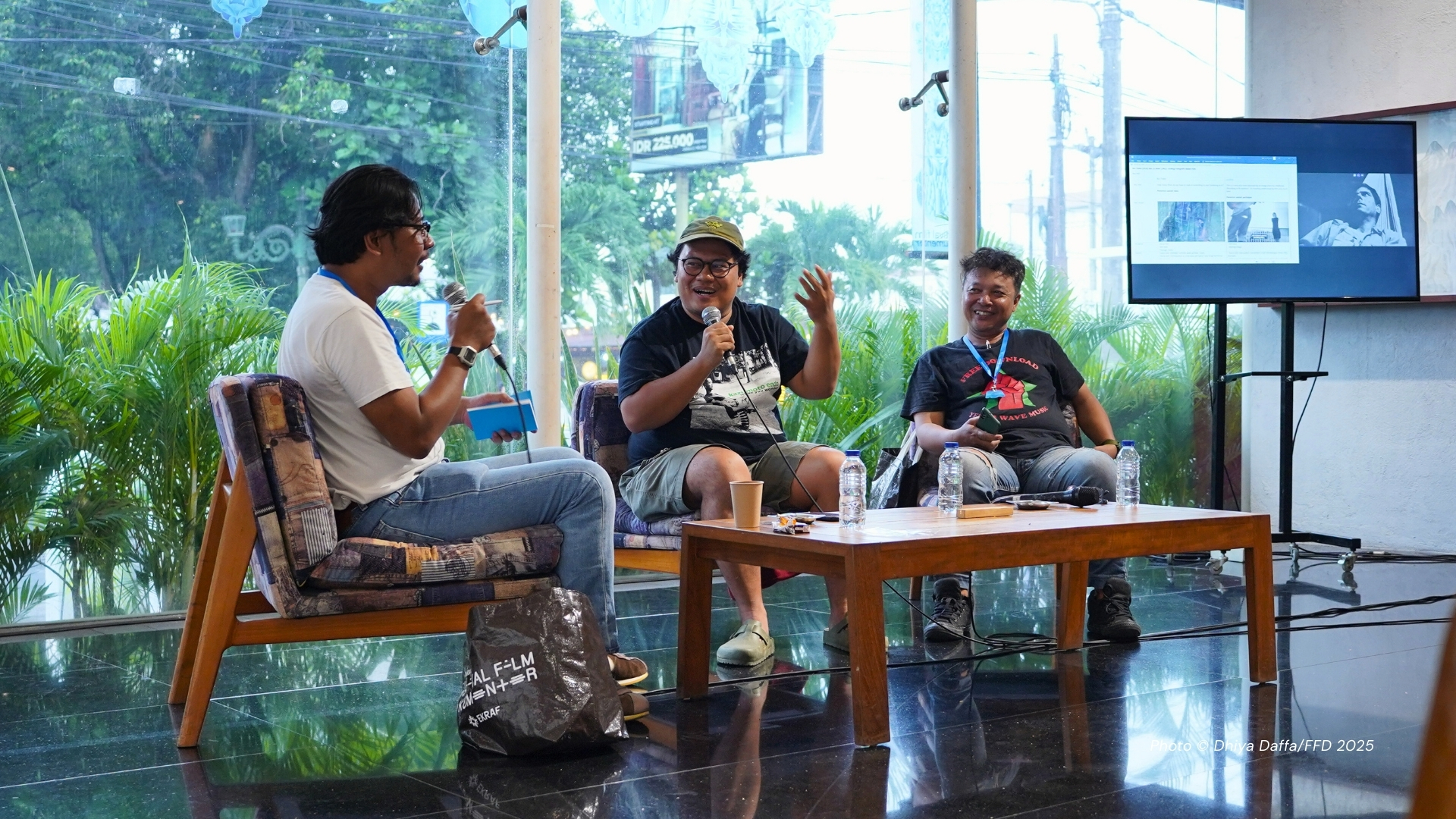
Akiq sees that the use of cinematic language in photography is not merely a technical necessity, but a political decision. When a photographic work is made to be “cinematic” in such a way, there is an awareness and tendency that cinema has shaped our visual imagination. In photography, the frame is not only a boundary, but also an invitation to see what is not visible outside of it. The discussion then touched on the issue of hybridity: are medium boundaries still relevant, especially in documentaries? Both Akiq and Riar agreed that boundaries are not a necessity. In fact, artistic practice flourishes when it is not restricted. On the other hand, it is the work of curators to read and constantly redefine these liminal spaces and limitations.
When the audience asked how cinema can use photography as part of artistic research, both gave layered and complex answers. Akiq explained that photography, as an approach, invites creators to pay attention to the space, context, and social conditions surrounding the act of photographing. Meanwhile, Riar described the process as fieldwork similar to ethnography: recording as much as possible, then reading the relationships between images while constructing a narrative in the editing phase. Most importantly, the image bank must exist first.
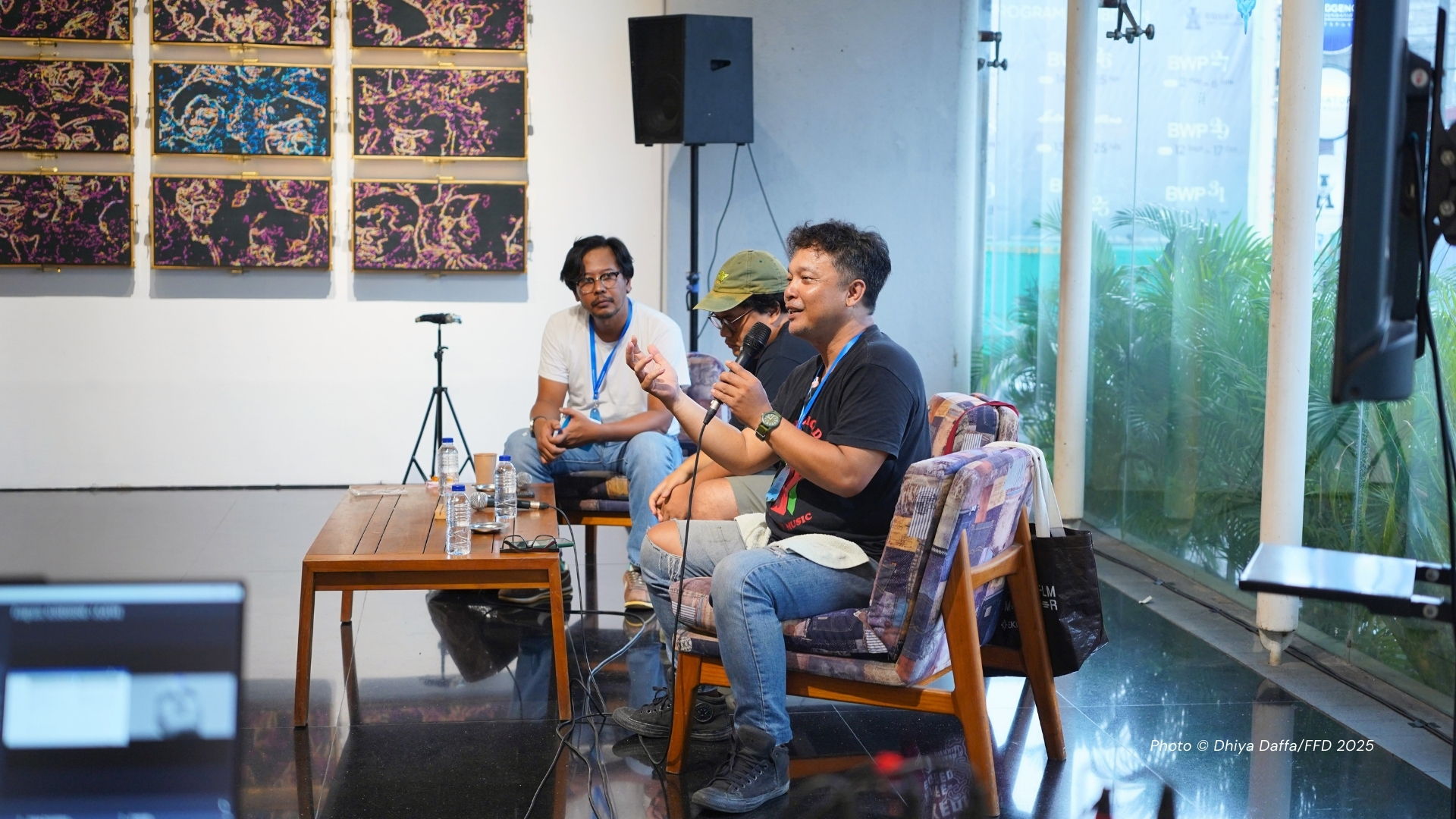
This discussion shows that the relationship between photography and cinema is not a matter of hierarchy or standard definitions, but rather an intersection between ways of seeing, composing time, and constructing visual experiences. Both photography and cinema now move flexibly across medium boundaries, borrowing each other’s logic and opening up new possibilities for today’s documentary practices. In other words, the debate is no longer about which one moves and which one stays still, but rather how both teach us to read the liminality of space and time. (Hesty N. Tyas, 23/11/2025 [Ed/Trans. Vanis])