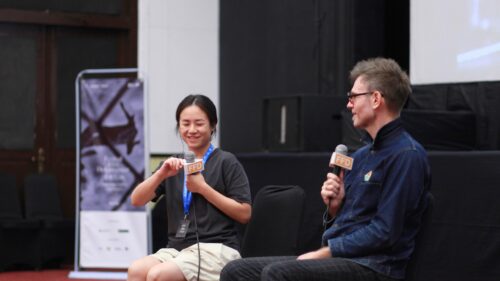
On Monday afternoon, at exactly 13.00 WIB, the seats of Militaire Societeit, Taman Budaya Yogyakarta, were filled with the audience who were ready to watch the first session of film screening (4/11/2024). In this session, Ibnu Nurwanto – The Wood (Eriliando Erick, 2024) was screened as part of the Indonesian Feature-length Competition program. In line with its screening in the first session, the documentary film which narrates Ibnu Nurwanto’s personal and liminal story also made its official public premiere.
The film opens with Ibnu Nurwanto discussing his identity and the hustle and bustle of his life behind his complex love for sculpture and the art of making it. It ends with his liminality towards the Other in the social sphere that makes him create a transcendental relationship with God. After the screening, the audience had the opportunity to take part in a Q&A session with the creators of this documentary. In this session, the director and producer of Ibnu Nurwanto – The Wood (2024), Eriliando Erick, was present alongside Dag Yngvesson as part of the Indonesian Feature-length Competition Selection Committee.
The first response came from Shelo, an audience member, who expressed his amazement at Erick’s closeness to the subjects in the documentary. Erick then explained his creative process in the production of the documentary, which he worked on for approximately 10 months. During this long process, he recounted the research he did and his encounters with the friendly subjects. Like any other documentary research process, he chose to engage in many conversations with his subjects.

For the technical aspects of the production, Erick did much of the recording himself. He acted as both director and cameraman using a camera mounted on a tripod and a wireless microphone. He chose this technical approach to reduce the distance that often makes interviewees uncomfortable in the recording process. Erick’s encounter with Ibnu began with a plan to make a short video for the opening of an exhibition by Ibnu Nurwanto. However, in the course of the production of the work, a desire arose in his mind to make a feature-length documentary. He then developed his research from interviews and media archives.
The depth of Ibnu Nurwanto’s story and emotions, which emanate through his facial expressions and speech, was actually the result of a synthesis of long recordings that Erick assembled and re-stitched. He added that Ibnu is a storyteller, so the full recording of his conversation and story to Erick was up to 3 hours long. However, after processing it together with his editor, the recording was stitched and presented as Ibnu Nurwanto – The Wood (2023).
The behind-the-scenes process of this documentary is not an easy task but rather a discursive and dialectical creative endeavor. Erick made Ibnu the subject and curator of the story and discourse within his documentary. Some recordings were not aired but were included in the credits. However, he ethically sorted and selected which stories were suitable and which were inappropriate to be aired to the public. “Maybe I don’t include the source in the film but I include the source in the credits, then look for other alternatives,” he said.
Perhaps the lively celebrations and exhibitions have always been a mirage in the eyes of art lovers. However, Erick managed to record and tell the story of the artist’s silent path—in this case Ibnu Nurwanto—through his documentary film. That is also what Prima appreciated about Erick’s work. In the Q&A session, Erick also shared personal details that were not covered in his documentary. The choice of jackfruit, teak and mahogany wood as the medium for Ibnu’s sculptures and the choice of his child’s name, Gori. He also told the story of Ibnu’s process of selecting wood, planting trees as potential material, as well as the process of waiting for the wood to dry, which can take years.

In response to Dede’s question about the curation of the footage and his inability to tell the story of Little Girl, even though she is a central figure in the story. Despite her central role in the narrative, Erick explained that he chose not to delve further into her story for ethical reasons, even though he was familiar with her. He then explained that the figure of Little Girl was the one who encouraged Ibnu to continue working and eventually realized the sculpture exhibition that was the background to the making of this documentary.
The creative process of documentary film production always has other stories behind it. Although documentary film is a medium to voice the unheard voices and cut the distance of knowledge. However, the humanist side of not revealing the personal stories of the sources is a choice. As a result, choosing to be liminal in other people’s personal stories is a decision that requires wise consideration.
Covered by Ahmad Radhitya Alam on 4 November 2024 (Ed. Vanis/Trans. Naufal Shabri)