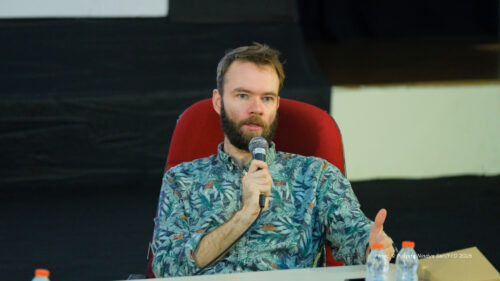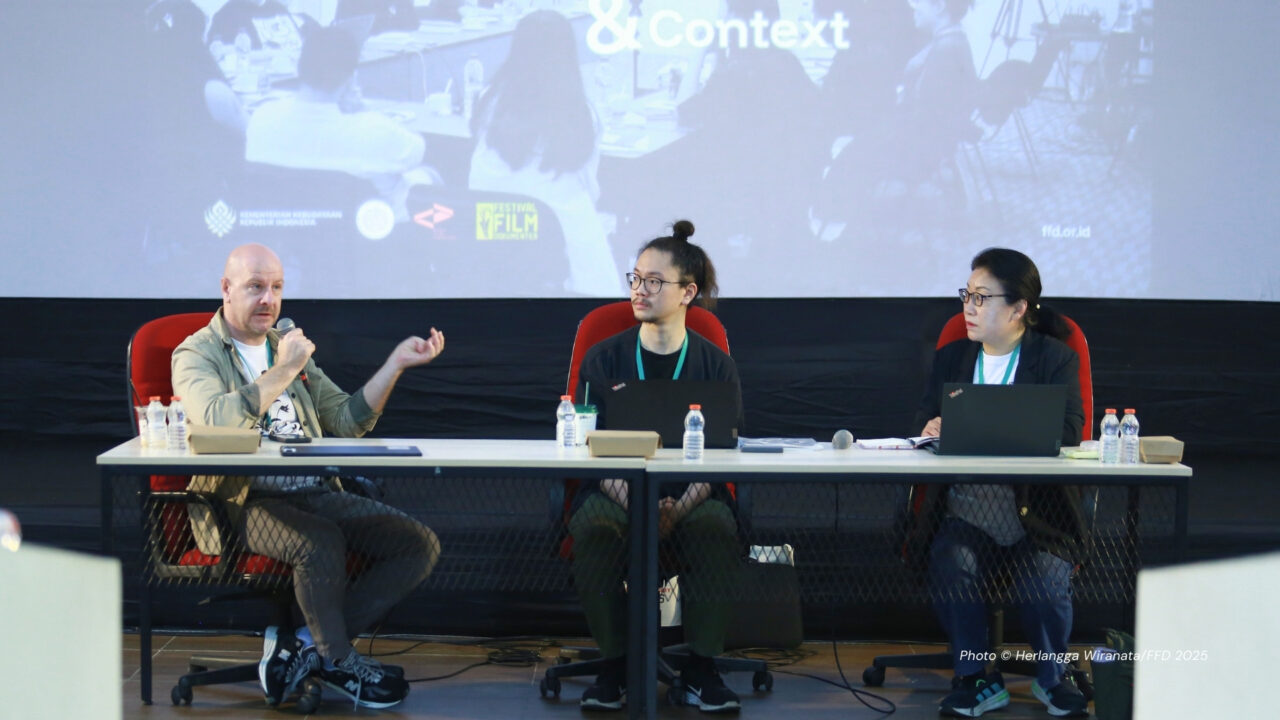
No film festival runs in a vacuum. Such was the atmosphere from the very first minute of the panel discussion Curatorship & Context: Film, Audience, and City Narrative held at Pascasarjana ISI Yogyakarta on November 27. Led by Thomas Barker, this panel featured two important figures in the Asian documentary festival network: Jinna Lee from Ulsan Ulju Mountain Film Festival (UUMFF) and Taichi Ishikawa from Yamagata International Documentary Film Festival (YIDFF). In front of a room full of participants, the two discussed the curatorial strategies of their respective festivals and how they relate to the way people understand the cultural landscape, the environment, and interregional relations.
Thomas opened the panel by stating that this topic cannot be separated from Asia’s geopolitical context. Documentary film festivals are increasingly becoming a fighting ground for ideas, be it about ecology, cultural identity, or representations of a sphere rarely seen in mainstream cinema. The basic question is simple but important: how do festivals build relationships between films and audiences, between regions and the world, between the local and the global, without losing their contextual depth?
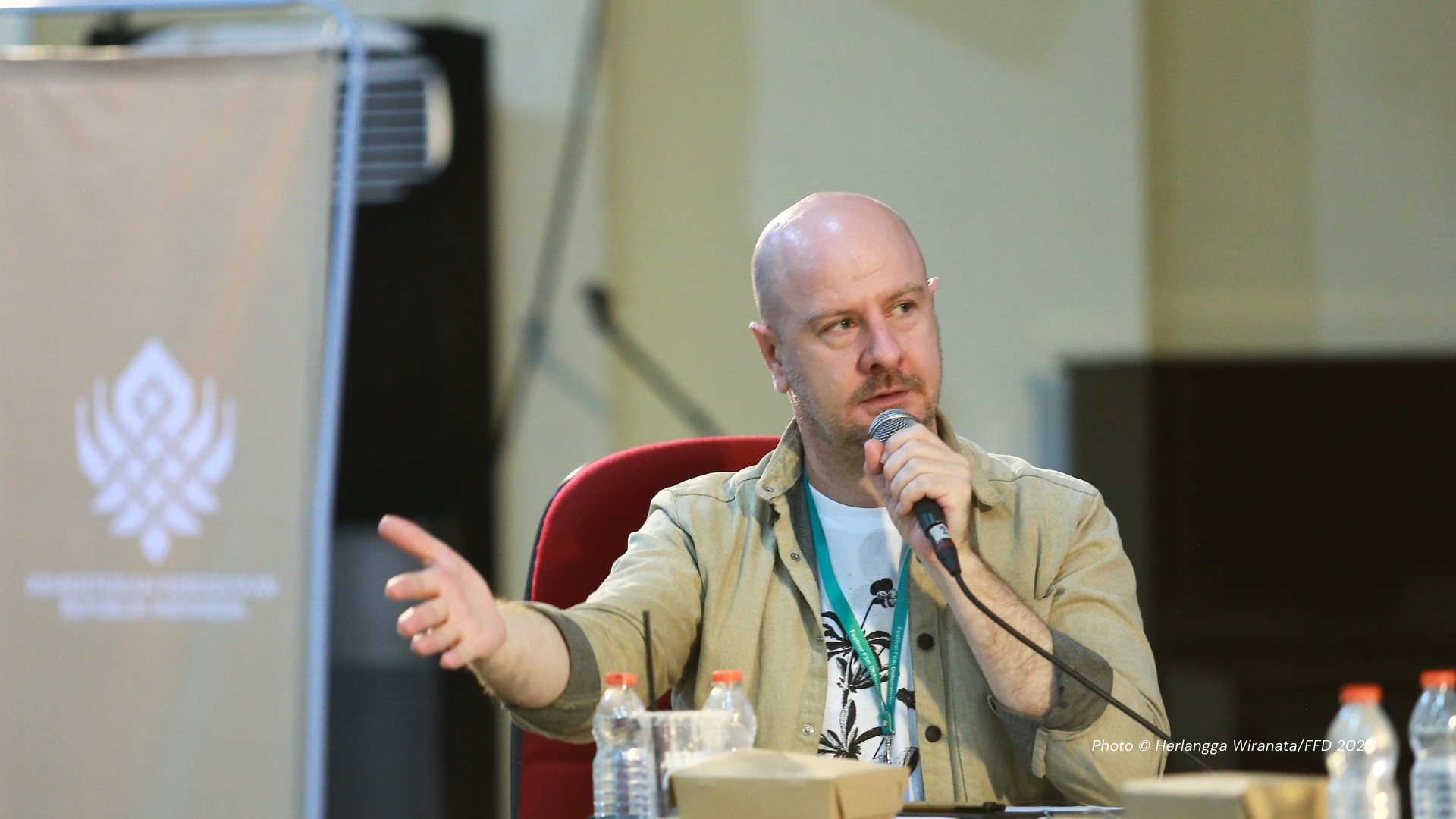
Jinna Lee served as the first speaker, presenting the curatorial perspective of UUMFF, a festival that grew out of the idea of mountains as a landscape of knowledge and life experience. She explained that rather than serving as a visual backdrop, UUMFF positions “mountains” as a relationship between humans and their environment. According to Jinna, the films in the festival were selected not based on dramatized adventures or extreme aesthetics, but rather on how the films pose ecological questions: how humans understand nature, live in it, care for it, or destroy it.
She said that the “mountain films” curated by UUMFF represent relationships. Many films come from communities living in mountainous areas—with cultures, beliefs, and knowledge systems that are often overlooked by mainstream cinema. Thus, UUMFF’s curatorial strategy not only promotes “environmental issues,” but also provides space to reinterpret the body, work, rituals, and continuity of life in fragile natural landscapes. Jinna emphasizes that the festival is a space to rearrange the way we see nature without separating it from the humans who live with it.
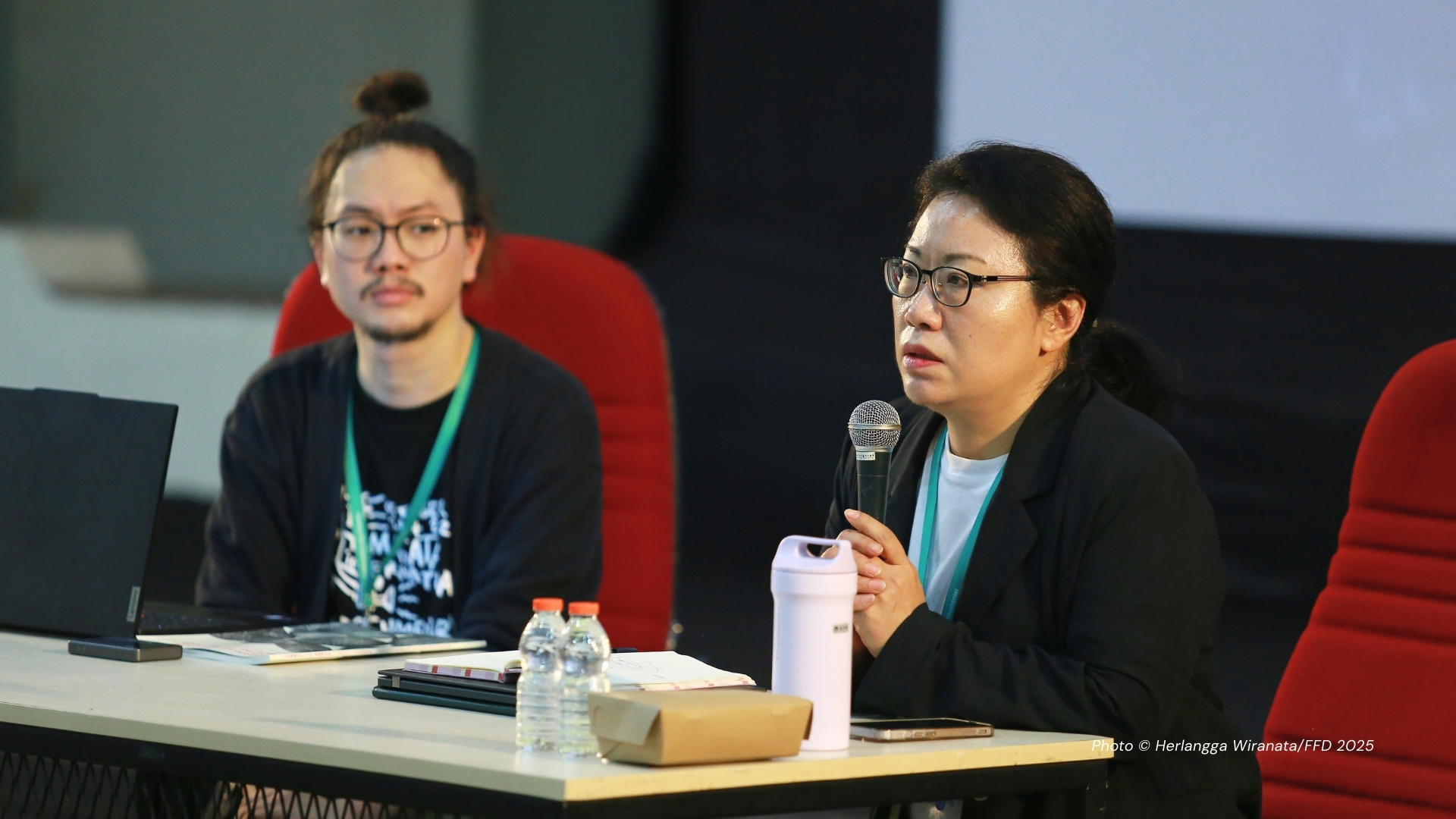
While Jinna spoke about festivals born out of ecological landscapes, Taichi Ishikawa explained that YIDFF has served as a meeting place for Asian documentary film traditions since the late 1980s. YIDFF has developed into a gathering place for filmmaking communities, each bringing their own history. In his perspective, documentary films are not merely aesthetic products, but forms of collective memory. When the festival selects films, they also select the social archives the films convey. Taichi highlighted how YIDFF acts as a listening space. For YIDFF, their curatorial work is a practice to make sure that films are kept grounded in their original context while also having an international resonance. Taichi mentions that the relationship between the festival and filmmakers is long-term. This is because beyond the screenings, films find their life off-screen through encounters, conversations, and collaborations.
Midway through the session, the discussion began to reveal a common ground between the two. Despite coming from different geographical and aesthetic backgrounds, Jinna and Taichi both reject curatorial approaches to abstract reality. Jinna resisted aestheticized nature stories that stripped away the very human aspect, while Taichi rejected international festivals that raised local issues but sterilized their social history. Both believe that festivals must function as ethical spaces. Films should not be treated as commodities of geography or identity. Responsible programming or curation must consider how the film’s community of origin is represented and how the film is introduced to new audiences.
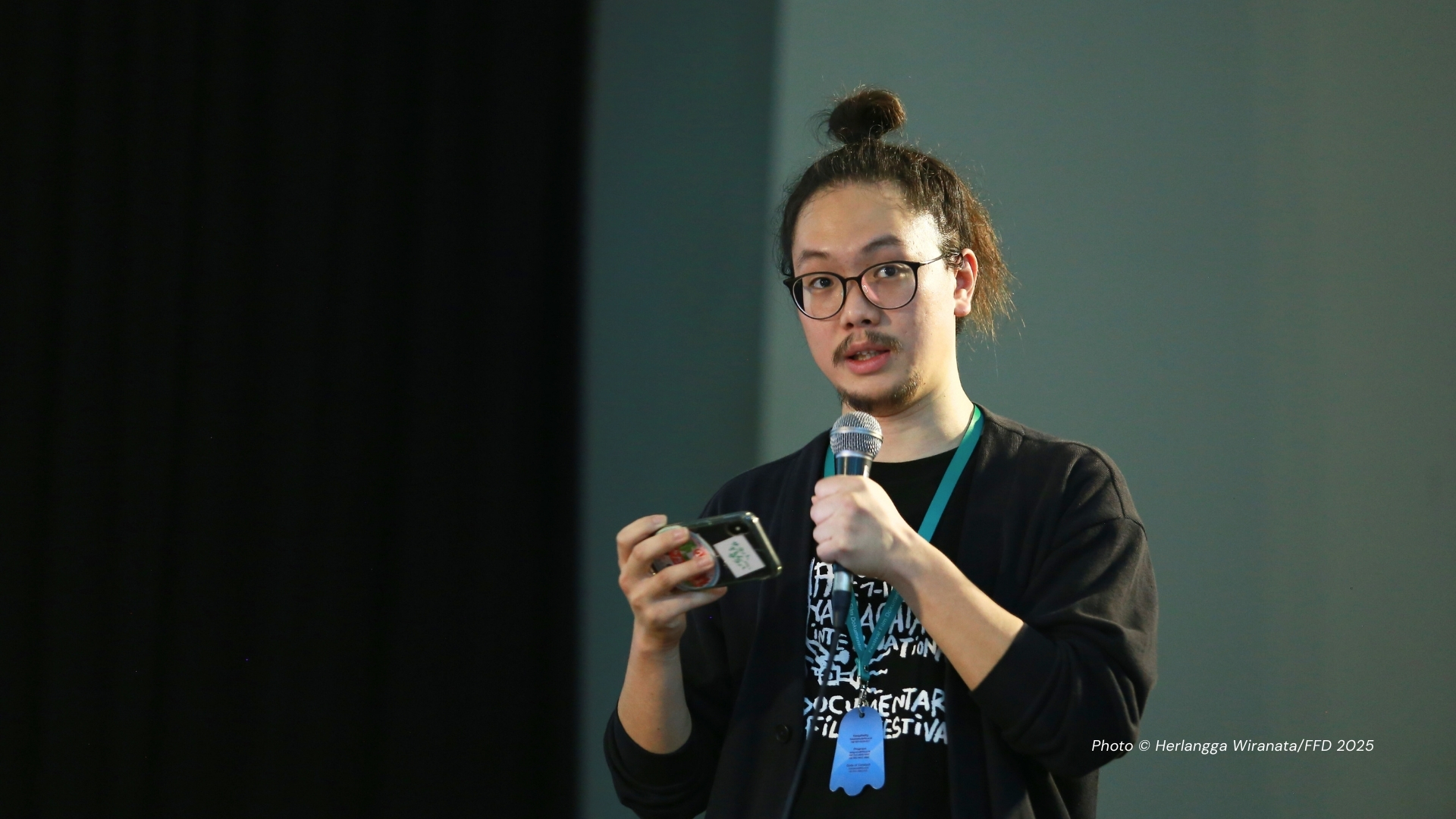
The conversation moved into the area of global networking when a participant asked how Asian festivals collaborate amid the dynamics of funding and international competition. Taichi explained that collaboration between festivals is not a stealth competition, but a mutually empowering endeavor. YIDFF works with festivals in Southeast Asia, Japan, Taiwan, and Korea to ensure that important works from this region are not lost in global distribution algorithms. The network that has been formed is a mechanism of solidarity. Jinna added that mountain festivals such as UUMFF work with environmental networks and community organizations to expand upon the function of the festival. In this context, film plays its role as an educational experience from within the community itself.
In the Q&A session, Thomas brought the conversation into reflective mode. He asked how curators or program managers can maintain a balance between the festival’s program vision and the ever-changing needs of the independent film industry. Taichi replied that festivals should not take over the direction of films; the festival’s duty is not to shape certain cinematic standards, but to provide a space for diversity to thrive. Meanwhile, Jinna argued that festivals must also maintain their empathy. In films about communities or nature, aesthetics should not overshadow the realities of the communities that are the subject of the film. (Vanis, 27/112025)