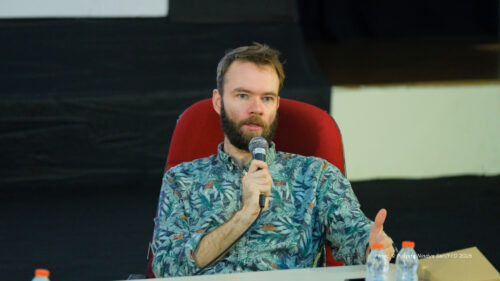
The Curatorship & Context: Strategy of Festival & Networking panel session was held at Pascasarjana ISI Yogyakarta on November 26 as part of panel sessions for Festival Film Dokumenter 2025, supported by the Ministry of Culture of the Republic of Indonesia. This class presented Ondřej Kamenický, Program Director of One World International Film Festival, and Alia Swastika, art curator and Director of Yayasan Biennale Yogyakarta. Moderated by Dinda Intan Pramesti Putri, this session highlighted how curatorship in a festival has evolved from simply selecting artworks to a process of shaping context, networking, and representation.
Dinda Intan opened the session by outlining the intent of the class, which was to unravel how curation works behind the scenes of a festival; that programming decisions have multiple effects: on the film, on its makers, on the audience, and even on the broader cultural ecology. The class attempted to analyze how strategies at the festival level create new directions in international networks.

From his very first sentence, Ondřej emphasized that festival curation is not technical, but political in a structural sense. Referring to his experience at One World International Film Festival (or One World)—one of the world’s largest documentary festivals focusing on human rights issues—he explained that festival programming must be built on the courage to give space to voices that may not find a place on mainstream platforms. According to him, the festival, rather than being a film aggregator, becomes an access mediator that determines who needs to be heard and when that voice can reach the public. Referring to this statement, Ondřej declares that curatorial strategy is an ethical decision, not a procedural one.
Ondřej then outlined the three layers of curatorial work in the festival: discovering films, establishing the context for screenings, and bridging the gap between films and their audiences. He explained how the films selected by One World often come from conflict zones, coercive state structures, or vulnerable communities, so the festival’s programming can never be separated from these socio-political realities. In many cases, the curatorial strategy is a protection strategy that ensures that films and their makers are not exploited or sensationalized. For him, the festival is a safe space where voices that are often silenced can be heard.

When asked how the networking strategy is carried out in practice, Ondřej responded that the festival does not only take place during the screening days, but throughout the year through funding networks, development laboratories, markets, residencies, co-production meetings, and cultural policy advocacy. He emphasized the term “networking as infrastructure,” which is the idea that festivals endure not due to their scale, but because of their ability to build long-term relationships. These relationships include those between filmmakers, institutions, distribution platforms, researchers, and social organizations relevant to the theme of the film.
In the second part of the class, Alia Swastika steered the panel toward the curatorial body’s experience in contemporary art. Unlike Ondřej, who started from the framework of human rights festivals, Alia discussed curating as a relational practice: art that lives within networks of power, language, history, and institutions. She revealed that curators always deal with structures that are not neutral, whether in the context of galleries or festivals. Curatorial decisions are always intertwined with the politics of representation: who is featured, who is left out, who is brought to the global stage, and in what framework.

Alia highlighted the phenomenon of increasing ideological expectations of curators, especially in the global landscape. She recalled a time when alternative spaces functioned as a resistance to established institutions, and how biennials, once positioned as spaces of contestation, gradually became systems with their own political, economic, and funding demands. In such circumstances, she argues, curators need to maintain the integrity of their work not by determining meaning, but by opening up possibilities. She noted that curation carries the risk of becoming too dominant, as if curators were the absolute authority over the work. The biggest challenge is to resist that temptation, while still providing the audience with a map of approaches without trapping them in a single direction of interpretation.
Both Ondřej and Alia agreed that curatorial practice is the work of producing knowledge. Films or artworks do not carry complete knowledge on their own, but rather their knowledge is constructed through the way they are shown, explained, celebrated, or even debated. Both agreed that programming—whether in film festivals or biennials—is not just a list of works, but a framework that can change the way people view the world.

This view became even more apparent when the moderator raised the question of how festivals and art institutions navigate controversy. Ondřej responded that controversy is something that arises when festivals choose not to shy away from important issues. He said that for One World, public criticism is evidence that festivals are sparking conversation. However, he also acknowledged that festivals must remain accountable in the way they present films and their makers—not turning trauma into spectacle, not commodifying suffering.
Alia added that public debate is not something to be feared. She highlighted that misunderstandings about curators often arise when the public wants a work or festival to provide a single answer. In fact, for art, questions are often far more important than answers. She said that in international networks, curators must maintain a balance between voicing the global context and maintaining local sensibilities. Each work carries its own history, and the public brings its own experiences; curators simply provide a space for the two to meet.

The Q&A section led to a practical conversation: can festival strategies and curatorial networks influence the development of film and art in Indonesia? Ondřej replied that international festivals cannot replace the work of local communities. Global networks are only meaningful if they are connected to healthy local infrastructure, namely filmmaking communities, education, funding, film criticism, archives, and public discussion. Alia concluded by stating that local institutions are the foundation, while global networks are merely an extension of them. (Sarahdiva Rinaldy, 26/11/2025)