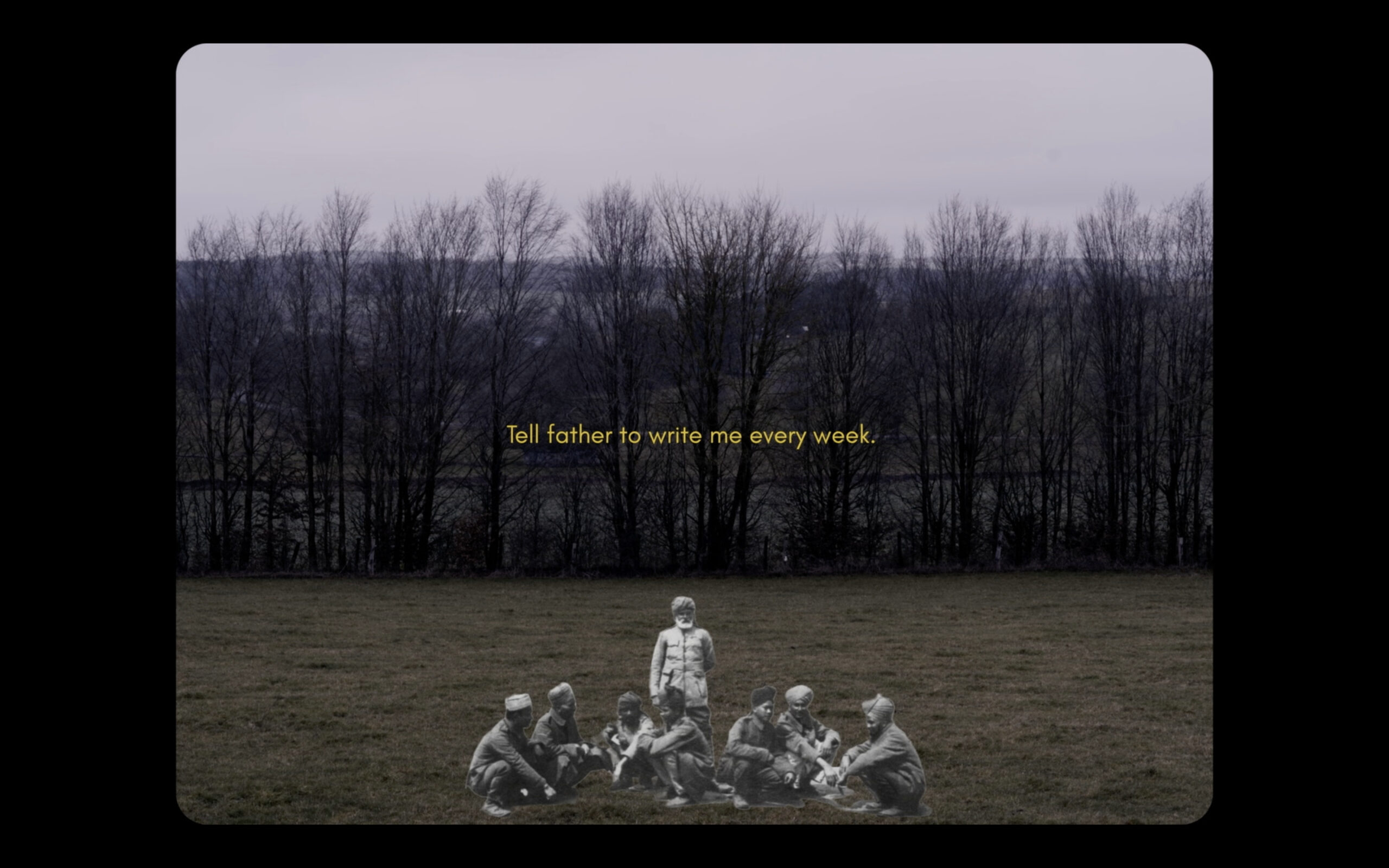
On a bright afternoon, Cemeti–Institute for Art and Society–grew ever more alive with visitors. On that day, Saturday (21/11/2025), the exhibition entitled In the Darkness, I Hold Memories, in collaboration with Festival Film Dokumenter and Cemeti–Institute for Art and Society, was officially opened. This exhibition is one of the programs in the Festival Film Dokumenter 2025. On the first day of opening the exhibition, Dito Yuwono, as Director of the Cemeti–Institute for Art and Society, invited visitors to explore the works displayed and installed in the gallery.
Among archives, forgotten records, and unspoken memories, Suvi Wahyudianto and Maharani Mancanagara tried to uncover Indonesia’s fractured history. This exhibition was initiated to provide a space for that effort. Not just an exhibition of works of art, but it was activated as an invitation to delve into the collective memory of the nation and to wonder who has the right to compose the story in it. Through a historical research approach, they not only offer aesthetic works but also other ways of reading history through archives, documentation, and personal experiences.
Suvi Wahyudianto, an artist from Madura, has long focused on the relationship between identity, violence, and history in the place where he was born. In 2023, he spent 20 days traveling through the collective memory of the 1999 conflict between the Madurese and Sambas communities—an event rarely discussed openly and often overshadowed by the larger narrative of reform.

Along the way, he was accompanied by Aloysius, a photographer and videographer from Sambas. Together, they tried to revisit an event that, in their childhood, existed only as whispers: blurred, dark, and distant. Their encounters with witnesses, the landscape, and archival records opened up a new way of seeing history: more intimate, more human, and allowing space for reconciliation.
In this exhibition, Suvi presented several fragments in a complete framework. His main work was an activation from his journey with Aloysius. They are the post-conflict generation of the 1999 interethnic violence between the Madurese and Dayak communities in Kalimantan. This event formed the backdrop that positions the younger Madurese generation as bearers of the postmemory of this tragedy. They believe that through art, as the heirs of trauma, they answer the ghosts of fear and the unresolved questions that have long drifted around them.
There were several fragments of Suvi’s work on display at Cemeti: 20 paintings, costume installations, and photography fragments captured the performing art in the Madurese landscape. If we looked at the details in the costume installation, there were several symbols that were attached to the shoulder area. Especially the symbol of cow legs, hornbills (Rangkong), and an open and transparent house. These costumes were worn by Suvi while performing the performing art.
In his photographic work, Suvi placed a tarpaulin as the base for his photographs, which are printed on paper. According to him, tarpaulins serve as a medium that represents the first space of mitigation when disaster strikes, whether natural or humanitarian. For him, and in his work, tarpaulins are the first safe space.
Visitors are invited to experience Suvi’s journey in Madura by boarding a 32-hour boat to Pontianak and finally arriving in Sambas. In every landscape, Suvi and Aloysius performed a performance art to communicate their reconciliation fundamentally, through friendship and mutual trust. Through his work, Suvi was freezing events, a fragment that eventually multiplies and becomes an international issue. This pictured how Sufi worked to process his trauma into reconciliation efforts through various fragments of cross-dimensional art installations.

Meanwhile, Maharani Mancanagara worked on the history of a more personal side: a family. For nearly a decade, she traced the life of her grandfather, R. Soegriwo Joedodiwirdjo, a teacher accused of being involved in the PKI in 1965. The accusation reshaped his life through a chain of systematic violence: detention, stigma, and ultimately, his erasure from the state’s official narrative.
A diary was found during her research, which opened a new door for Maharani. Through that note, she not only came to understand her family’s story but also discovered how historical wounds are shaped by the erasure of individual stories. Her work then offered a space for the public to re-read the country’s history, not just from textbooks, but from the real human experience.
Amid a wave of global geopolitical tensions and domestic socio-political dynamics, the exhibition also echoed a wider anxiety about how history is built, claimed, and wielded in the service of power. The singular narrative-which has so far eliminated minor voices, witnesses, and victims-became a challenge that is still relevant. Through Suvi and Maharani’s works, art appears not just as an expression, but as a resistance to the erasure of memory and the silencing of alternative interpretations.
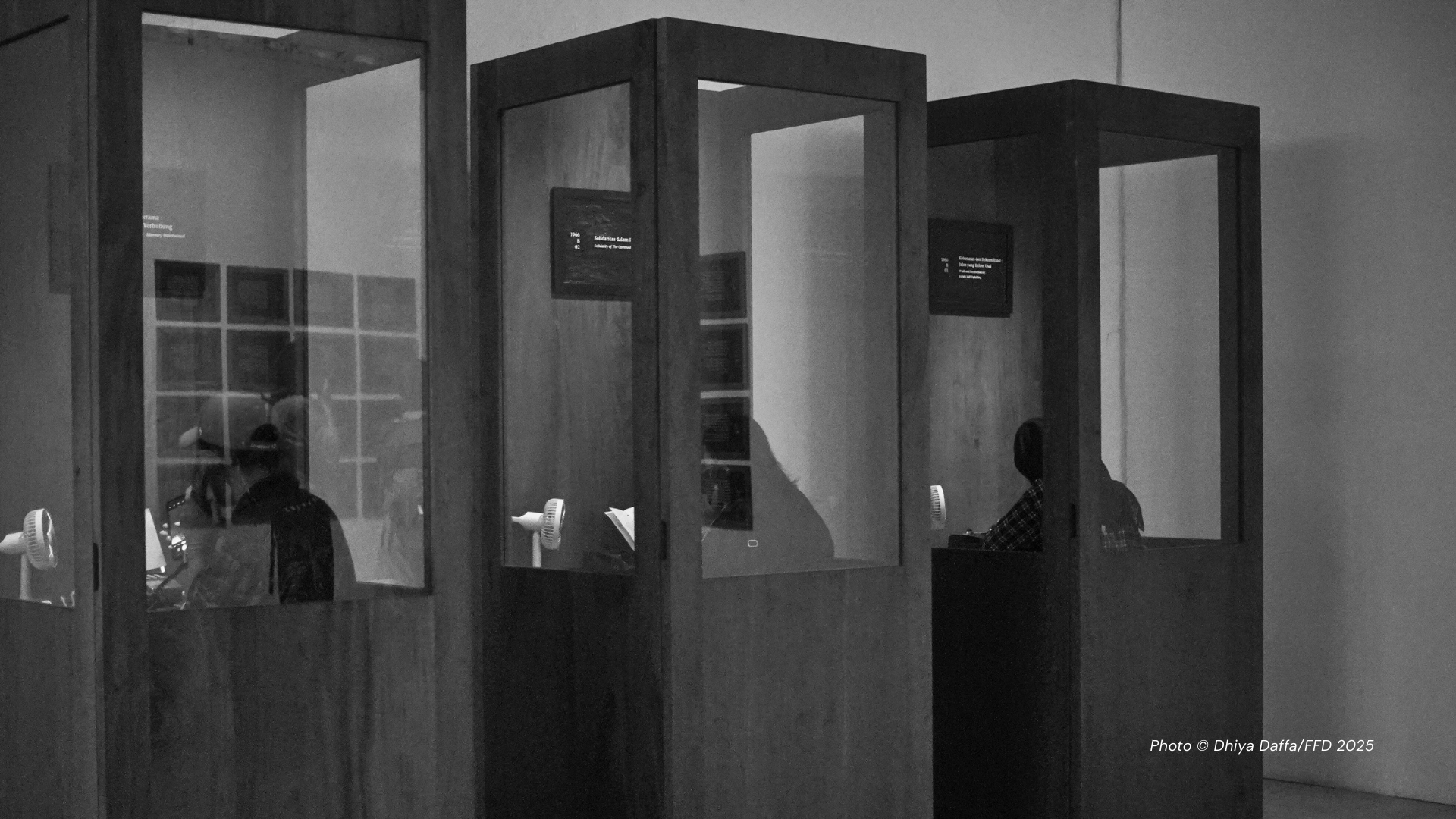
This was not the first time Maharani had exhibited her works in Yogyakarta. Previously, the same work was also exhibited during ARTJOG 2025 at the Jogja National Museum. However, there were differences in space and installation practices, allowing the visitors to find a difference in experiencing and responding to the work. Ima, one of the visitors to the exhibition, explained that the space, kept from becoming completely dark by not being fully painted black, created an urge to revisit the recording in the box. She also expressed her response to Maharani’s work, “Maharani’s work is a documentary work presented through voice in the telephone box. It becomes interesting when a documentary is presented through voice and reading the text, not watching it on screen,” she explained.
This exhibition program is part of the long journey of Festival Film Dokumenter and Cemeti to build a cross-disciplinary learning space. Not only to relearn history, but also to inculcate a broader meaning of solidarity, especially in the context of crises, conflicts, and injustices in different regions of the world.
In the quiet of the exhibition space, archives, recorded voices, fragments of memory, and visual works come together as one. There, history does not appear as a rigid record, but as something alive—fragile, complex, and constantly questionable. In the darkness, memories that once wished to be obliterated find light. And through art, their voices find their way back. (Ahmad Radhitya Alam, 21/11/2025 [Ed. Vanis/Trans. Shafira Rahmasari])