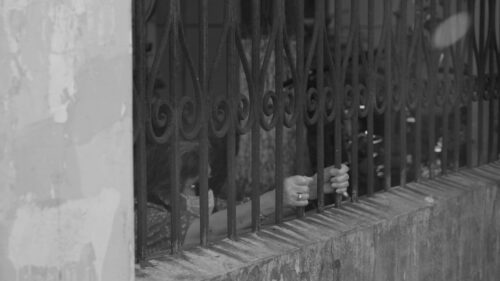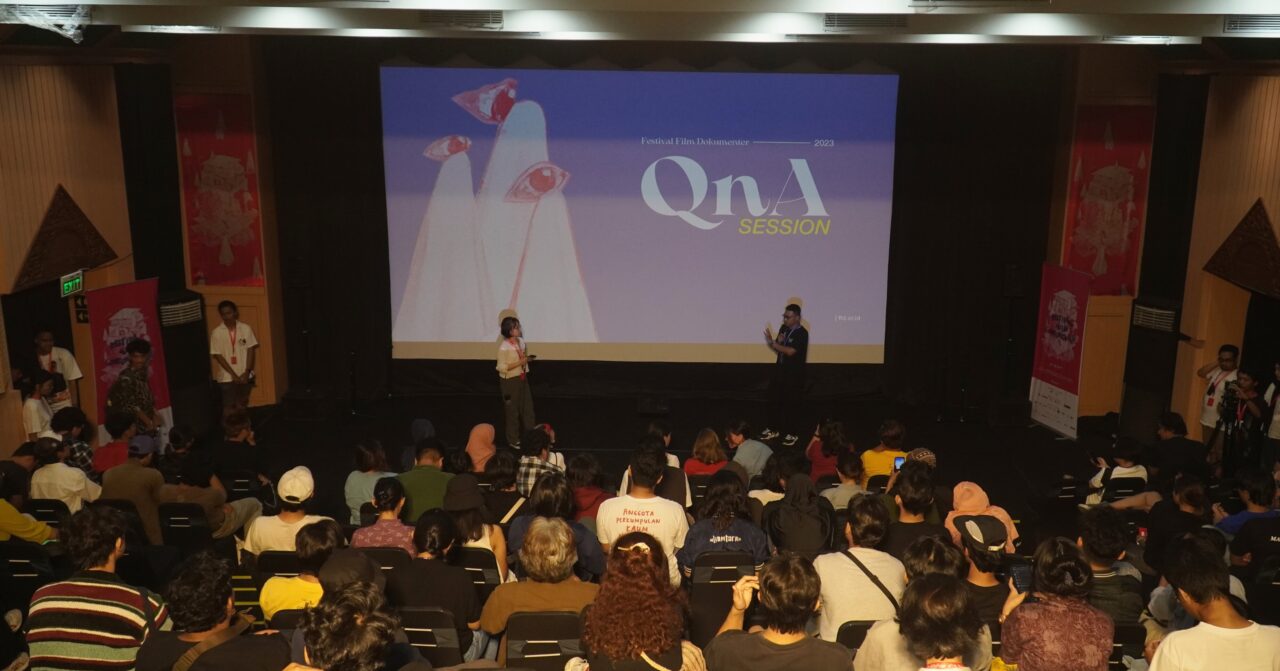
Producer BM Anggana opened the Q&A session with an answer, “We traveled, met with many people. From what was discussed, we (tried) to present the three perspectives in this film as a whole: scientific, capital, and spiritual.” The screening of Monisme (2023) in the International Feature-Length Competition program was held at Gedung ex Bioskop Permata on 6 December 2023, at 19.00 WIB. The film tells the story of a non-anthropocentric view of Mount Merapi and the layers of elements that compose it through various human perspectives. That Merapi, in fact, is a space and time that continues to burn, hand in hand with us. After the screening, the audience had the opportunity to join a Q&A session with producer BM Anggana.
Traveling around various mines around Merapi, Sabo Dam, Kaliurang, and meeting Yulianto, the supervisor of Babadan Merapi Post in Magelang, Central Java, and the Jathilan Kudho Taruno Wonolelo group was one of the paths that brought Rizaldi and Anggana to the idea of Monisme (2023). “The idea of a work about Merapi, not yet specific to Monisme, has been in the works since 2018. In 2020, we met to further discuss the formation of a feature-length film, regardless of its form.” Anggana said. Some audience members raised their hands, ready to get their questions answered.

This story is a philosophical contemplation that brings us to a further meaning of what Merapi is. My question is, what is the position of the people around Merapi with the jathilan montage taken?
Regarding the ritual, it is actually jathilan as usual in general. The interesting thing is the involvement of the community. For example, the bamboo horse used in jathilan cannot be used arbitrarily. Some rituals are performed on the horse. Processes, beliefs are still carried out in the making of the performance.
Since it would be very easy for filmmakers to get caught up in cultural exoticism, how was the process of working with the community?
When talking about the spiritual side of Merapi, which perspectives do we actually want to look for outside of the mainstream view? We look for alternatives by discussing together so that the perspective that we present in the film emerges. The script that we made, collaboratively, was also returned to the community.
How important is the depiction of violence in this film?
From the conversation between the two of us (Anggana and Rizaldi), the depiction of violence is an important element. Films are not sacred. Violence in Monisme is portrayed as pure evil, something very malicious, with the hope that these things will never happen. We try to portray the evil that exists loudly, vividly, because if the evil was portrayed in a subtle way, the narrative that we want to convey would not be delivered.
How urgent was it to have a rape scene in the film, when in reality, there were rarely any women’s roles?
We wanted to illustrate that there is brutal repression in the field against women. Each character plays a key role, like the scenario in the film, where there is a female researcher who is repressed, and a female artist who tries to record the reality in the mine. We want to show that women’s positions in such matters are strong positions even though their presence, perhaps, in Monisme, is not as thick as you might expect.
Where do reality and imagination diverge in this film?
The boundaries are up to you to define for yourself. Monisme does not aim to make the boundaries clear. We play with the territory of biases-where is reality and where is not-like juxtaposing what is scientific and what is spiritual.
What was the experience-technically and experientially-when making this film?
The first thing we experienced was Covid (audience laughs). Our challenge was dealing with a situation that we could not predict. At that time, the rainfall was high, and the Covid situation was also quite intense, making us very adaptive in reading the situation every day. In addition, we also continuously perform rituals to kula nuwun (ask for permission).

As Merapi did not reveal itself to everyone, Anggana said, one of the difficulties during the filming process was that the crew could not take any shots. “However, believe it or not, when we were in Babadan, clean, Merapi opened itself.” Anggana concluded. Monisme (2023), a record of the life of Mount Merapi and the life of the beings around it, has been completed. The unification between all factors and nature, the manifestation of Merapi as a living unity that is diverse and intact, are messages that are clearly articulated in Monisme (2023).
Covered by Tuffahati Athallah on December 6, 2023.