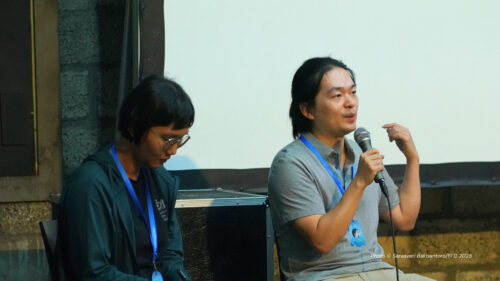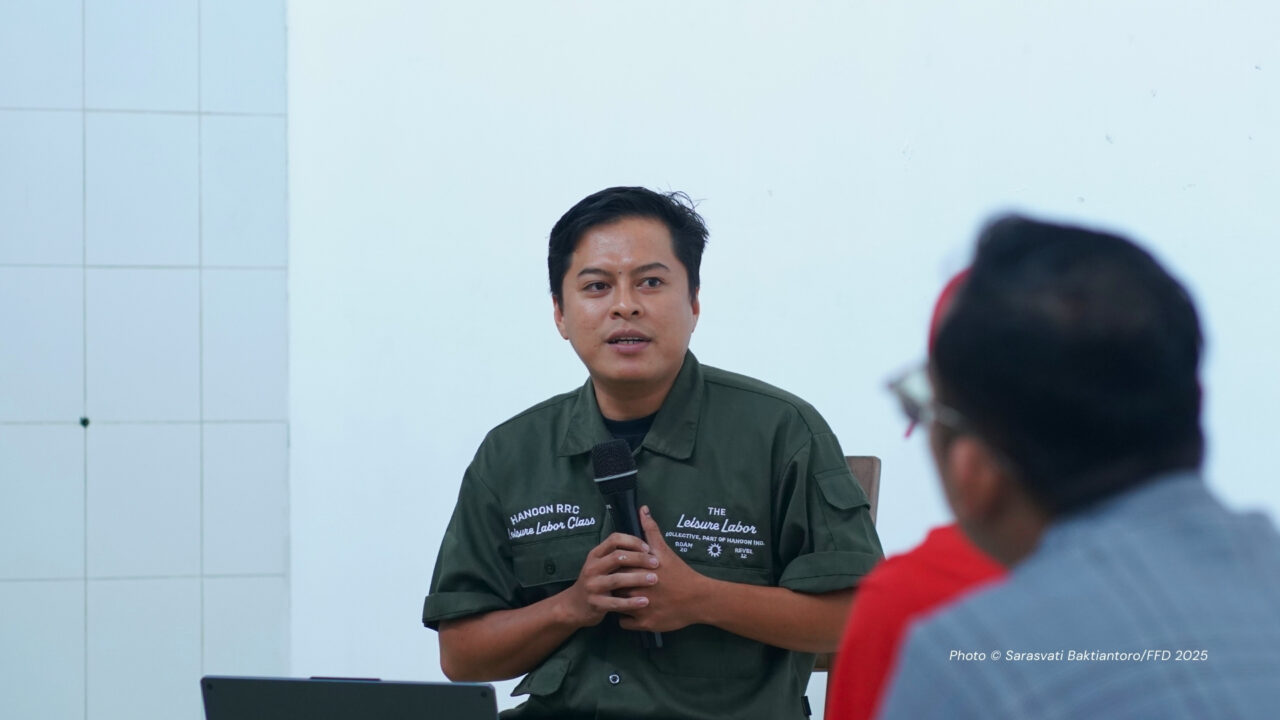
On Wednesday afternoon (26/11) the weather was slightly cloudy and overcast. It was as if the sky itself was lending an ear to Suvi Wahyudianto’s story during an Artist Talk held at Cemeti-Institute for Art and Society. At this talk, Suvi invited us to join him on the “pilgrimage” he’s been on for the past few years, tracing the 1999 Sambas conflict through his performative journey with his partner. He shared his findings and reflections from this journey through his exhibition “Pilgrim, Past Promise,” which clearly challenges the single narrative of history. This exhibition serves as a counter-narrative to the dynamic practices of art and documentary that intersect each other. Archives are not mere objects to be preserved, but rather a way of life that is nurtured and continually reinterpreted.
For Suvi, Sambas is not just the name of an event or tragedy. Since the conflict in 1999, Suvi, who is a native of Madura, has felt reluctant or awkward to introduce himself as a Madurese. It is not because he is ashamed of his identity, rather because he knows that it will provoke many prejudices and fears that he has not had the chance to address. The trauma he recounts through this exhibition is a personal experience that has been passed down through generations within his family and community.
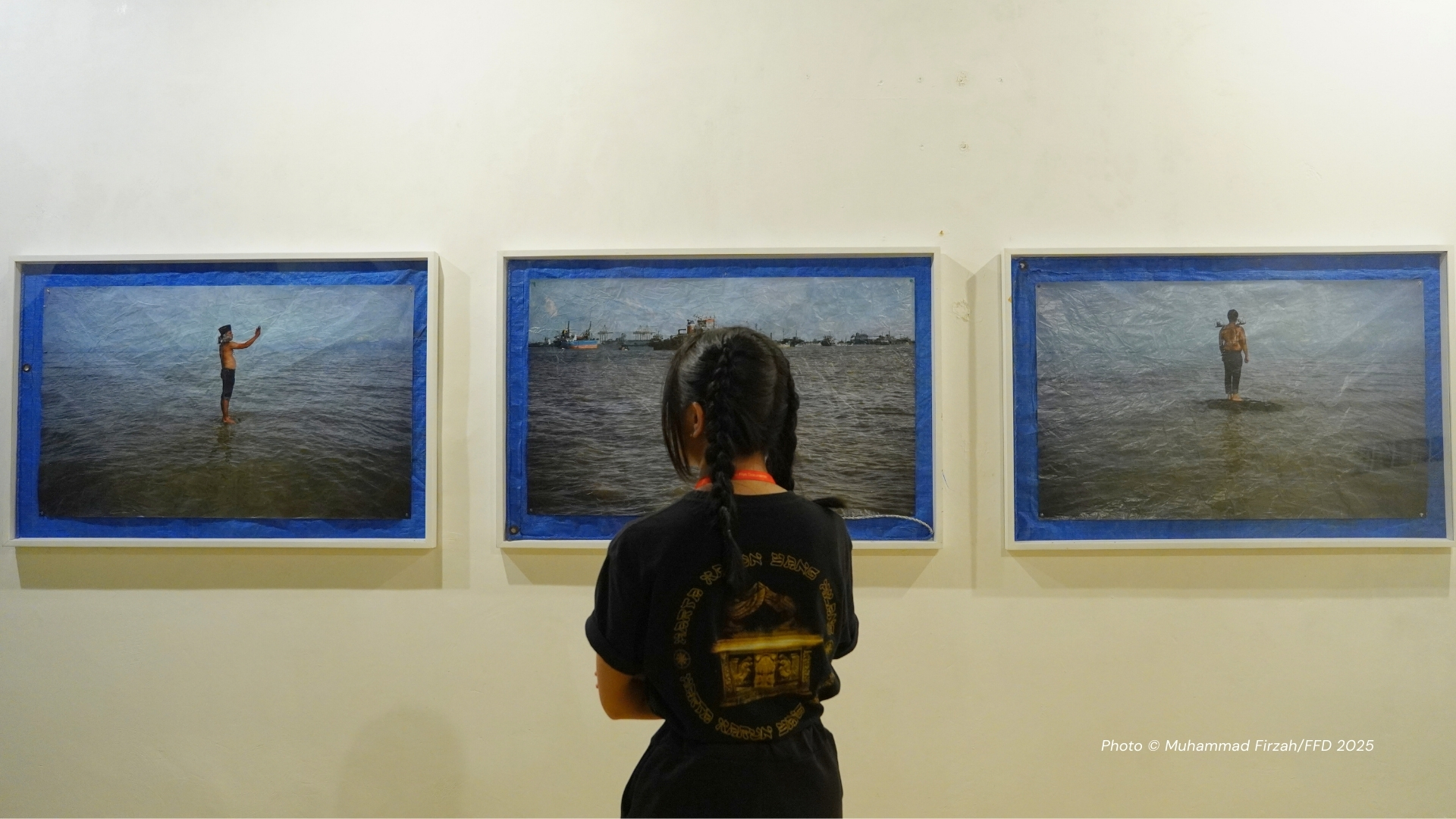
Suvi processes his memories through autoethnography, making himself a walking archive, a body that records and is recorded. In this methodology, fragments, poems, and notes become strategies for uncovering something that is difficult to put into words. Suvi, together with Aloysius, a photographer/videographer from Sambas, traveled the route from Madura to Sambas. At the beginning of their meeting, there was an inexplicable anxiety. They were two people from two communities that had once been at odds with each other. Then, slowly, they learned that their blood was just as red, and that the wounds of the past belonged to them both, yet they had to fight for their right to a future without passing on resentment.
In his presentation, Suvi refused to place art as a source of emotional comfort. He was closer to the idea of conflict as structural tension. From there, art became a battlefield to materialize collective wounds so that they could be communicated more assertively and affectively.
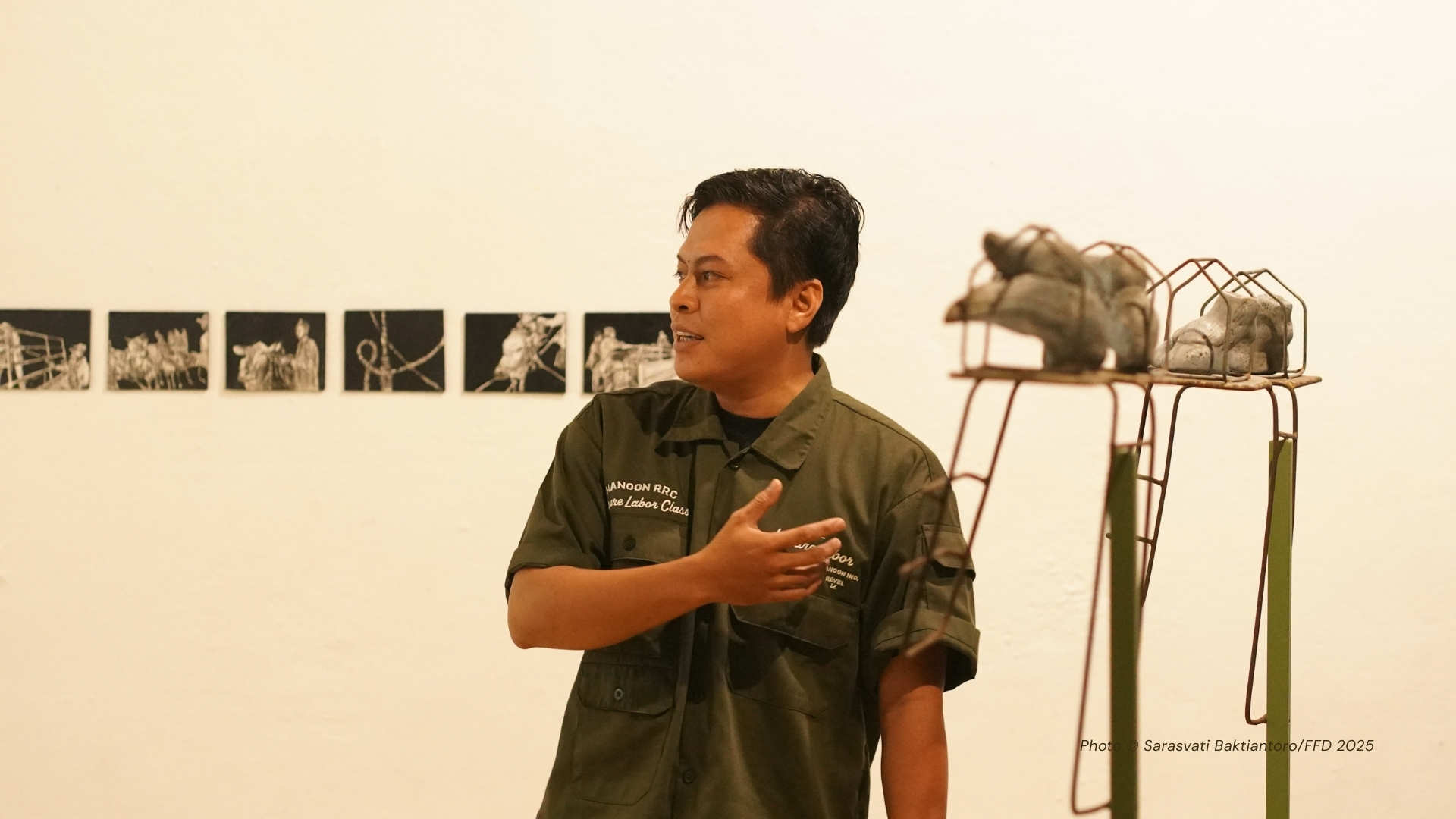
The discussion session opened up three important questions. First, why do we continually face conflict, and how do we begin reconciliation? Suvi responded that he chose the path of art because he wanted to first understand himself and the constellation of identities he carries, along with his trauma. It is possible that art cannot linearly resolve conflict because its effects cannot be designed. However, in the most intangible realm, feelings, art is able to open doors of awareness and initial resistance. Second, did the subjects (the people Suvi encountered during his journey from Madura to Sambas with Aloysius) know that they were part of the artwork itself? Suvi described this journey as personal, with many spontaneous and unplanned moments in the realm of everyday performativity. He negotiated the ethics as a process: acknowledging boundaries and allowing the camera to function as a record. Third, who benefits from this “trauma”? Here, Suvi touches on a harsher landscape: the politics of power that nurtures wounds as electoral capital. In identity contests, from general elections to regional elections, old sentiments are often revived to bolster the ranks of supporters. This map needs to be understood so that reconciliation does not remain nothing more than a slogan.
At this point, “pilgrimage” can be interpreted as a way of moving forward: recognizing fear, negotiating with other people’s memories, refraining from commodifying experiences, and daring to hope for reconciliation; a promise of the past that the future wants to fulfill. In an era where labels are quickly affixed—“What ethnicity are you?” or “Which side are you on?”—this kind of work invites us to investigate the language, gestures, and silences that often bear the heaviest burdens. (Hesty N. Tyas, 26/11/2025)